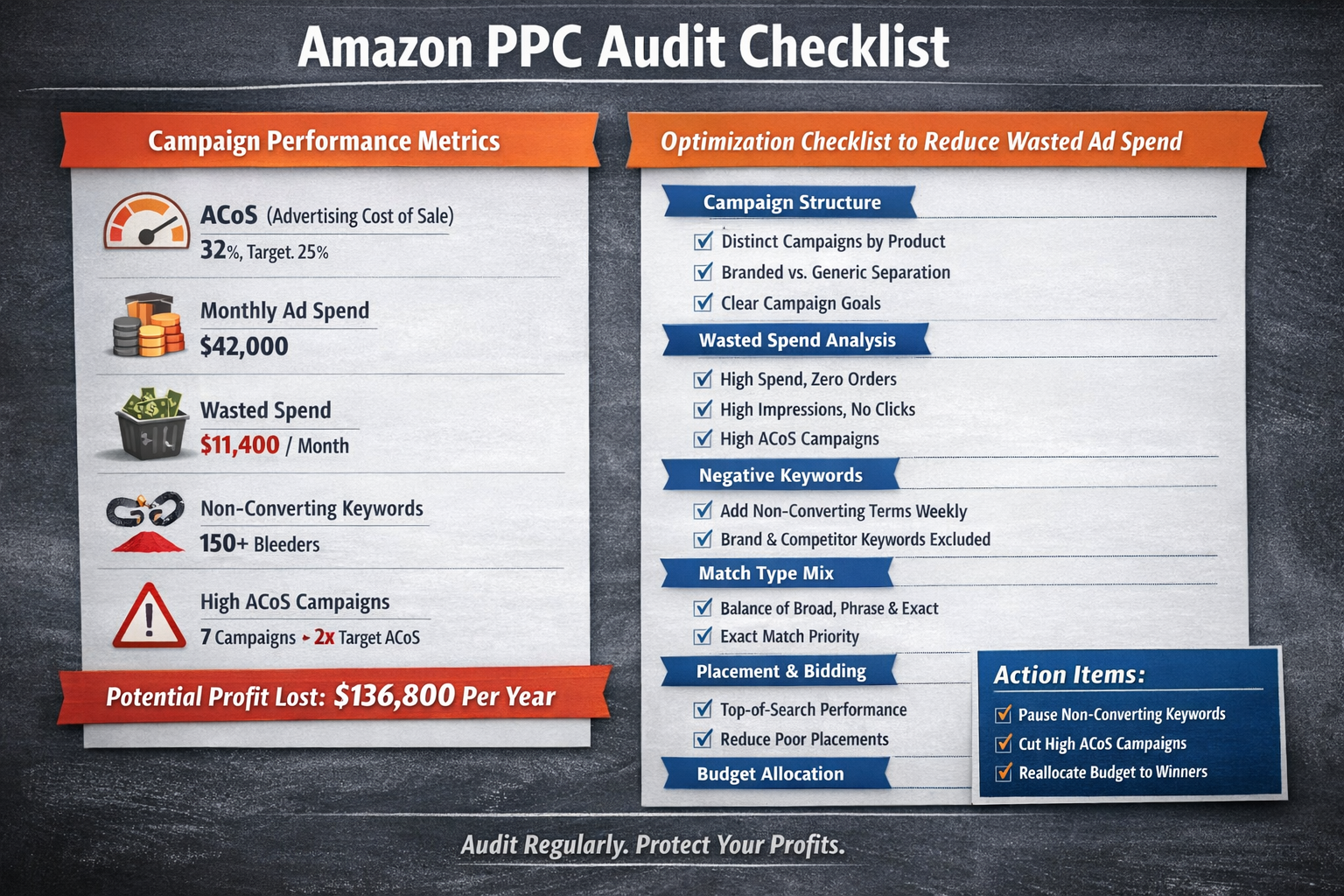
Last quarter, I ran the numbers on a client's US account. TACoS sitting at 14%. Margins squeezed. Every keyword felt like a bidding war against aggregators with bottomless budgets.
Then we launched the same product line in Germany.
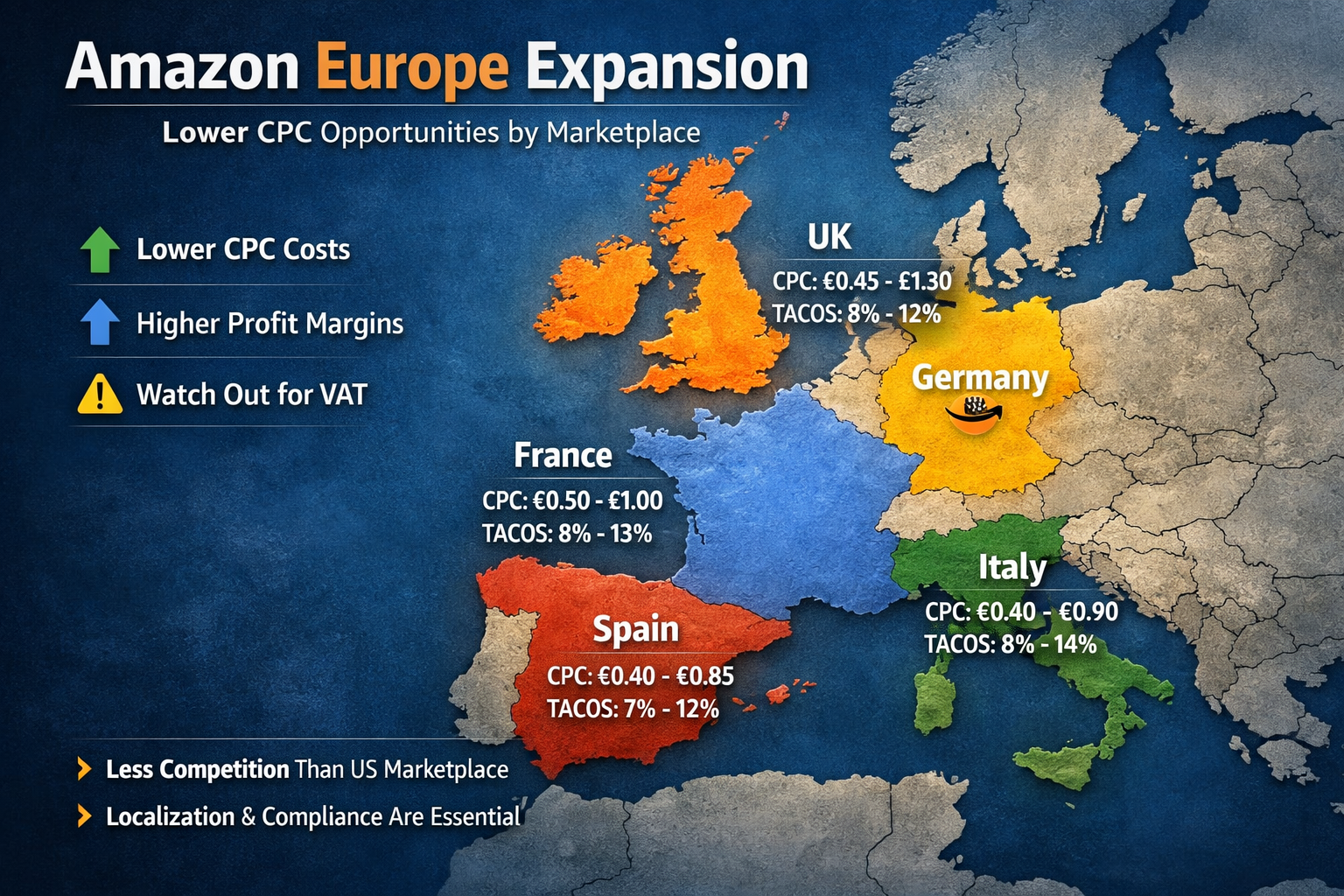
CPC dropped 41%. TACoS came in at 8.2%. Profit per unit nearly doubled.
That's not a fluke. That's the European opportunity most 7-figure sellers are sleeping on.
But here's the catch: lower CPC doesn't automatically mean higher profit. I've seen sellers expand to Amazon Europe and lose money because they ignored VAT implications, skipped compliance requirements, botched their localization, and ran their US playbook in markets that operate completely differently.
This guide breaks down exactly how to approach Amazon Europe expansion with a profit-first mindset—not just "more sales in more places."
Why Amazon Europe CPC Is Fundamentally Different
The math is simple. Fewer advertisers competing for the same impressions equals lower cost-per-click.
Amazon US has approximately 2 million active sellers [1]. Amazon's five major European marketplaces combined? Significantly fewer competitors per category, with Germany and the UK leading in seller density but still lagging far behind US saturation levels [2].
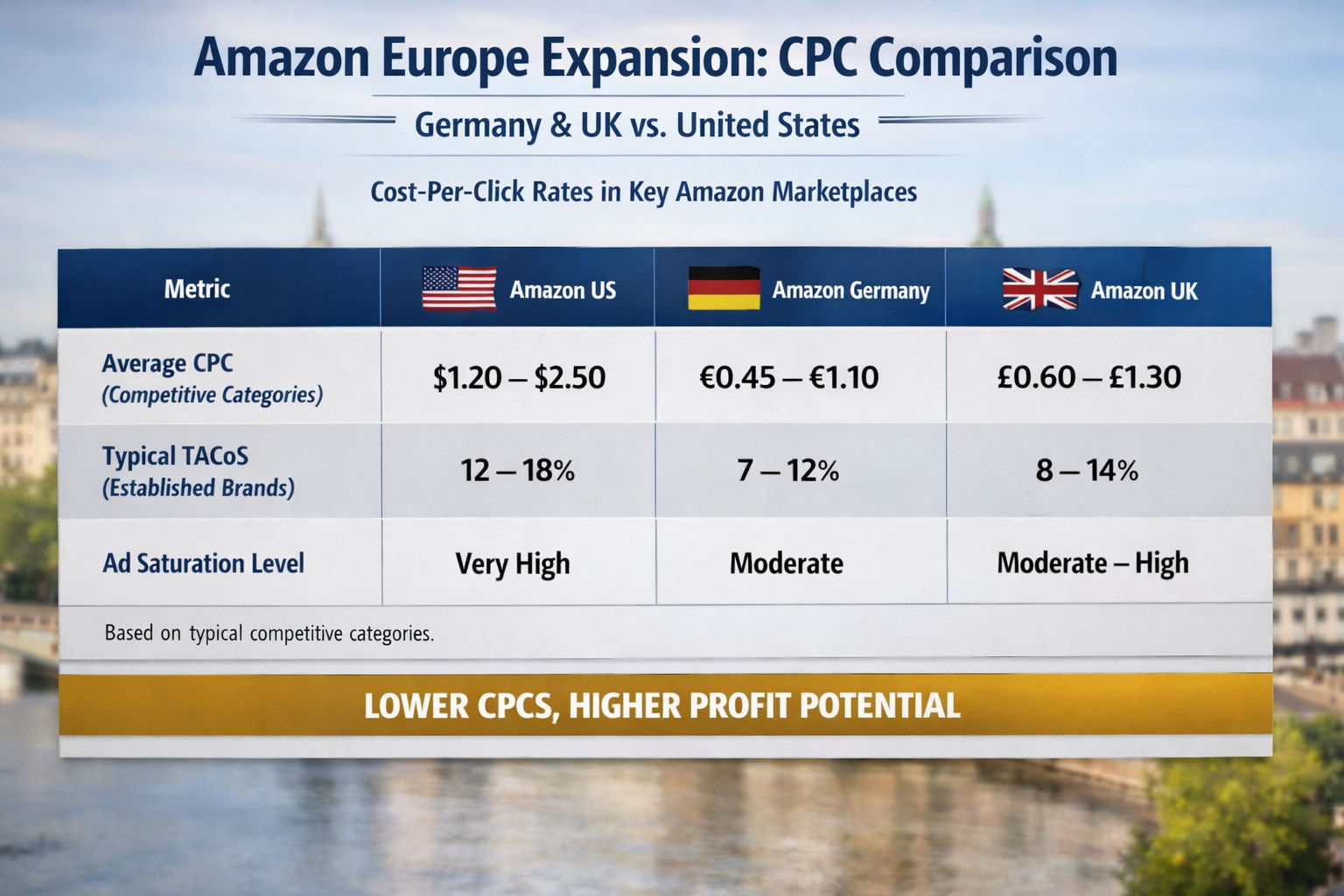
Here's what that looks like in practice:
| Metric | Amazon US | Amazon Germany | Amazon UK |
| Average CPC (competitive categories) | $1.20–$2.50 | $0.45–$1.10 | $0.60–$1.30 |
| Typical TACoS (established brands) | 12–18% | 7–12% | 8–14% |
| Ad saturation level | Very High | Moderate | Moderate-High |
Ranges based on category and competition; your mileage will vary.
Lower CPC means your ad budget stretches further. But the real opportunity isn't cheaper clicks—it's what those clicks do to your overall TACoS and contribution margin.
Want to see what your specific margins could look like in EU markets? Book a profit optimization audit and we'll model it out.
The VAT Problem Nobody Talks About
Here's where most US sellers get blindsided.
You launch in Germany. CPC is half what you pay in the US. You're celebrating.
Then VAT hits.
In Germany, VAT is 19%. UK is 20%. France is 20%. This isn't sales tax that gets added at checkout and passed to the customer. This is baked into your cost structure and affects how you calculate margin, TACoS targets, and profitability thresholds [3].
Let me break it down:
US Scenario:
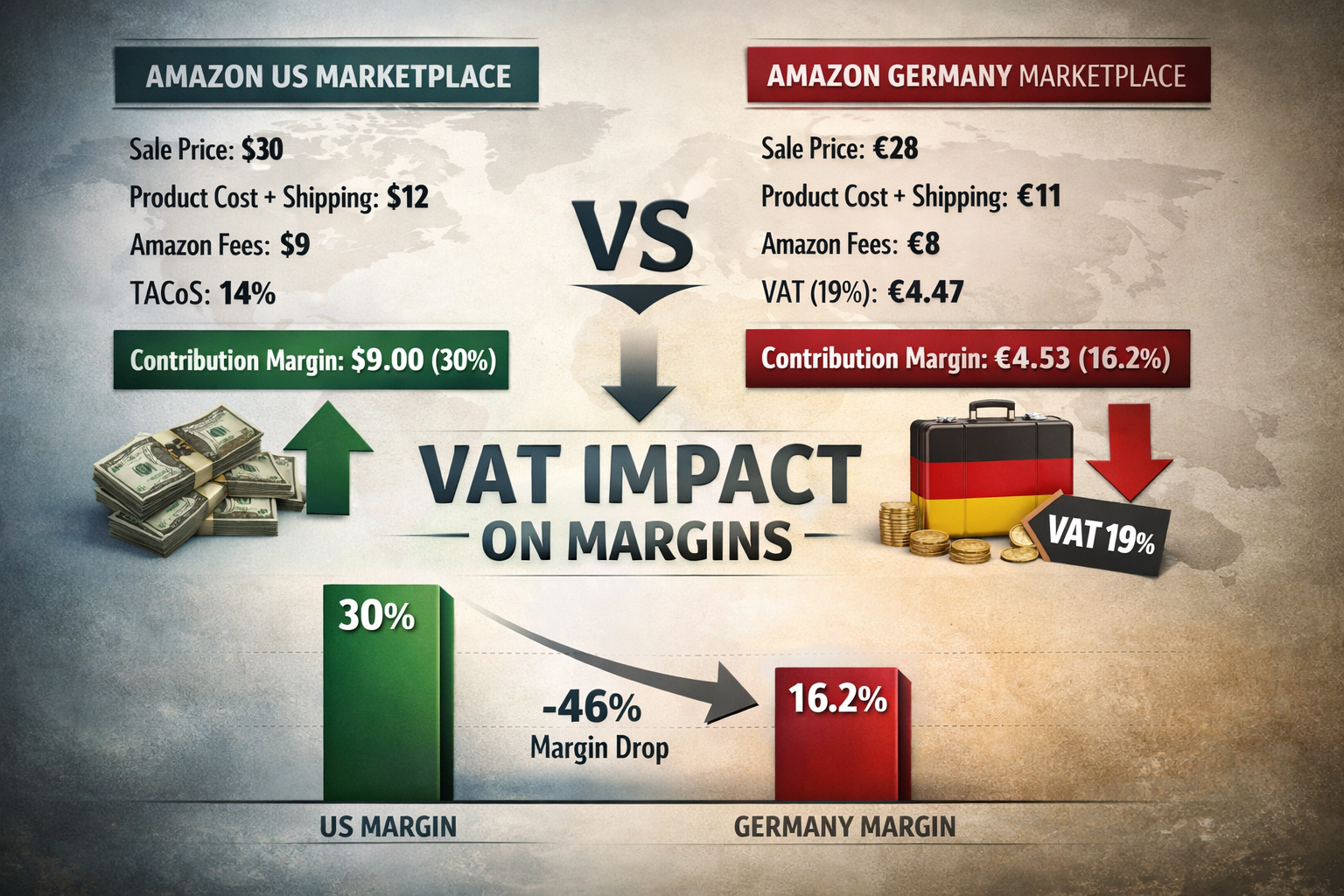
Sale price: $30
Product cost + shipping: $12
Amazon fees: $9
Contribution margin: $9 (30%)
Germany Scenario (same product, €28 sale price):
Sale price: €28
Product cost + shipping: €11
Amazon fees: €8
VAT liability (19%): €4.47
Contribution margin: €4.53 (16.2%)
Your margin just got cut nearly in half.
This changes everything about how you set TACoS targets. A 12% TACoS that works in the US could be a profit killer in Germany if you haven't adjusted for VAT.
VAT Registration: The Timeline Nobody Mentions
Here's another blindspot: VAT registration typically takes 2–4 months depending on the country. Germany can be faster if you use Amazon's VAT Services. UK post-Brexit requires separate registration entirely.
This impacts your cash flow planning. You can't just "launch next month" in Europe. Build the registration timeline into your expansion roadmap, or you'll be sitting on inventory you can't legally sell.
How to Set EU TACoS Targets That Actually Protect Profit
The Profit Feedback Loop framework I use with clients starts with contribution margin, not ACoS. In EU markets, that means:
Calculate your true post-VAT margin for each marketplace
Set TACoS ceilings at no more than 60% of that margin during scale phase
Monitor profit per click, not just CPC or ACoS
A 10% TACoS in Germany with 16% margin leaves you 6 points of profit. A 10% TACoS in the US with 30% margin leaves you 20 points.
Same TACoS. Completely different outcomes.
The Compliance Reality Check (Before You Spend a Dollar on Ads)
This is where I've watched sellers blow €50k before making a single profitable sale.
You cannot run PPC in Germany if your products aren't legally compliant. And "compliant" in the EU means way more than it does in the US.
LUCID and Germany's Packaging Act
If you're selling in Germany, you need a LUCID registration number. This is non-negotiable. Germany's VerpackG (Packaging Act) requires every seller to register packaging with the LUCID database and contract with a dual system for recycling [4].
No LUCID number? Amazon can suspend your listings. Your ads don't run. Your inventory sits.
Extended Producer Responsibility (EPR)
EPR regulations are expanding across Europe. France, Germany, and others now require producers to take responsibility for the end-of-life disposal of their products and packaging.
This means additional registration, potential fees, and compliance tracking.
The "Responsible Person" Requirement
For certain product categories, EU regulations require a designated "Responsible Person" located within the EU. This person is legally accountable for product compliance, labeling, and documentation.
Without this in place, your listings can be removed—and your ad spend becomes worthless.
The point: All that beautiful low-CPC opportunity disappears if you're not legally allowed to sell. Get compliance sorted before you build campaigns.
Logistics Costs That Change Your Profit Math
Here's another number most sellers ignore until it's too late: fulfillment fees vary dramatically based on which logistics program you choose.
EFN vs. Pan-European FBA
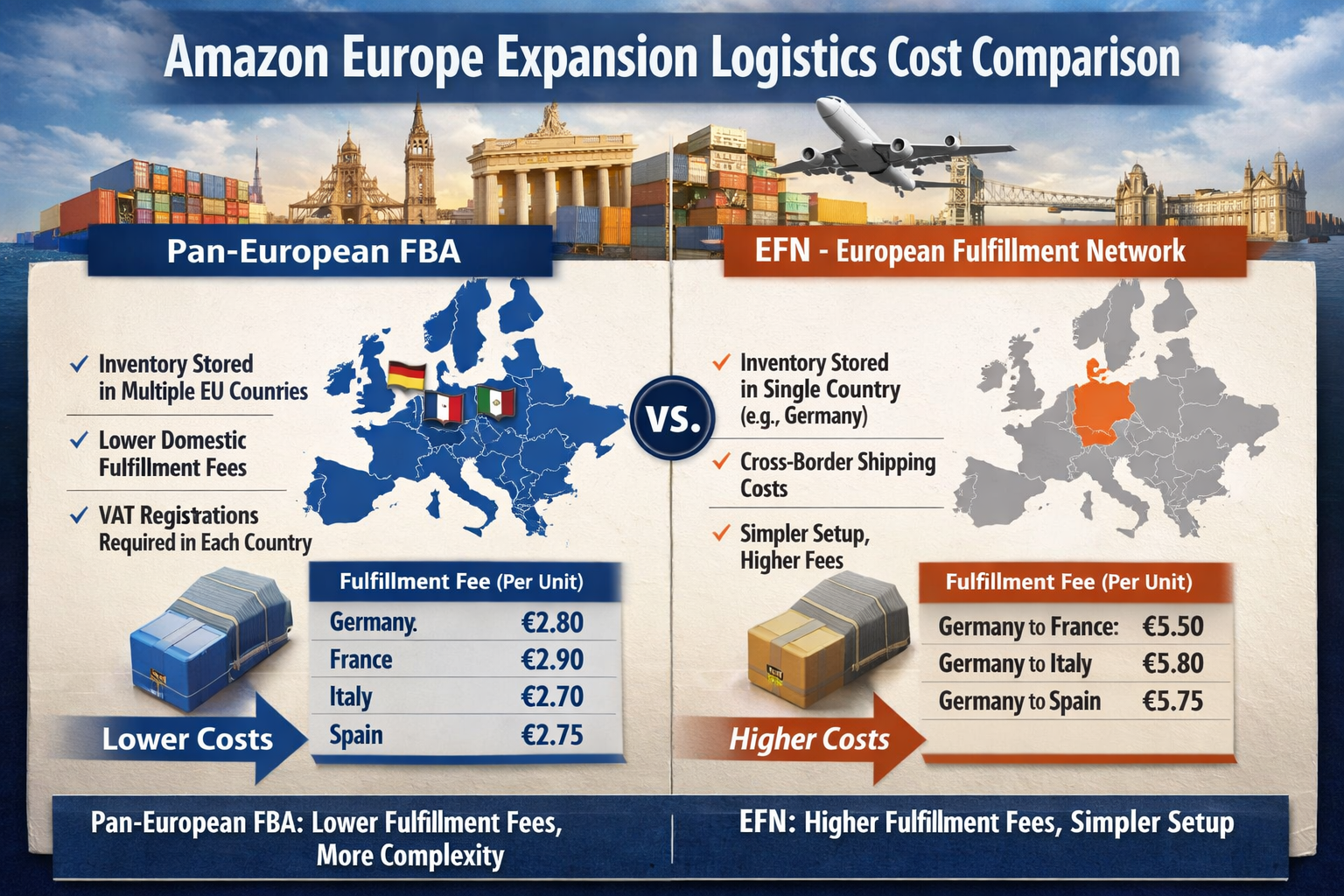
European Fulfillment Network (EFN): You store inventory in one country (usually Germany or UK), and Amazon ships cross-border to customers in other EU countries.
Pro: Simpler. One inventory pool.
Con: Higher per-unit fulfillment fees for cross-border orders. These fees can be 2–3x domestic rates.
Pan-European FBA: Amazon distributes your inventory across multiple EU fulfillment centers based on demand.
Pro: Lower fulfillment fees (domestic rates in each country).
Con: You need VAT registration in every country where inventory is stored. More compliance. More complexity.
This isn't a minor detail. The fee difference between EFN cross-border fulfillment and Pan-EU domestic fulfillment can swing your margin by 5–8% per unit.
That margin swing changes your TACoS ceiling. It changes which products are even viable in Europe.
Run the numbers on both scenarios before you commit to a logistics strategy.
The Localization Multiplier (Where Free Money Hides)
I pulled a search term report for a US seller who had been running in Germany for six months.
They were bidding on English keywords.
In Germany.
47% of their ad spend went to search terms that German shoppers barely use. Clicks happened—Germans often understand English—but conversion rates were abysmal because the listings weren't localized either.
We rebuilt their keyword strategy with native German terms, localized the listings properly, and conversion rate jumped 34% in 60 days.
Here's the localization workflow that actually moves the needle:
Step 1: Native Keyword Research (Not Translation)
Machine translation of your US keywords is worthless. "Yoga mat" in German isn't just "Yogamatte"—it's also "Gymnastikmatte," "Fitnessmatte," and half a dozen other terms Germans actually search [5].
You need:
Native speaker keyword research
Amazon autocomplete mining in each marketplace
Competitor ASIN reverse lookups (local competitors, not US brands)
Step 2: Listing Localization Beyond Words
This means:
A+ content that references local use cases
Images with metric measurements (not imperial)
Bullet points addressing local concerns (eco-certifications matter more in Germany than the US)
Remove any FDA logos or US-specific certifications from images—these are irrelevant (and potentially misleading) in EU markets
No imperial measurements in images—this creates friction and signals "foreign product"
Step 3: Backend Search Term Optimization
Each EU marketplace has its own search algorithm nuances. Your backend keywords need to be marketplace-specific, not copy-pasted across the EU.
Market Selection: Where to Launch First
Not all EU marketplaces deserve your attention equally.
Here's how I rank them for 7-figure US sellers:
Tier 1: Germany (DE)
Largest EU marketplace by revenue
Moderate CPC, strong purchasing power
VAT complexity offset by volume potential
Requires LUCID registration (non-negotiable)
EORI number required for customs clearance
Tier 2: UK
English-speaking (easier localization)
Post-Brexit complications: separate VAT registration, customs declarations, potential need for UK Responsible Person
Higher CPC than continental Europe
Completely separate inventory and compliance from EU
Tier 3: France, Italy, Spain
Lower volume, lower competition
Requires full localization investment
Best approached after DE/UK are profitable
EPR requirements vary by country
My recommendation: Start with Germany. Get profitable. Then expand.
Trying to launch in all five marketplaces simultaneously is how sellers blow through €50k in ad spend with nothing to show for it.
Campaign Architecture for EU Markets
Your US campaign structure probably won't translate directly to EU markets. Here's why:
Search volume is lower. Those hyper-segmented, single-keyword campaigns that work in the US? They'll starve in Germany. You need broader match types and consolidated campaigns to gather enough data.
Keyword isolation still matters—but differently. Instead of isolating at the keyword level, I often isolate at the search term category level in EU markets. Group related terms, let Amazon's algorithm find the winners, then isolate those into exact match.
Placement strategies shift. Top-of-search premiums that make sense in crowded US SERPs often don't pencil out in EU markets with less competition. Test before committing budget.
The Cutting Bleeders SOP applies universally—you're still looking for search terms burning cash without converting—but your thresholds need adjustment for lower volume markets.
The Profit-First EU Expansion Checklist
Before you launch a single campaign in Europe:
Compliance & Legal:
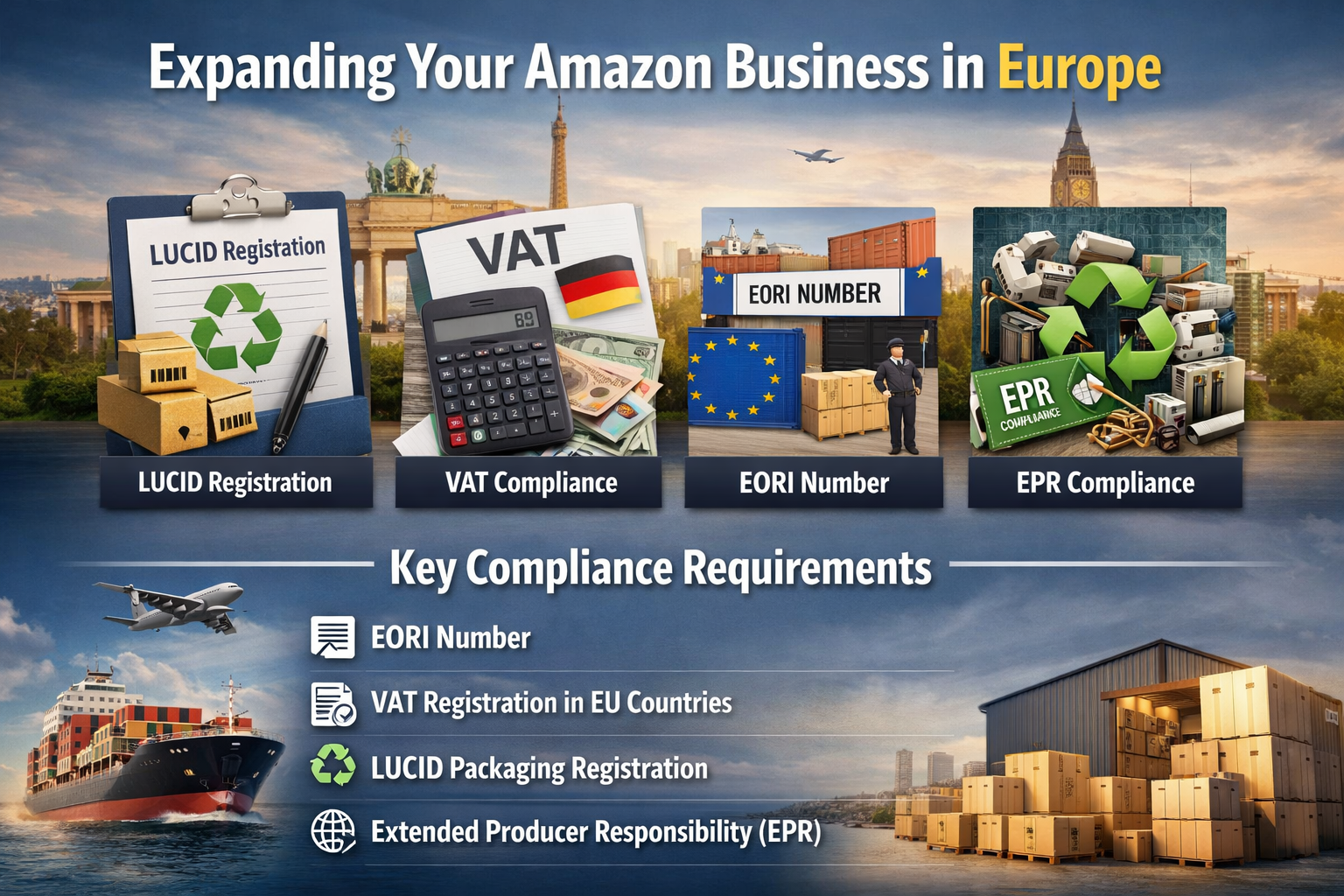
[ ] Obtain EORI number for customs clearance
[ ] Register for VAT in target countries (allow 2–4 months)
[ ] Complete LUCID registration for Germany
[ ] Verify EPR requirements for your product category
[ ] Designate EU Responsible Person if required for your category
[ ] Ensure product labeling meets EU requirements (CE marking if applicable)
Logistics & Financials:
[ ] Calculate post-VAT contribution margin for each target marketplace
[ ] Model EFN vs. Pan-EU fulfillment fees and margin impact
[ ] Set marketplace-specific TACoS ceilings based on actual margin
[ ] Choose FBA Europe logistics strategy based on volume projections
Localization & PPC:
- Native keyword research & localized listings
- PPC strategy tailored for lower volume EU markets
- Marketplace-specific TACoS targets
[ ] Complete native keyword research (not translation)
[ ] Localize listings with native speakers
[ ] Update images: metric measurements, remove US-specific certifications
[ ] Build consolidated campaign structures appropriate for lower volume
[ ] Establish profit tracking by marketplace (not blended EU numbers)
Skip any of these steps and you're gambling, not expanding.
When EU Expansion Doesn't Make Sense
I'm not here to tell you Europe is the answer to all your problems. Sometimes it isn't.
Don't expand to EU if:
Your US account isn't profitable yet (fix that first)
Your product requires significant regulatory approval in EU (some categories are compliance nightmares)
You can't commit to proper localization
Your margins are already razor-thin and can't absorb VAT impact
You're not willing to invest 3–6 months in compliance setup before seeing returns
The sellers who win in Europe are the ones who treat it as a profit center, not a vanity metric. "We sell in 6 countries" means nothing if 5 of them are bleeding cash.
What I've Seen Work
One client came to me doing $3.2M annually in the US with a 15% TACoS. Margins were getting crushed by increasing competition.
We launched in Germany with:
Full listing localization
VAT-adjusted TACoS targets (capped at 9%)
Consolidated campaign structure
Pan-EU logistics to minimize fulfillment fees
Weekly profit feedback loop reviews
Six months later:
Germany contributing $480k in additional revenue
TACoS at 7.8%
Profit margin 4 points higher than US despite VAT
The EU didn't just add revenue. It improved overall business profitability.
That's the difference between expanding for growth and expanding for profit.
Ready to model what EU expansion could look like for your brand?
Book a profit optimization audit and we'll analyze your current margins, identify which EU markets make sense, and build TACoS targets that protect your bottom line.
No fluff. Just numbers.
Frequently Asked Questions
Is Amazon Europe worth it for US sellers?
For 7-figure sellers with healthy US margins, absolutely. Lower CPC and less competition create real profit opportunities—but only if you account for VAT, comply with regulations like LUCID and EPR, localize properly, and set marketplace-specific TACoS targets. Expanding without that foundation is how sellers lose money in new markets.
How much does VAT affect Amazon PPC profitability in Europe?
VAT ranges from 19–25% depending on the country and directly reduces your contribution margin. A product with 30% margin in the US might only have 16–18% margin in Germany after VAT. Your TACoS targets must be recalculated accordingly, or you'll be "profitable" on paper while losing money in reality.
Which European Amazon marketplace should I launch first?
Germany (amazon.de) for most sellers. It's the largest EU marketplace by revenue, has moderate CPC compared to the UK, and the logistics infrastructure is excellent. You'll need LUCID registration and an EORI number before launching. Once Germany is profitable, expand to UK, then France/Italy/Spain.
Do I need to translate my Amazon listings for Europe?
Translation isn't enough—you need localization. That means native keyword research (not translated US keywords), locally relevant A+ content, metric measurements, and addressing market-specific concerns. Remove US-specific elements like FDA logos from images. Sellers running English keywords in Germany typically see conversion rates 30–40% lower than properly localized competitors.
What's the difference between EFN and Pan-European FBA?
EFN stores inventory in one country and ships cross-border, which is simpler but has higher fulfillment fees (2–3x domestic rates). Pan-EU distributes inventory across multiple countries for lower fees but requires VAT registration in each country where stock is held. The fee difference can swing your margin by 5–8% per unit—run the numbers before deciding.
About PPC Maestro
PPC Maestro is led by Bernard Nader, a profit-first Amazon PPC specialist who has managed millions in ad spend for 7-figure private label brands. Bernard developed the Profit Feedback Loop framework after seeing too many sellers chase low ACoS while their actual profits disappeared. His team focuses exclusively on cutting wasted spend, protecting contribution margins, and building PPC systems that scale profitably—whether you're optimizing in the US or expanding into European markets. Bernard regularly shares audit breakdowns and PPC strategies through his YouTube channel and speaks at Amazon seller events.
Works Cited
[1] Marketplace Pulse — "Number of Sellers on Amazon." https://www.marketplacepulse.com/amazon/number-of-sellers
[2] Amazon — "Sell in Europe with Amazon."
https://sell.amazon.com/global-selling/europe
[3] Amazon — "VAT on Amazon Services." https://sellercentral.amazon.com/help/hub/reference/G200838320
[4] German Environment Agency — "VerpackG and LUCID Registration." https://lucid.verpackungsregister.org/
[5] Jungle Scout — "Amazon Keyword Research Guide." https://www.junglescout.com/blog/amazon-keyword-research/