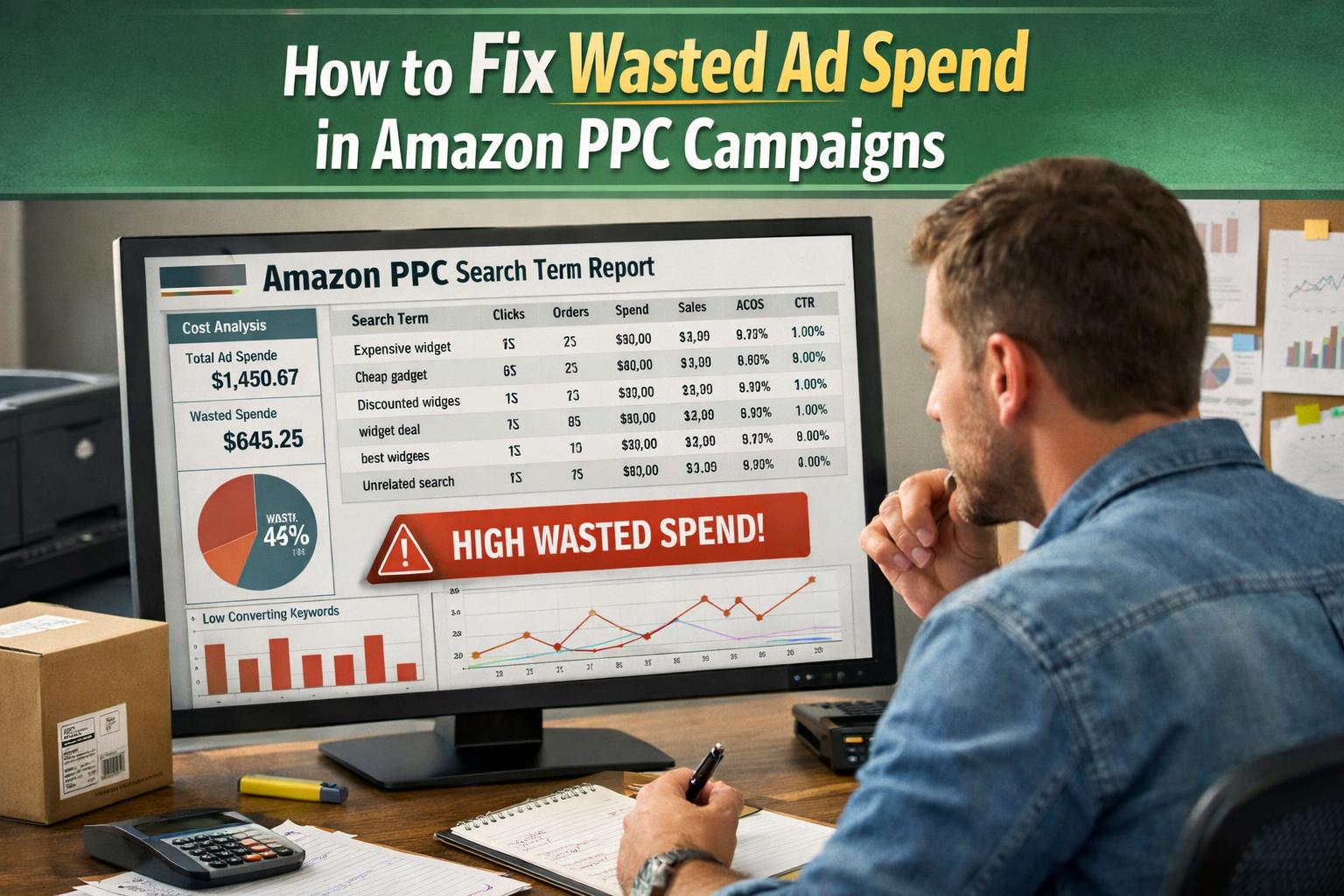
I audited a 7-figure account last month—$86k in monthly ad spend, $44k completely wasted.
The seller had hired a consultant on Upwork for $800/month thinking they'd found a bargain.
Six months later? They'd burned through $264k in wasted spend trying to save $9,600 on management fees.
That's not cost savings. That's financial self-sabotage.
Here's what no one tells you: the agency-vs-consultant decision isn't about which one is "better." It's about which execution model stops the bleeding fastest at your specific scale.
I'm Bernard Nader, founder of PPC Maestro. We're a profit-first Amazon PPC agency, so yes—I have a dog in this fight. But I've also worked with dozens of sellers who came to us after hiring consultants, agencies, and hybrid setups that didn't work. I've seen what breaks, what scales, and what's just expensive theater.
This article will show you exactly when each option makes sense, how to calculate the real cost (not just the invoice), and how to avoid the expensive mismatch that's bleeding your margin right now.
Disclosure: This article is written from the perspective of an agency owner, but I'll show you when consultants are the smarter move—and when you shouldn't hire either of us.
Let's cut through the noise.
What Is an Amazon PPC Agency?
An Amazon PPC agency is a team-based service that owns your campaign execution end-to-end.
They don't just advise. They do.
That means:
Building campaign architecture (exact match harvesting, auto-to-manual funnels, placement splits)
Daily bid and budget management
Weekly negative keyword mining
Search term isolation and match type progression
Placement optimization (top-of-search vs rest-of-search vs product pages)
Performance reporting tied to profit, not vanity ACoS
Pricing models:
Retainer: $2,000–$10,000/month (flat fee, regardless of spend)
Percentage of spend: 10–15% of monthly ad budget
Hybrid: base retainer + performance bonus tied to profit lift [1]
Best for: Sellers spending $50k+/month on ads who need systems, not heroics. Brands planning exits in 12–24 months who need transferable infrastructure. Founders who don't have time to babysit freelancers.
Here's what most people miss: agencies aren't just "expensive consultants." They're process infrastructure. You're paying for redundancy, documentation, and the ability to scale without founder bottleneck.
What Is an Amazon PPC Consultant?
A PPC consultant is an individual expert who advises, audits, or executes on a contract basis.
They're hired for:
One-time audits (find the bleed, write the fix)
Strategic roadmaps (build the plan, you execute it)
Training internal teams (teach your VA how to stop making expensive mistakes)
Interim optimization while you hire full-time
Pricing models:
Project-based: $1,500–$8,000 for audits or buildouts
Monthly retainer: $500–$5,000/month for ongoing advisory
Hourly: $100–$300/hour for ad-hoc support [2]
Best for: Sellers spending under $20k/month who can't justify agency fees. Brands with internal teams who need strategic elevation. Accounts that need a one-time fix, not ongoing management.
The hidden constraint: consultants don't scale. One person can realistically manage 5–10 accounts depending on complexity. After that, quality crashes or they start hiring—and they're not structured to manage a team the way agencies are.
Amazon PPC Agency vs Consultant: The Real Differences
Here's the breakdown no one gives you upfront.
| Factor | Agency | Consultant |
| Cost | $2k–$10k+/month or 10–15% of spend | $500–$5k/month or project-based |
| Execution | Full hands-on daily management | Advisory or limited execution |
| Scale | Built for $50k–$500k+/month spend | Best under $30k/month |
| Speed | Systemized processes; optimizes weekly | Highly personalized but slower iteration |
| Team Redundancy | If your manager leaves, backup exists | If consultant leaves, you start over |
| Customization | Standardized frameworks (efficient but rigid) | Fully tailored (flexible but harder to transfer) |
| Onboarding | 2–4 weeks (full audit + team ramp) | 1–2 weeks (lean, fast diagnostic) |
| Exit Readiness | Documented SOPs increase valuation | Harder to transfer knowledge to buyer |
The Hidden Cost Everyone Ignores
Let's say you hire a consultant for $2,000/month to save money.
You're spending $60k/month on ads.
The consultant gives great advice. But they can't execute daily optimizations because they're advising six other accounts.
Meanwhile, 15% of your spend ($9k/month) is bleeding into non-converting placements, high-ACoS broad match terms, and search terms you'll never rank for.
Over six months, that's $54,000 in waste.
You saved $18,000 on agency fees.
You lost $54,000 in profit.
The real question isn't "who costs less?" It's "who stops the bleeding fastest?"
Want to know exactly how much you're wasting right now? Run the numbers with our Wasted Ad Spend Calculator—it takes 90 seconds and might save you $30k this quarter.
When to Hire an Amazon PPC Agency (And Why)
Hire an agency when the cost of not having systems exceeds the cost of the retainer.
Here's when that threshold hits:
1. You're Spending $50k+/Month on Ads
At this scale, manual optimization can't keep up.
You need:
Daily bid adjustments across 200+ targets
Weekly bulk file downloads for negative mining
Placement-level budget shifts based on CVR and margin
Continuous testing (new keywords, creatives, dayparting)
One person—even a great consultant—can't execute this at velocity without mistakes.
Agencies have teams. Strategist sets direction. Analyst pulls data. Manager executes. QA catches errors before they cost $10k [3].
2. You Don't Have an Internal Team (And Don't Want One)
If you're a founder doing product, ops, and finance, you don't have 10 hours/week to review a consultant's recommendations and tell your VA what to execute.
Agencies are plug-and-play.
They own the outcome, not just the advice.
3. You're Planning an Exit in 12–24 Months
M&A buyers discount businesses with single-person dependencies.
If your PPC is run by "Dave the consultant" and Dave's knowledge lives in his head, that's a valuation risk.
Agencies provide:
Documented SOPs (negative mining cadence, bid rules, budget allocation formulas)
Transferable dashboards (profit per click, TACoS by SKU, contribution margin tracking)
Team continuity (your buyer isn't inheriting a freelancer relationship)
This isn't theoretical. We've worked with sellers preparing for acquisition who needed to convert consultant setups into agency infrastructure specifically to de-risk their PPC for buyers [4].
4. Your TACoS Is Climbing and Profit Is Shrinking
If Total Advertising Cost of Sales (TACoS) is creeping from 12% to 18% and you don't know why, you need a full-funnel diagnostic.
Most consultants optimize campaigns. Agencies (the good ones) optimize profit systems—tying PPC to listing CVR, inventory velocity, and SKU-level contribution margin.
Example from a recent audit:
Client's ACoS was "good" at 22%.
But 60% of spend was going to products with 25% margin.
Effective profit per click was negative.
We reallocated spend to high-margin SKUs, raised TACoS to 26%, and increased net profit by $18k/month.
A consultant could spot this. An agency can execute the reallocation without waiting for your approval on every bid change.
See how we approach profit-first optimization in our Profit Feedback Loop framework.
When to Hire an Amazon PPC Consultant (And Save Money Doing It)
Hire a consultant when you need leverage, not labor.
Here's when that's the smarter play:
1. You're Spending Under $20k/Month
Agency economics don't work at this scale.
If you're spending $15k/month on ads, a $3k/month agency retainer is 20% overhead before you've made a dollar.
A consultant charging $1,500/month can audit your account, build a 90-day optimization roadmap, and train your VA to execute—leaving you with a system you own.
Caveat: This only works if you have someone to execute. If you don't, the consultant's recommendations sit in a Google Doc while your account bleeds [5].
2. You Already Have a Team—You Just Need Strategy
If your VA or junior PPC manager is executing but doesn't know how to set TACoS targets by margin, isolate search terms, or prune "bleeders," bring in a consultant to level them up.
Consultants excel at teaching. Agencies rarely transfer knowledge (it's not in their economic interest).
3. You Need a One-Time Fix, Not Ongoing Management
Examples:
New product launch: need campaign architecture and keyword research
ACoS spike: need diagnostic and action plan
Pre-sale audit: need to document ad performance for due diligence
Consultants are perfect for scoped projects. You're not paying for overhead or unused capacity.
4. You Want to Build Internal Capabilities (And Eventually Fire Everyone)
If your long-term goal is bringing PPC fully in-house, a consultant can:
Document your processes as SOPs
Train your internal hire
Set up dashboards and reporting
Phase out as your team ramps
Agencies don't do this. They're incentivized to retain you, not replace themselves.
How Agencies and Consultants Differ in Profit Optimization (This Is What Actually Matters)
Most sellers think the difference is execution speed.
That's wrong.
The real difference is how they model profit.
Consultant Approach: SKU-Level Diagnosis
A good consultant will:
Pull your product-level P&L
Calculate contribution margin per SKU (revenue - COGS - fees - shipping)
Set TACoS targets by margin tier (12% for high-margin, 8% for low-margin)
Identify which campaigns are profitable and which are burning cash
Deliverable: a spreadsheet and a strategy memo.
What you still need to do: execute the bid changes, budget shifts, and negative mining yourself (or hire someone to do it).
Agency Approach: System-Level Execution
A profit-first agency will:
Model profit per click across all campaigns (not just ACoS)
Automate budget pacing based on inventory levels (cut spend when you're OOS, scale when restocked)
Set dynamic TACoS targets that adjust by promotion calendar, seasonality, and competitive pressure
Reallocate spend daily based on profit per click, not just ROAS
Deliverable: a managed system that executes these optimizations without your input.
What you still need to do: approve strategic pivots (new product launches, major budget increases).
Example: TACoS Targeting by Margin
Let's say you sell three products:
Product A: 40% margin → can sustain 20% TACoS and still be profitable
Product B: 25% margin → breaks even at 12% TACoS
Product C: 15% margin → unprofitable above 8% TACoS
Consultant approach: "Set TACoS targets at 20%, 12%, and 8% respectively. Here's how to adjust bids to hit those targets."
Agency approach: We set those targets in our bid rules engine and adjust daily based on conversion rate, average order value, and inventory. You see the results in weekly profit dashboards.
The consultant is right. The agency just does it faster.
Want to see this in action? Check out our case study results to see exactly how we've applied this across 7- and 8-figure accounts.
The Costliest Mistake: Choosing Based on Price Instead of Profit
I've seen this pattern a dozen times:
Seller hires a $1,000/month consultant to "save money" vs. a $4,000/month agency.
Six months later:
They've spent $300k on ads
$90k was wasted (30% waste rate is common in unoptimized accounts)
They saved $18k on management fees
They lost $90k in profit
Net outcome: $72k worse off than if they'd hired the agency.
Here's the calculation you should run before deciding:
Wasted Spend ROI Calculator
Estimate your current wasted ad spend (10–40% is typical; use our calculator if you don't know)
Multiply wasted spend by 12 months
Compare that number to the annual cost of hiring better help
Example:
Monthly ad spend: $60k
Estimated waste: 25% = $15k/month = $180k/year
Consultant cost: $2k/month = $24k/year
Agency cost: $5k/month = $60k/year
If the consultant reduces waste to 15% (saves $6k/month = $72k/year), net profit improvement = $48k.
If the agency reduces waste to 8% (saves $10.2k/month = $122k/year), net profit improvement = $62k.
The agency costs $36k more but delivers $14k more profit.
Stop optimizing for the invoice. Optimize for the bank account.
Hybrid Option: Consultant + Internal Team (The Smart Middle)
Here's the setup I recommend for sellers spending $30k–$75k/month who want agency results without agency cost:
Structure:
Hire a PPC consultant ($2k–$3k/month) to:
- Build strategy, SOPs, and reporting dashboards
- Set profit targets and campaign architecture
- Review performance weekly and adjust strategy monthly
Build strategy, SOPs, and reporting dashboards
Set profit targets and campaign architecture
Review performance weekly and adjust strategy monthly
Hire a VA or junior PPC specialist ($1k–$2k/month) to:
- Execute daily bid adjustments
- Mine negative keywords weekly using consultant-provided templates
- Update budgets and pause underperformers
- Flag anomalies for consultant review
Execute daily bid adjustments
Mine negative keywords weekly using consultant-provided templates
Update budgets and pause underperformers
Flag anomalies for consultant review
Total cost: $3k–$5k/month (vs. $6k–$8k for full agency at this scale)
You get:
Agency-level execution speed (daily optimizations)
Consultant-level customization (tailored to your margin structure)
Knowledge transfer (you own the SOPs and dashboards)
What this requires from you:
Managing the VA (or hiring a part-time ops manager to do it)
Being the "air traffic controller" between consultant and executor
This works beautifully for operationally sophisticated sellers. It breaks for founders who are already underwater.
How to Vet an Amazon PPC Agency vs Consultant (Ask These Questions)
Don't hire based on case studies alone. Anyone can cherry-pick wins.
Ask these questions instead:
For Agencies:
"Walk me through your process for cutting wasted spend in the first 60 days."
Good answer: "We start with placement analysis, isolate non-converting search terms, audit match type spend distribution, and reallocate budget to exact-match winners. Here's a sample audit showing $40k/month waste we found in similar accounts."
Bad answer: "We optimize bids and add negatives." (Too vague; no process.)
"Do you optimize for profit per click or just ACoS?"
Good answer: "We set TACoS targets by SKU margin and track contribution margin per campaign. Here's how we model it."
Bad answer: "We aim for 20% ACoS." (Ignores margin and profit; vanity metric optimization.)
"How do you handle inventory-driven budget pacing?"
Good answer: "We integrate with your inventory dashboard and reduce spend automatically when you hit restock thresholds, then scale back up when inventory arrives."
Bad answer: "We'll pause campaigns if you tell us you're out of stock." (Reactive, not systematic.)
"Can I see your SOPs for negative keyword mining and search term isolation?"
Good answer: Shares a documented process with screenshots, filters, and cadence.
Bad answer: "That's proprietary." (Translation: we don't have SOPs; we wing it.)
For Consultants:
"How many active accounts are you managing or advising right now?"
Good answer: "I'm actively working with 6 accounts, advising 3 others on a quarterly basis."
Bad answer: "I work with 15–20 sellers." (Overextended; can't give you sufficient attention.)
"What's your process for training my internal team?"
Good answer: "I record Loom walkthroughs, build SOPs in Notion, and hold bi-weekly training sessions for the first 90 days. Here's a sample training doc."
Bad answer: "I'll send you my recommendations and you can share them with your team." (No knowledge transfer; you're just paying for advice.)
"Can you provide references from 7-figure sellers in my category?"
Good answer: Provides 2–3 references; ideally in similar categories and ad spend ranges.
Bad answer: "Most of my clients are in different industries." (Lack of relevant experience.)
"Do you offer ongoing support or just one-time projects?"
Good answer: "I offer both. One-time audits start at $3k. Ongoing advisory retainers start at $2k/month. Here's what each includes."
Bad answer: Vague about scope and pricing. (You'll end up with scope creep and surprise invoices.)
Red Flags for Both:
Guarantees of specific ACoS or ROAS without auditing your account
No mention of profit, TACoS, or contribution margin (just vanity metrics)
Cookie-cutter proposals that don't reference your category, margin, or competitive landscape
Unwillingness to share references, case studies, or sample SOPs
What Most Comparison Articles Won't Tell You: When to Hire Neither
Here's the truth no agency or consultant will say:
Sometimes the best move is to do nothing—for now.
If you're spending under $10k/month on ads and your TACoS is stable, you might not need either.
Spend that $2k–$5k/month on:
Better product photography
A listing copywriter who understands conversion
A backend email sequence that increases repeat purchase rate
PPC optimization has diminishing returns. If your listing converts at 8% and your competitor converts at 15%, better ads won't save you. Fix the listing first.
When does PPC help matter more than listing help?
When:
Your CVR is competitive (within 20% of category average)
Your ACoS is high (>30%) or TACoS is climbing
You're spending $20k+/month and don't have time to manage it
You're bleeding cash and don't know where
If none of those apply, save your money.
Final Recommendation: Match the Solution to Your Scale and Capability
Here's the decision tree:
Spending under $20k/month?
→ Start with a consultant. Get an audit. Build a roadmap. Train internal execution.
Spending $20k–$50k/month and operationally strong?
→ Hire consultant + VA/junior specialist. Get agency results at consultant cost.
Spending $50k+/month?
→ Hire a full-service agency with profit-first systems. Optimize for speed and redundancy.
Planning an exit in 12–24 months?
→ Always choose an agency. Buyers pay premiums for transferable infrastructure.
Operationally underwater or lacking internal bandwidth?
→ Hire an agency regardless of spend level. You need someone who owns the outcome, not just gives advice.
The worst move? Staying in the middle—burning $30k/month on ads while you "figure it out."
Ready to stop guessing? Book a free profit audit and we'll show you exactly where your ad spend is leaking—and whether an agency, consultant, or hybrid model makes sense for your business. No pitch, just numbers.
Frequently Asked Questions
What's the average cost of hiring an Amazon PPC agency?
Most Amazon PPC agencies charge $2,000–$10,000/month on flat retainer or 10–15% of your monthly ad spend, depending on account complexity and spend volume. Sellers spending $50k–$100k/month typically pay $5k–$8k/month. Accounts over $200k/month may negotiate performance-based fees tied to profit lift, not just ROAS. Always ask how the agency ties pricing to profit outcomes rather than campaign activity, and whether onboarding or setup fees apply in the first 60 days [1].
Can a consultant manage Amazon PPC as effectively as an agency?
A skilled consultant can deliver expert strategy, audits, and training—but can't match agency execution speed at scale. Consultants excel when you need strategic direction, one-time diagnostics, or internal team training. Agencies excel at daily optimizations, systemized processes, and team redundancy. If you're spending under $30k/month and have internal support to execute, a consultant often delivers better ROI. Above $50k/month, agencies typically outperform due to specialization, automation, and dedicated analysts handling data-heavy optimizations like placement-level bid adjustments and bulk negative mining [2].
How do I know if I need an Amazon PPC agency or just a consultant?
If you're spending $50k+/month on ads, lack an internal PPC team, or are preparing for an exit, hire an agency for systemized execution and transferable infrastructure. If you're spending under $20k/month, need strategic guidance, or want to train an internal team, start with a consultant for cost efficiency and knowledge transfer. The key decision factor: can your current setup identify and eliminate wasted spend at the speed your account scales? If not—and you're losing 20–40% of spend to non-converting placements or poorly structured campaigns—you need more support regardless of invoice cost [3].
What should I ask before hiring an Amazon PPC agency?
Ask: "How do you identify and cut wasted spend in the first 60 days?" (look for structured diagnostics, not vague promises). "Do you optimize for profit per click or just ACoS?" (agencies should model TACoS by SKU margin, not chase vanity metrics). "How do you set TACoS targets for products with different margins?" (good agencies adjust targets by contribution margin, not one-size-fits-all). "Can I see SOPs for negative keyword mining and search term isolation?" (documented processes signal systemized optimization). Avoid agencies promising specific ACoS without auditing your account, or those that don't mention profit, margin, or exit readiness [4].
Is hiring a consultant cheaper than an agency for Amazon PPC?
Upfront, yes—consultants charge $500–$5,000/month vs. $2,000–$10,000+ for agencies. But cost-per-result often favors agencies at scale. If a consultant can't execute fast enough and 25% of your $60k/month ad spend ($15k/month) continues leaking into wasted placements, the "cheaper" option costs you $180k/year in lost profit. Calculate wasted spend (typically 10–40% in unoptimized accounts), multiply by 12 months, and compare to annual management cost. If an agency costing $60k/year eliminates $120k in waste vs. a consultant costing $24k/year eliminating $70k, the agency delivers $14k more net profit despite higher fees [5].
E-E-A-T Section
This article was written by Bernard Nader, founder of PPC Maestro, a profit-first Amazon PPC agency serving 7-figure private label sellers in the U.S., UK, and international markets. Bernard has managed millions in Amazon ad spend, developed the Profit Feedback Loop framework for eliminating wasted spend and optimizing TACoS by margin, and teaches Amazon PPC strategy publicly via YouTube tutorials, AMZ Summit presentations, and documented SOPs published on PPC Maestro. The strategies, cost benchmarks, and decision frameworks in this article are drawn from real client audits, multi-year agency operations, and systematic profit optimization across dozens of 7- and 8-figure Amazon accounts. While PPC Maestro offers full-service agency management, this article presents objective guidance on when consultants, hybrid models, or in-house teams may be more appropriate based on spend scale, operational capability, and business goals.