Last week I reviewed an account paying $4,500/month in management fees.
The agency's "optimization" consisted of one bid adjustment every three weeks and a monthly report copy-pasted from Amazon's dashboard.
That's not Amazon PPC campaign management pricing that delivers value. That's a subscription to hope.
Here's the truth: what you pay for PPC management matters far less than what you get for it. I've seen $1,500/month arrangements outperform $8,000/month contracts. The difference isn't the price tag—it's the system behind it.
If you're a 7-figure seller evaluating agencies (or wondering if your current one is worth it), this breakdown will show you exactly what each pricing model includes, what it should cost, and how to calculate whether you're actually getting ROI.
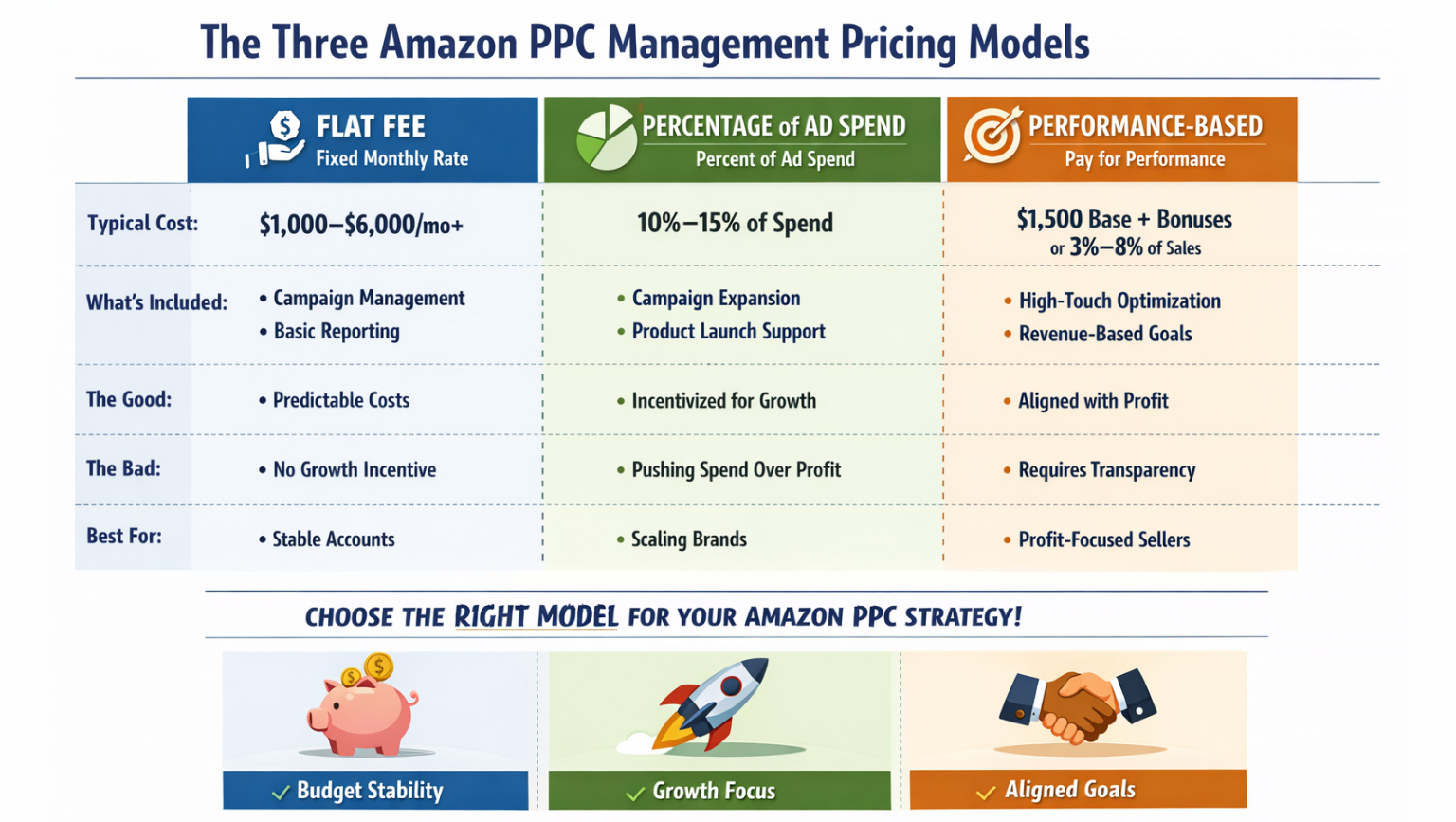
The Three Core Amazon PPC Management Pricing Models
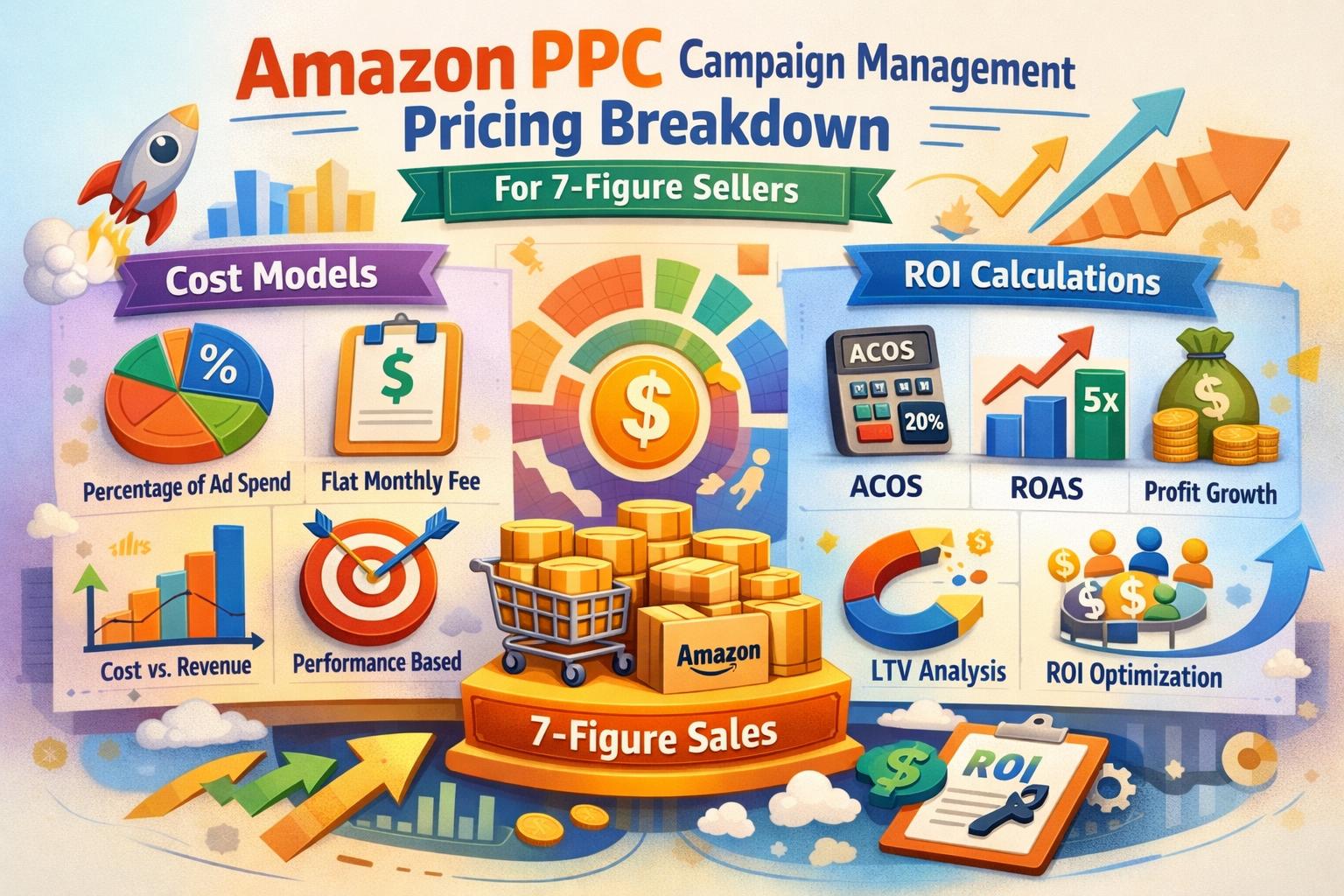
Every agency falls into one of three buckets. Each has trade-offs. None is inherently "best"—it depends on your ad spend, margins, and growth goals.
1. Flat Fee Model
You pay a fixed monthly amount regardless of ad spend.
Typical Range: $1,000–$6,000/month for most 7-figure sellers. Enterprise accounts with complex catalog structures can run $8,000–$15,000+.
What's Usually Included:
Campaign builds and restructures
Weekly or bi-weekly bid optimizations
Negative keyword mining
Basic search term analysis
Monthly reporting calls
The Good: Predictable costs. Easy to budget. Your management fee doesn't climb just because you scaled spend for Q4.
The Bad: Agencies have zero incentive to push for growth. A flat fee model can breed complacency—especially if they're juggling 40 other accounts at the same rate.
When It Works Best: Mature accounts with stable spend. Sellers who want "maintenance mode" rather than aggressive scaling.
2. Percentage of Ad Spend Model
The agency takes a cut of your total monthly ad spend.
Typical Range: 8%–20% of spend. Most land between 10%–15% for accounts spending $20k–$100k/month.
Important Detail: Most percentage-based contracts include a minimum monthly floor—typically $1,500–$3,000. So even if your spend drops, your fee doesn't go below that threshold.
Here's how that math plays out:
| Monthly Ad Spend | 10% Fee | 15% Fee |
| $20,000 | $2,000 | $3,000 |
| $50,000 | $5,000 | $7,500 |
| $100,000 | $10,000 | $15,000 |
What's Usually Included:
Everything in flat fee, plus:
More aggressive campaign expansion
Product launch support
Sponsored Brands and Display management
Deeper reporting and analysis
The Good: Agency incentives align with growth. They make more when you spend more, so they're motivated to find profitable scale.
The Bad: Here's where it gets dangerous. "Spend more" isn't the same as "profit more." I've audited accounts where the agency pushed spend to inflate their fee—while TACoS ballooned and the seller's margins cratered.
If your agency bills on spend percentage, ask one question: Are you optimizing for my profit or your invoice?
When It Works Best: Growth-phase brands actively scaling. Works only if there's accountability tied to profitability metrics—not just spend volume.
Quick gut-check: If your current agency is burning through budget while your contribution margin shrinks, grab my Wasted Ad Spend Calculator and see exactly where the money's going.
3. Performance-Based Model
The agency earns based on hitting specific KPIs—usually revenue targets, ROAS thresholds, or profit metrics.
Typical Structure:
Base retainer ($1,500–$3,500/month) plus performance bonuses
Or pure commission (3%–8% of attributed revenue)
Some hybrids: reduced flat fee + percentage of profit improvement
What's Usually Included:
High-touch optimization (daily or every-other-day)
Strategic consultation beyond ads
Cross-functional input on listings, pricing, inventory
Custom dashboards and deeper analytics
The Good: True alignment. When they only win if you win, priorities stay straight.
The Bad: These deals require trust and transparency on both sides. You'll need to share margin data. And honestly? Most agencies won't offer this model because it exposes them. If their "optimization" is smoke and mirrors, performance-based pricing will bankrupt them.
When It Works Best: Sophisticated sellers with clean financials who can share real profit data. Best for long-term partnerships where both sides have skin in the game.
Freelancer vs. Agency: Understanding the Entry-Level Tier
Before we break down what separates price tiers, let's clarify who's actually doing the work. For a deeper look at how each option compares on cost, risk, and results, see our full breakdown of amazon ppc software vs agency vs in-house.
Freelancers ($1,000–$2,500/month)
At this price point, you're typically hiring a solo PPC consultant—often found on Upwork or through referrals. Some are excellent former agency strategists. Many are generalists running 15+ accounts.
Pros: Lower overhead, direct communication, often more flexible
Cons: Limited bandwidth, single point of failure, may lack advanced tools
Watch for: Offshore freelancers charging $500–$800/month often lack the market-specific knowledge for US/UK Amazon nuances
Boutique Agencies ($2,500–$5,000/month)
Domestic agencies with dedicated account managers typically start here. You're paying for infrastructure: backup coverage, proprietary tools, and documented processes.
The question isn't "freelancer or agency?" It's "what level of system and accountability do I need?"
Hidden Costs That Blow Up Your Budget
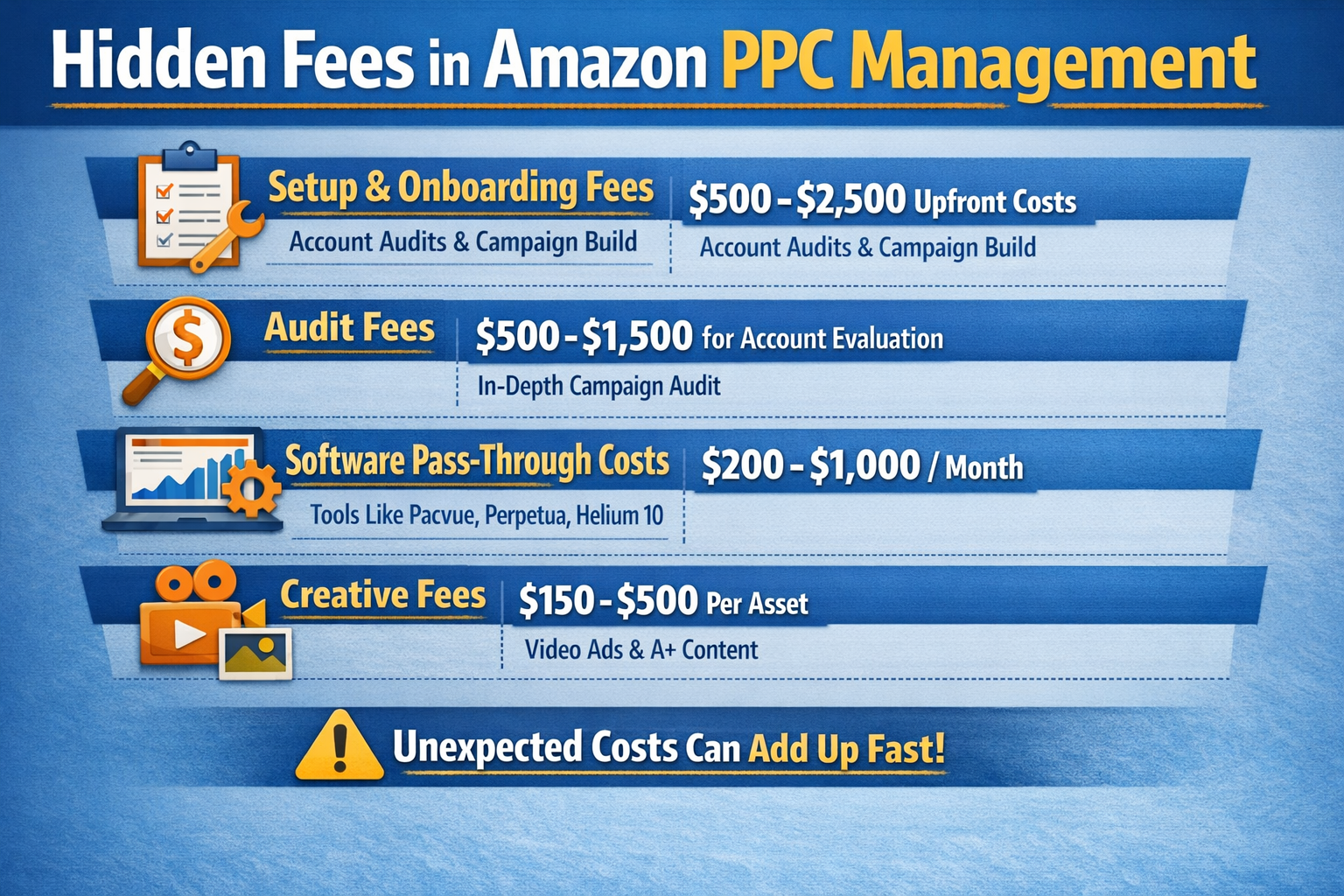
The monthly retainer or percentage fee is rarely the whole story. Here's what catches sellers off guard:
Setup/Onboarding FeesMany agencies charge $500–$2,500 upfront for account audits, campaign builds, and initial restructuring. Some fold this into the first month's fee; others bill separately.
Audit FeesWant an agency to evaluate your current setup before committing? Expect to pay $500–$1,500 for a comprehensive audit. (Some agencies offer free audits as a sales tool—quality varies wildly.)
Software Pass-Through CostsAgencies using premium tools like Pacvue, Perpetua, or Helium 10 sometimes pass those costs to clients—anywhere from $200–$1,000/month depending on the platform and your catalog size.
Creative FeesVideo ads for Sponsored Brands? Custom A+ Content testing? These often fall outside "management" scope and get billed at $150–$500 per asset.
Always ask: What's included in the management fee, and what gets billed separately?
What Separates a $2,000/Month Agency From a $6,000/Month One?
Price alone tells you nothing. Here's what actually changes at different investment levels:
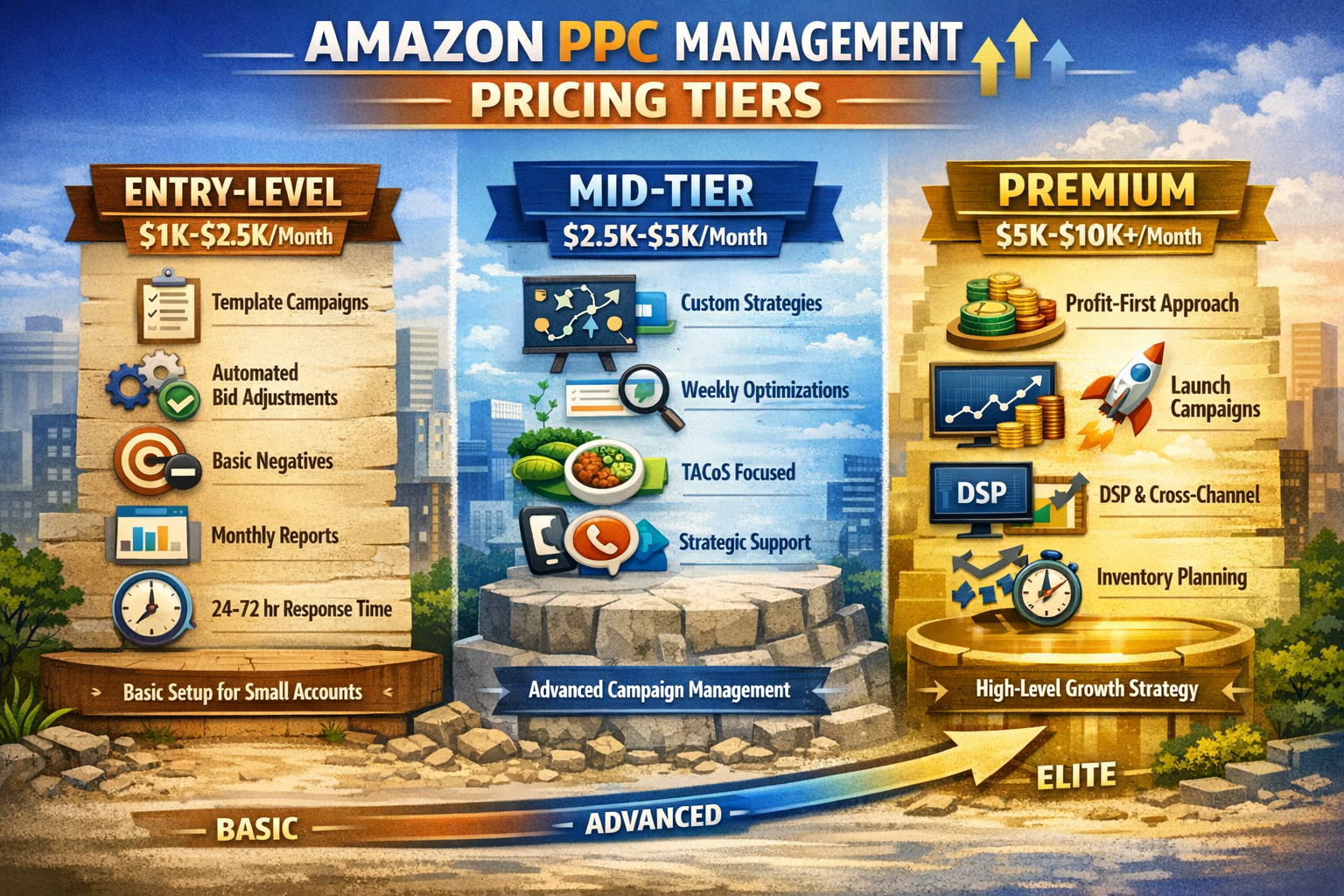
Entry-Level ($1,000–$2,500/month)
Template-based campaign structures
Bi-weekly bid adjustments (often automated)
Basic negative keyword adds
Generic monthly reports
Response times: 24–72 hours
This tier handles the basics. If your account is small and simple, it might be enough. But don't expect strategic thinking or proactive optimization. At this level, you're often one of 20+ accounts your manager handles.
Mid-Tier ($2,500–$5,000/month)
Custom campaign architecture
Weekly manual optimizations
Search term isolation strategies
Placement analysis and adjustment
TACoS-aware budget allocation
Bi-weekly or weekly calls
Response times: same day
This is where most 7-figure sellers should land. You're paying for a dedicated strategist—not just a bid jockey running scripts.
Premium ($5,000–$10,000+/month)
Everything above, plus:
Profit-first frameworks (like our Profit Feedback Loop)
Custom reporting tied to contribution margin
Launch playbooks and ranking campaigns
DSP integration strategy
Inventory-aware pacing
Cross-channel coordination
Response times: hours, sometimes faster
At this level, you're not hiring task executors. You're hiring strategic partners who think about your business holistically.
How to Calculate If Your Management Fee Actually Delivers ROI
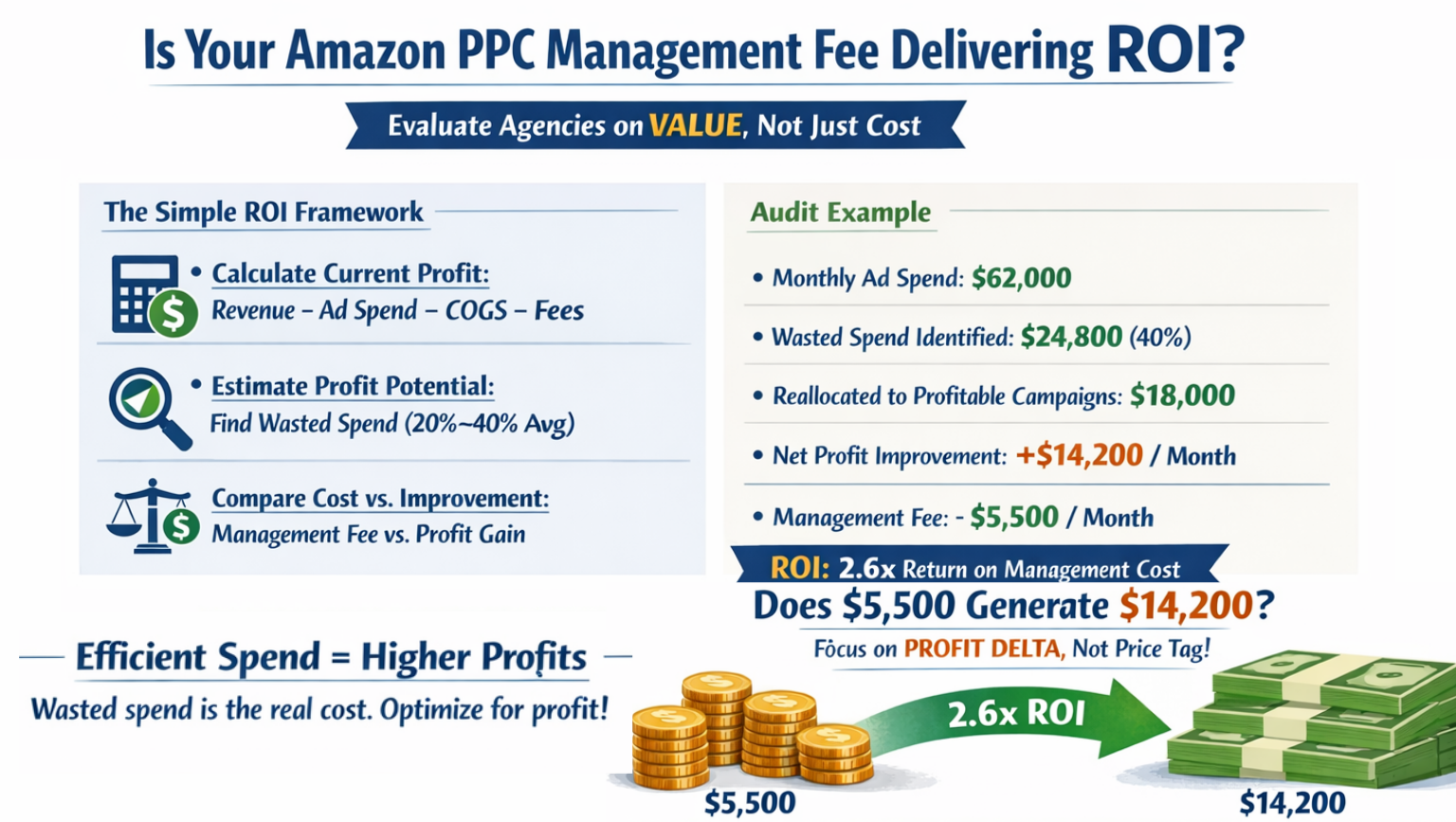
Here's where most sellers mess up: they evaluate agencies on cost instead of value.
Stop asking "Is $4,000/month too much?"
Start asking "What's the profit delta?"
The Simple ROI Framework
Calculate your current monthly profit from PPC (Revenue – Ad Spend – COGS – Fees)
Estimate profit improvement potential (most accounts have 20%–40% wasted spend)
Compare management cost vs. profit improvement
Real example from an audit last quarter:
Monthly ad spend: $62,000
Wasted spend identified: $24,800 (40%)
Reallocated to profitable campaigns: $18,000
Net profit improvement: $14,200/month
Management fee: $5,500/month
ROI: 2.6x the management cost returned as pure profit
That's the math that matters. Not "Is $5,500 expensive?" but "Does $5,500 generate $14,200?"
Industry data backs this up. According to Jungle Scout's research on Amazon advertising trends, average cost-per-click continues to rise year over year, making efficient spend allocation more critical than ever [1]. When CPCs climb, wasted clicks become exponentially more expensive.
Red Flags That Signal Poor Value (Regardless of Price)
Reports that only show ACoS (ignoring TACoS and profit per click)
No clear explanation of what they changed and why
Bid adjustments as their only "optimization"
Zero negative keyword additions in 30+ days
They can't explain their process—only their "proprietary AI"
No performance benchmarks or goals documented
If any of these sound familiar, your money isn't working. Book a call and let's see what a profit-first approach looks like for your account.
What Smart Sellers Negotiate Into Their Contracts
Beyond pricing model, these terms separate good deals from bad ones:
Performance Clauses: Build in review periods. If TACoS exceeds X% for 60 days, you can exit without penalty.
Transparency Requirements: Weekly bulk file exports. Access to the actual campaigns (not just a dashboard summary). You own the account—always.
Scope Clarity: What's included vs. extra? Creative testing? DSP? Video ads? Ambiguity here leads to surprise invoices.
Communication Cadence: Lock in call frequency and response time SLAs. "We'll be in touch" isn't a commitment.
Exit Terms: 30-day notice maximum. Agencies that require 90-day lockups are handcuffing you for a reason.
The Bottom Line on Amazon PPC Campaign Management Pricing
Pricing tells you what you'll pay.
Service tells you what you'll get.
Results tell you whether it was worth it.
The best investment isn't the cheapest agency or the most expensive one. It's the one that treats your ad spend like it's their money—and proves it with systems, transparency, and profit-focused optimization.
If you're spending $30k+ monthly on Amazon ads and can't clearly see where your money goes and what it returns, that's the real problem to solve.
Ready to see what's actually happening in your account? Book a call and we'll walk through your numbers together.

Frequently Asked Questions
What's the average cost of Amazon PPC management for 7-figure sellers?
Most 7-figure sellers pay between $2,500 and $6,000 monthly for quality management. The range depends on catalog complexity, ad spend volume, and service depth. Percentage-based models typically run 10%–15% of ad spend with minimum monthly floors of $1,500–$3,000. Focus less on average cost and more on documented ROI—a $5,000 fee that saves $15,000 in waste beats a $1,500 fee that does nothing.
Is percentage-based pricing better than flat fee for Amazon PPC?
Neither is inherently better. Flat fees offer predictable costs and work well for stable accounts. Percentage models align growth incentives but can encourage overspending if not tied to profitability metrics. The key is accountability: whatever model you choose, ensure your agency tracks TACoS and contribution margin—not just spend volume or vanity ACoS.
What services should be included in Amazon PPC management?
At minimum: campaign builds, weekly bid optimization, negative keyword mining, search term analysis, and transparent reporting. Better agencies add placement optimization, TACoS monitoring, launch support, and strategic consultation. Premium services include profit-first frameworks, inventory-aware pacing, and custom reporting tied to contribution margin. Always clarify what's included versus billed separately.
How do I know if my Amazon PPC agency is worth the cost?
Calculate your profit delta. Compare monthly profit before and after management (accounting for fees). Quality agencies identify and eliminate wasted spend—typically 20%–40% of budget in underperforming accounts. If your TACoS is climbing, margins are shrinking, and reports only show ACoS without context, your investment isn't delivering.
What hidden fees should I watch for with Amazon PPC agencies?
Common surprises include setup/onboarding fees ($500–$2,500), software pass-through costs for tools like Pacvue or Helium 10 ($200–$1,000/month), creative production fees for video ads, and audit fees. Always ask for a complete fee breakdown before signing. Percentage-based contracts often have minimum monthly floors that apply even when spend drops.
Why Trust This Analysis
PPC Maestro has managed millions in Amazon ad spend across 7-figure and 8-figure accounts. Our Profit Feedback Loop framework is built specifically for sellers who care about contribution margin—not vanity metrics. Every recommendation here comes from real audits, real accounts, and real profit improvements documented in our results. We teach what we do, and we do what we teach.
Works Cited
[1] Jungle Scout — "The State of Amazon Advertising Report." https://www.junglescout.com/amazon-advertising-report/
[2] Amazon Advertising — "Sponsored Products Campaign Management." https://advertising.amazon.com/solutions/products/sponsored-products