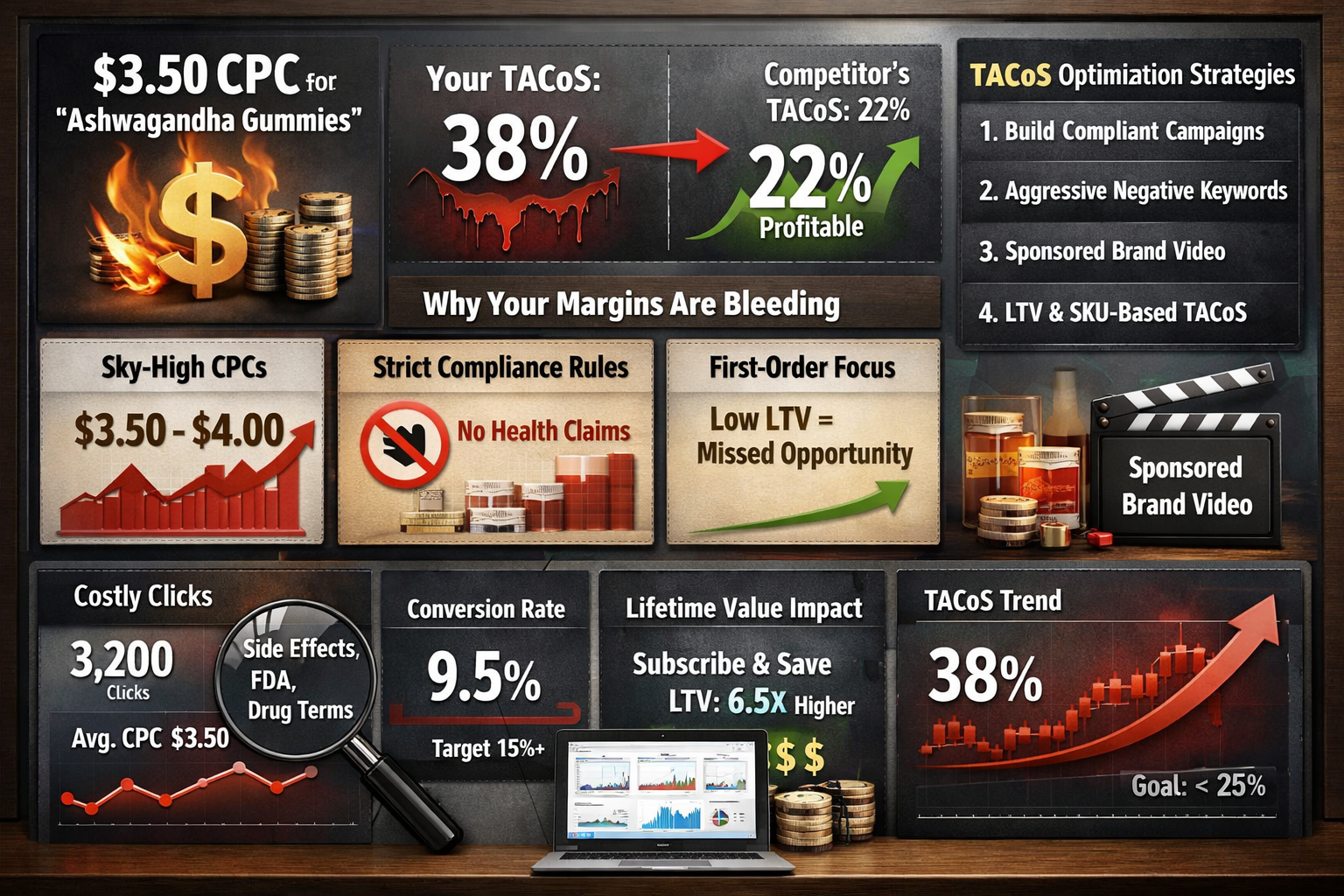
You're spending $3.50 per click on "ashwagandha gummies."
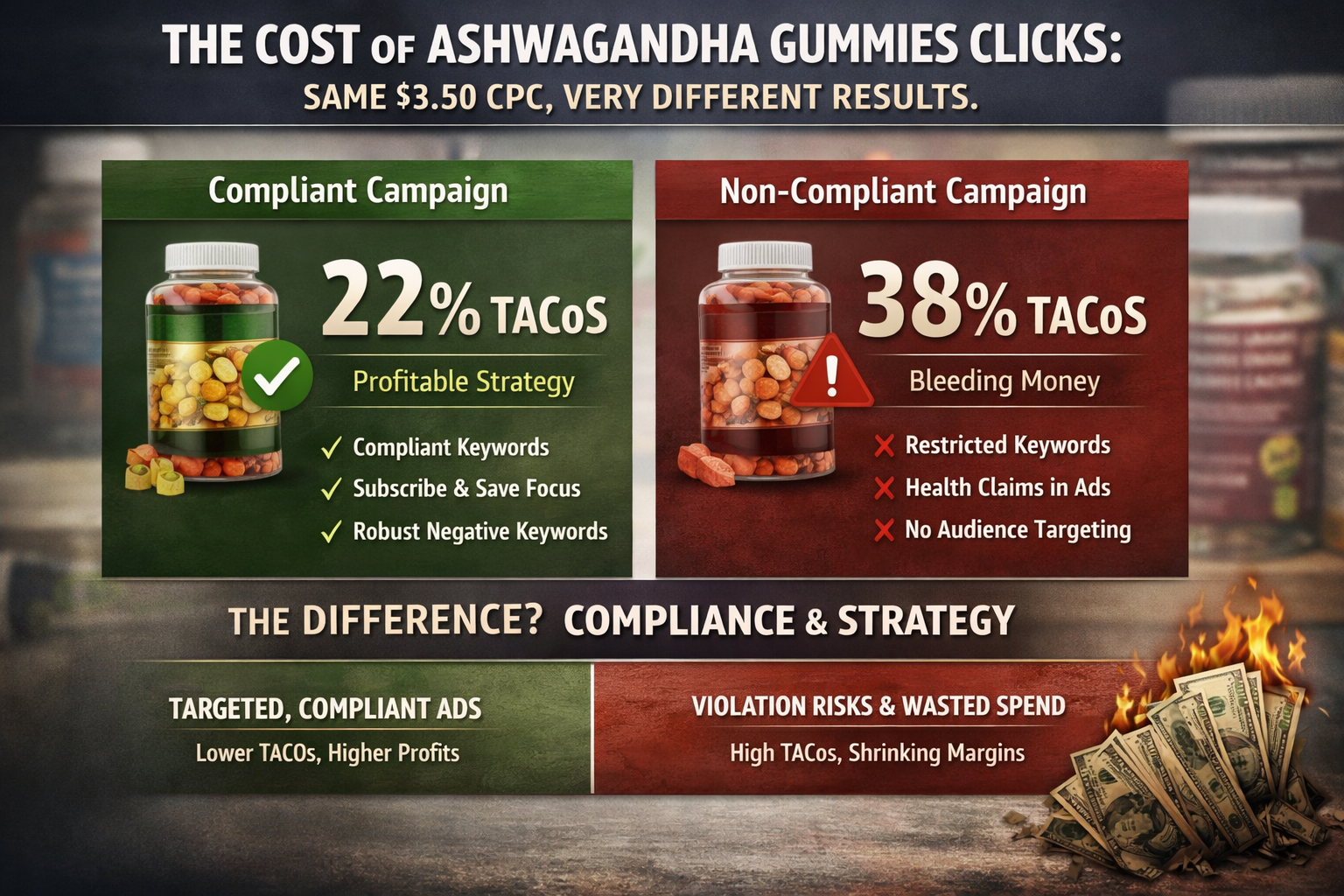
Your competitor? Same keyword. Same bid. But they're profitable at a 22% TACoS while you're bleeding out at 38%.
The difference isn't budget. It's strategy.
I've managed Amazon PPC for supplement brands burning through six figures monthly—and watched sellers pour money into clicks that Amazon's algorithm practically guarantees won't convert. Supplement CPCs are brutal. The category is crowded, the margins are tight, and one compliance slip can tank your entire ad account.
But here's what most agencies won't tell you: sky-high CPCs aren't the problem. The problem is treating supplement PPC like every other category when the rules are fundamentally different.
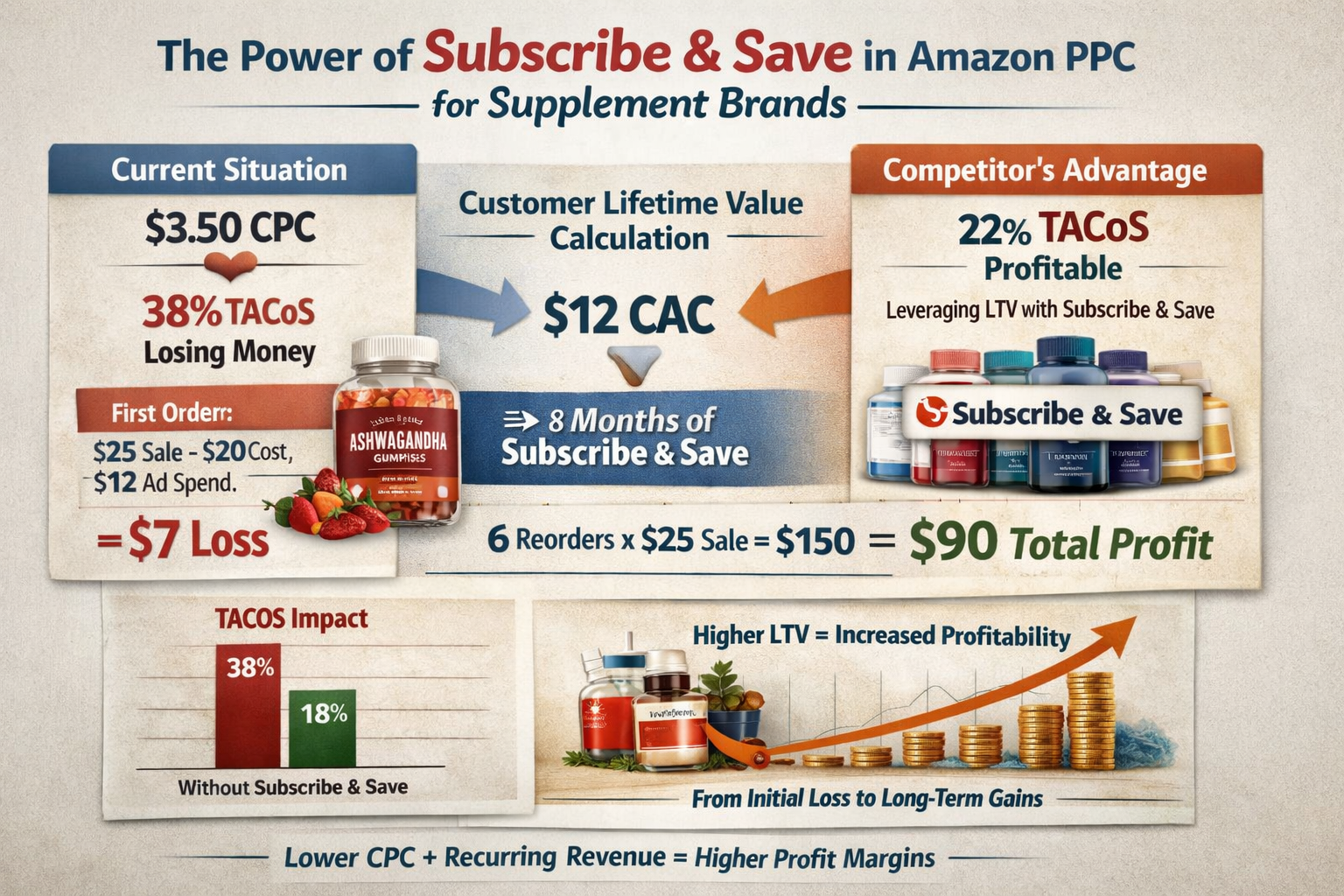
The math changes when you factor in customer lifetime value. A $3.50 click that converts into a Subscribe & Save customer buying monthly for 8 months? That's not expensive—that's cheap customer acquisition. Most supplement sellers obsess over first-order profitability and miss the bigger picture entirely.
Let me show you how to stop the bleeding.
Why Supplement CPCs Are Crushing Your Margins
Supplement brands face a perfect storm that most sellers never deal with.
First, the competition is relentless. Amazon's supplement category has exploded, with thousands of sellers fighting for the same high-intent keywords [1]. When everyone's bidding on "vitamin D3 5000 IU," prices skyrocket. Your share of voice shrinks while your customer acquisition cost climbs.
Second, Amazon restricts what you can say. You can't make health claims. You can't mention disease prevention. You can't use testimonials about results. This means your listing has to convert on limited messaging—while paying the same inflated CPCs as categories with no restrictions [2].
Third, the first-order math is unforgiving. A typical supplement margin sits between 25-40% after Amazon fees and COGS. When your average CPC hits $2.50-$4.00 on competitive terms, you need a conversion rate north of 15% just to break even on ad spend.
Most supplement sellers I audit are nowhere close.
The result? TACoS creeping up quarter over quarter. Profit margins shrinking. And a growing suspicion that Amazon PPC "just doesn't work" for supplements.
It works. You're just playing the wrong game.
Want to know exactly where your supplement ad spend is leaking? Grab our free Wasted Ad Spend Calculator and run your numbers.
1. Build Compliant-First Campaign Architecture
Most supplement PPC disasters start in campaign setup.
I audited a collagen brand last quarter—$127k in monthly ad spend. Their campaigns were a mess of broad match keywords, including terms Amazon explicitly restricts. They'd been running "anti-aging" and "reduces wrinkles" in their targeting. Not only were they wasting money on non-converting traffic, they were one audit away from account suspension.
Amazon's supplement advertising policies are strict and getting stricter [2]. You cannot:
Make disease claims (prevents, treats, cures)
Reference specific health conditions
Use before/after language implying medical results
Target keywords related to prescription medications
Here's the fix: Build your campaigns around compliant keyword clusters from day one.
Tier 1 – Product descriptors: "collagen peptides powder," "unflavored collagen supplement," "grass-fed collagen"
Tier 2 – Benefit-adjacent (compliant): "protein for hair skin nails," "collagen for smoothies," "daily collagen routine"
Tier 3 – Audience-based: "collagen for women over 40," "keto collagen powder," "collagen for athletes"
Notice what's missing? No health claims. No medical language. Just compliant terms that still capture buyer intent.
Structure your campaigns to isolate these tiers. This lets you bid aggressively on what converts while keeping your account safe.
Before vs. After Example:
Non-compliant (risky): "Cures insomnia" / "Treats joint pain" / "Reduces inflammation"
Compliant (safe): "Supports restful sleep" / "Joint support supplement" / "Turmeric curcumin capsules"
One word choice can be the difference between a thriving campaign and a suspended account.
2. Negative Keyword Mining on Steroids
In supplements, your negative keyword list might be more valuable than your targeting list.
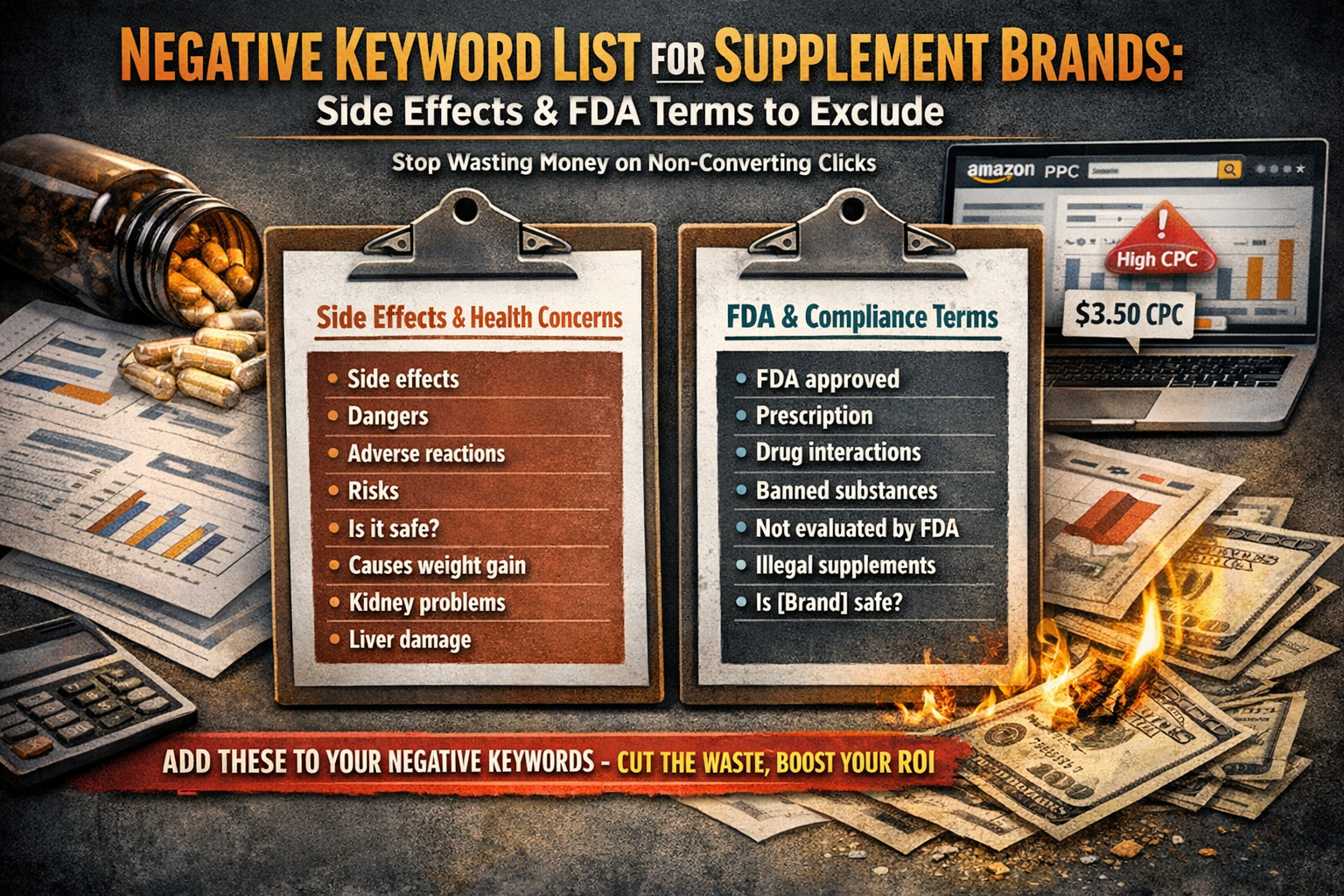
Here's why: supplement shoppers search weird stuff. They're looking for drug interactions, side effects, warnings, and comparisons to prescription medications. Every one of those clicks costs you $3+ and converts at basically zero.
I pulled a search term report for a probiotic brand last month. They were paying for clicks on:
"probiotics side effects diarrhea"
"can probiotics cause weight gain"
"probiotics vs antibiotics"
"is [brand] FDA approved"
None of these convert. All of them drain budget.
Your weekly SOP should include:
Pull search term reports (minimum 14-day lookback)
Filter for terms with 10+ clicks and zero orders
Flag any term containing: side effects, dangers, warnings, interactions, FDA, prescription, drug
Add to campaign-level negatives immediately
This isn't optional maintenance. For supplement brands, aggressive negative mining is the difference between profitable PPC and expensive brand awareness you didn't ask for.
We've documented this exact process in our Cutting Bleeders SOP—it's the same framework we use on every supplement account we manage.
3. Sponsored Brand Video: Your Secret Weapon for Compliance
Here's something most supplement sellers miss entirely.
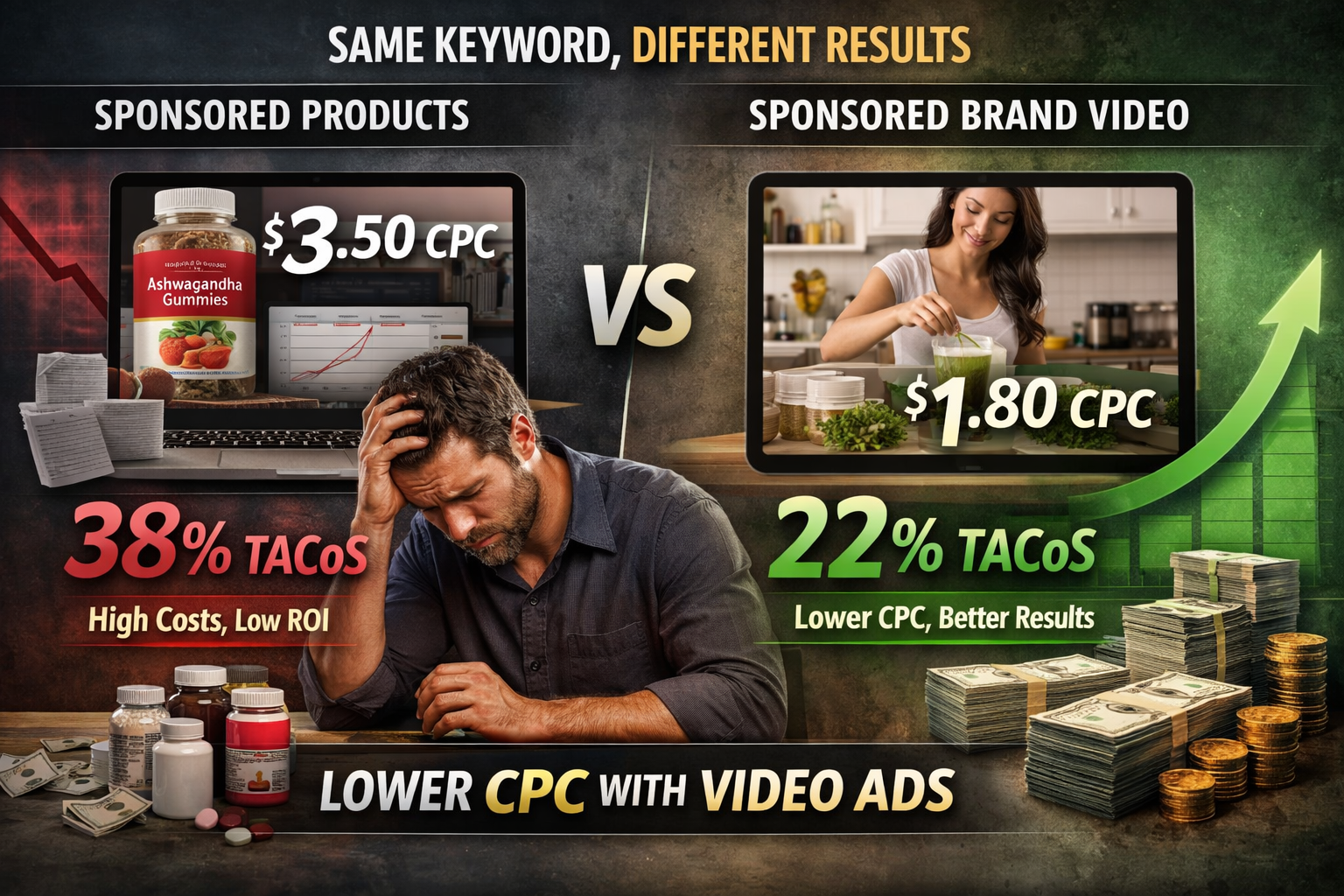
Sponsored Brand Video lets you demonstrate product usage without making claims. You're showing, not telling. And Amazon's algorithm rewards video with lower CPCs and higher placement priority [3].
I've seen supplement brands cut their effective CPC by 30-40% by shifting budget from Sponsored Products to Sponsored Brand Video—same keywords, dramatically better efficiency.
Why does this work?
Traditional Sponsored Products ads compete purely on bid and relevance. You're in a knife fight with every other supplement brand willing to pay $4 per click.
Sponsored Brand Video occupies different real estate. It's visually engaging. It stops the scroll. And it pre-qualifies shoppers before they click—meaning your conversion rate jumps because only genuinely interested buyers come through.
Compliant video content for supplements:
Product unboxing and texture/consistency shots
Mixing or usage demonstrations
Ingredient callouts (what's in it, not what it does)
Lifestyle context (morning routine, post-workout, etc.)
Comparison to your own products (not competitors)
What to avoid:
Any claim about results or benefits
Customer testimonials
Before/after implications
Text overlays with restricted terms
One vitamin brand I work with shifted 35% of their Sponsored Products budget to video campaigns. Same total spend. TACoS dropped from 31% to 24% in 60 days.
The clicks cost less. The conversions came faster. The math finally worked.
4. TACoS Targeting by SKU Margin—Plus the LTV Factor Most Sellers Ignore
This is where most supplement sellers—and their agencies—get lazy.
They set a blanket TACoS target across the entire catalog. "We're aiming for 25% TACoS." Sounds reasonable until you realize your protein powder has 42% margins while your single-ingredient vitamin has 23%.
One target. Two completely different profit realities.
Here's the framework we use:
For each SKU, calculate your contribution margin after Amazon fees and COGS. Then set TACoS targets that preserve actual profit.
Example:
SKU A (Premium Multivitamin): 45% contribution margin → Target TACoS: 28-32%
SKU B (Basic Vitamin D): 24% contribution margin → Target TACoS: 14-18%
SKU C (New Launch Probiotic): Margin TBD → Aggressive TACoS acceptable for ranking (30-40% for 60 days, then reassess)
Same brand. Three different strategies. This is what profit-first PPC actually looks like.
The Lifetime Value Shift: Why Subscribe & Save Changes Everything
Here's where supplement PPC gets interesting—and where most sellers leave money on the table.
Supplements are consumable. Customers reorder. If you're only measuring first-order profitability, you're making decisions with half the data.
The math:
Let's say your customer acquisition cost (CAC) on a probiotic is $12. First order margin after ad spend? Breakeven or slightly negative.
But if 35% of those customers convert to Subscribe & Save and average 6 orders over their lifetime? That $12 CAC now looks like genius-level marketing.
How to factor LTV into your PPC strategy:
Track Subscribe & Save conversion rate by SKU. Some products naturally drive recurring purchases. Others don't.
Calculate average customer lifetime value. Orders per customer × margin per order = LTV.
Adjust acceptable TACoS accordingly. High-LTV SKUs can absorb higher acquisition costs. Low-LTV SKUs need tighter TACoS targets.
A supplement brand I work with discovered their greens powder had 3x the Subscribe & Save rate of their single-ingredient capsules. We shifted budget aggressively—accepting 35% TACoS on greens (knowing LTV made it profitable) while holding capsules to 18% TACoS.
Total profit increased. TACoS looked "worse" on paper for one product. But the business was healthier.
When CPCs are high—and they will be in supplements—you cannot afford to over-invest in low-margin, low-LTV SKUs. Let those run lean. Pour your budget into the products where $3 clicks generate customers who stick around.
5. Time-of-Day Bid Management for Maximum Efficiency
Supplement buyers have patterns. Your ad spend should follow them.
I've analyzed conversion data across dozens of supplement accounts, and the patterns are consistent:
Peak conversion windows for supplements:
Morning (6-9 AM): Health-conscious buyers adding to routine
Evening (7-10 PM): Research-and-purchase after work
Sunday afternoons: Weekly health planning and bulk ordering
Low-conversion periods:
Overnight (12-5 AM): Browsing, not buying
Mid-afternoon weekdays: Distracted clicks, low intent
The tactical approach:
Amazon doesn't offer native dayparting controls in Seller Central. For 7-figure brands, the right solution is intraday bid adjustments—not simply letting budget run out early.
Option 1: Bid management software. Tools that connect to Amazon's API can automatically lower bids during low-conversion hours and increase them during peak windows. You maintain presence 24/7 (protecting organic ranking momentum) while paying less for off-peak clicks.
Option 2: Amazon Marketing Stream. If you're running significant spend, Amazon Marketing Stream provides hourly performance data. Use this to identify your specific brand's conversion patterns and build bid rules accordingly.
Option 3 (smaller accounts): Budget pacing. If you don't have software, a simpler approach is setting campaign budgets to front-load spend during high-conversion hours. But understand the trade-off: running out of budget kills your evening visibility, which can hurt organic ranking signals.
One brand I worked with was burning 40% of daily budget between 11 PM and 6 AM. Conversion rate during those hours? 4.2%. Compared to 14.8% during morning peak. We implemented bid rules—lowering overnight bids by 40% rather than cutting budget entirely. TACoS dropped 6 points in three weeks while maintaining 24-hour presence.
Same spend. Smarter timing. More profit.
The Compliance Trap That Kills Supplement Campaigns
I need to be direct about something.
Every strategy above assumes you're operating within Amazon's supplement advertising guidelines. If you're not, none of this matters—because one policy violation can pause your campaigns, restrict your account, or worse [2].
Amazon uses automated scanning and manual review to flag supplement ads. They're looking for:
Prohibited claims: Disease treatment, prevention, or cure language
Unapproved supplements: Certain ingredients are completely restricted
Misleading content: Implied results without substantiation
Targeting violations: Bidding on restricted health-condition keywords
Your compliance checklist:
Review Amazon's Restricted Products policy for supplements quarterly
Audit all ad copy and keyword targeting against prohibited terms
Keep product listings compliant—ads inherit listing violations
Monitor for policy warning emails and address immediately
I've seen brands lose six-figure monthly revenue from account restrictions that started with one flagged keyword. The CPCs are already painful. Don't add compliance risk to the equation.
The Profit Feedback Loop for Supplements
Everything I've outlined connects back to one principle: optimize for profit, not vanity metrics.
Low ACoS means nothing if your TACoS is climbing and net profit is shrinking. High CPCs aren't the enemy if your conversion architecture turns those clicks into customers profitably—especially customers who subscribe and reorder.
The Profit Feedback Loop we use with every client follows this sequence:
Launch with intent: Compliant campaign architecture, margin-based TACoS targets, LTV considerations
Prune fast: Aggressive negative mining, cut bleeders weekly
Analyze real profit: TACoS by SKU, contribution margin after ad spend, Subscribe & Save rates
Iterate and scale: Double down on what works, starve what doesn't
For supplement brands specifically, this loop runs tighter because the margin for error is smaller. High CPCs mean every wasted click hurts more. Compliance constraints mean every campaign decision carries more risk.
But when you get it right? Supplement PPC becomes a profit engine, not a cash furnace.
Ready to Stop Burning Money on Supplement PPC?
If you're a 7-figure supplement brand watching TACoS climb while profit shrinks, the problem isn't Amazon PPC. It's the strategy behind it.
We've helped supplement sellers cut wasted ad spend by 30%+ while staying fully compliant—then reallocated that budget into campaigns that actually convert.
Here's how to start:
Download our free Wasted Ad Spend Calculator to see exactly where your budget is leaking
Check out real results from brands we've helped turn around
Book a free profit audit and let's find your hidden waste
Your supplement brand deserves PPC that builds profit, not just sales reports.
Frequently Asked Questions
Why are supplement CPCs so much higher than other categories?
Supplement CPCs run higher because the category combines intense competition with high purchase intent keywords. Thousands of sellers bid on the same health-focused terms, and Amazon prices that demand accordingly. Add restricted advertising options that limit differentiation, and you get inflated costs across the board. The solution isn't avoiding PPC—it's building strategy around the constraint and factoring customer lifetime value into acquisition costs.
How do I know if my supplement ads are compliant with Amazon's policies?
Amazon restricts health claims, disease references, and certain ingredient categories in supplement advertising [2]. Review your keyword targeting and ad copy against Amazon's Restricted Products policy. Any term implying treatment, prevention, or cure of health conditions violates policy. When in doubt, focus on product descriptors (ingredients, format, quantity) rather than benefit claims. Example: "Supports restful sleep" is compliant; "Cures insomnia" will get flagged.
What's a realistic TACoS target for supplement brands?
TACoS targets should match your individual SKU margins and customer lifetime value—not category averages. A supplement with 40% contribution margin and strong Subscribe & Save rates can sustain 25-30% TACoS profitably. A lower-margin product with minimal repeat purchases needs TACoS under 15% to preserve profit. Set targets by SKU based on actual margin math and LTV data.
Should supplement brands use Sponsored Brand Video?
Absolutely. Sponsored Brand Video often delivers lower CPCs than Sponsored Products for the same keywords, plus higher conversion rates from pre-qualified clicks [3]. Video lets you demonstrate product usage compliantly—showing, not claiming. Shift 25-35% of your Sponsored Products budget to video and test performance over 60 days.
How do I factor Subscribe & Save into my PPC strategy?
Track Subscribe & Save conversion rates by SKU and calculate average customer lifetime value (orders per customer × margin per order). Products with high Subscribe & Save rates can justify higher acquisition costs because profitability comes from repeat orders, not just the first sale. Adjust your acceptable TACoS accordingly—high-LTV products can run at higher TACoS while low-LTV products need tighter targets.
About PPC Maestro
PPC Maestro is led by Bernard Nader, a profit-first Amazon PPC specialist who has managed millions in supplement and health category ad spend. Bernard's Profit Feedback Loop framework has helped 7-figure Amazon sellers cut wasted spend, improve TACoS, and build PPC systems that scale profitably. His approach combines hands-on audit experience with documented SOPs used across dozens of private-label brands. Bernard regularly shares tactical PPC insights through YouTube tutorials, industry presentations, and the PPC Maestro blog.
Works Cited
[1] Jungle Scout — "Amazon Advertising Benchmarks." https://www.junglescout.com/resources/articles/amazon-advertising-benchmarks/
[2] Amazon Seller Central — "Restricted Products: Dietary Supplements." https://sellercentral.amazon.com/help/hub/reference/G200164330
[3] Amazon Advertising — "Sponsored Brands Video Best Practices." https://advertising.amazon.com/resources/ad-specs/sponsored-brands-video