
An Amazon PPC manager isn't a button-pusher.
They architect your entire paid traffic system to extract profit, not just clicks.
Amazon PPC Manager: What We Do
Here's what that looks like in practice.
1. Campaign Setup & Structure
Most brands launch campaigns like throwing darts blindfolded.
A profit-first PPC manager builds three-tier campaign architecture:
Ranking campaigns: push organic rank with aggressive bids on high-intent keywords
Profit campaigns: defend margin with exact-match, low-ACoS targets
Data campaigns: auto and broad match to harvest new search terms
Each campaign has a different goal, different budget, and different success metric.
You don't measure a ranking campaign by ACoS. You measure it by rank movement and organic lift.
You don't measure a data campaign by profit. You measure it by how many winning search terms it finds.
This is the foundation of the Profit Feedback Loop—and it's why most agencies fail. They treat every campaign the same.
2. Negative Keyword Mining & Waste Elimination
I've seen brands waste $30k/month on search terms they should've negated in week one.
"Cheap." "Knockoff." "Alternative to [competitor]." "Return policy."
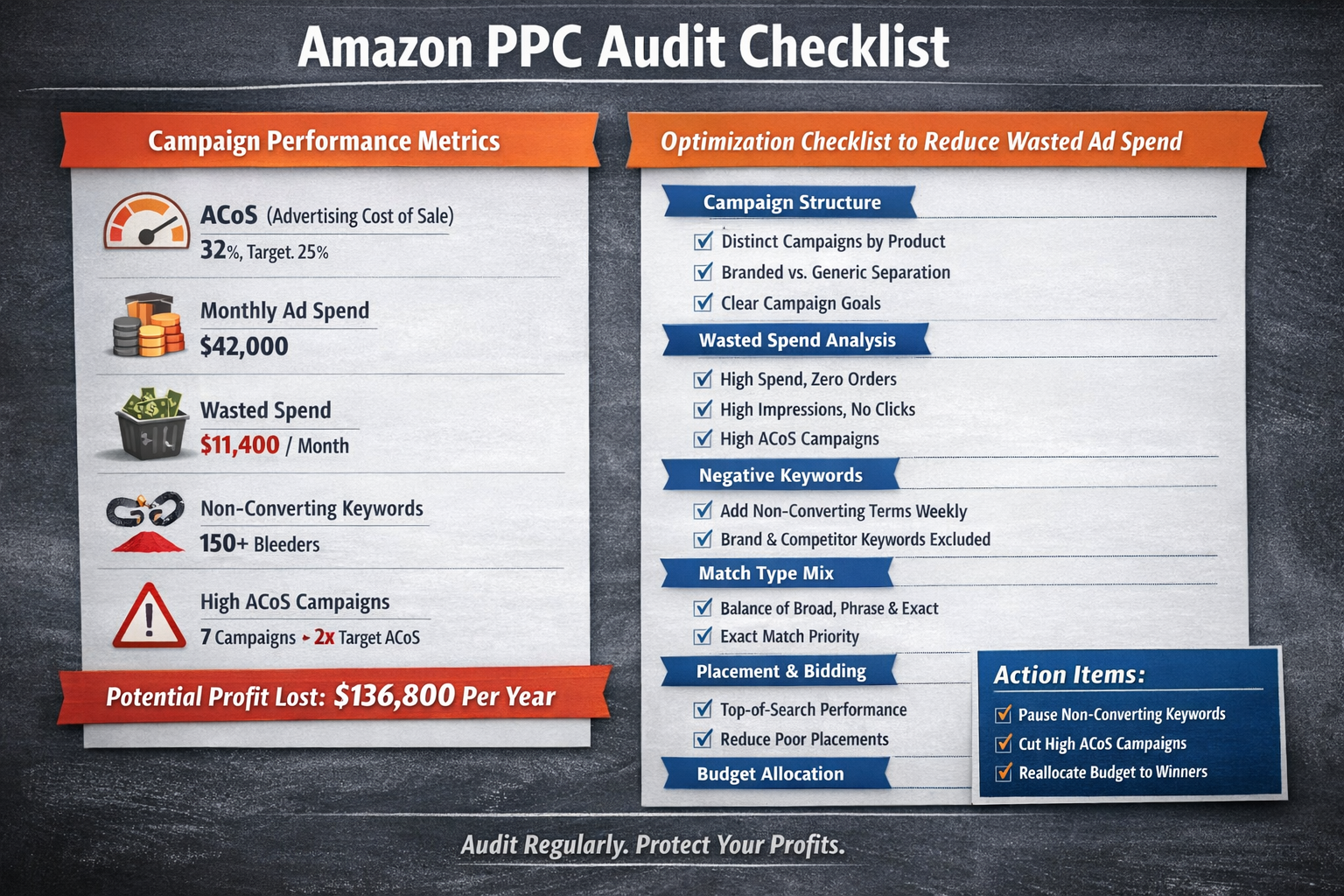
A specialized PPC manager runs weekly bulk-file audits to isolate bleeders—search terms with 20+ clicks, zero orders, and hemorrhaging budget.
Then they negate them. Fast.
Real example: One client was spending $1,200/month on the search term "free shipping."
Zero orders. Ever.
We negated it. Reallocated that budget to exact-match profit terms.
Profit per click jumped 18% in 30 days.
That's the difference between a manager who optimizes and one who just "monitors."
3. Bid & Budget Optimization
Bids aren't static. Markets shift. Competitors enter. Inventory fluctuates.
A profit-first manager adjusts bids based on:
Contribution margin per SKU (not blanket ACoS targets)
TACoS trend (total advertising cost of sales—PPC spend ÷ total revenue)
Organic rank position (if you're page one, you can dial back and harvest profit)
Inventory velocity (if you're overstocked, increase spend; if tight, throttle back)
Most agencies set ACoS targets in a spreadsheet and walk away.
A profit-first manager adjusts bids based on:
Contribution margin per SKU (not blanket ACoS targets)
TACoS trend (total advertising cost of sales—PPC spend ÷ total revenue)
Organic rank position (if you're page one, you can dial back and harvest profit)
Inventory velocity (if you're overstocked, increase spend; if tight, throttle back)
Most agencies set ACoS targets in a spreadsheet and walk away.
We set TACoS targets by product margin, then optimize profit per click—not cost per click.
4. Placement & Creative Testing
Top-of-search isn't always the most profitable placement.
Product pages and rest-of-search often convert better at lower CPCs.
A skilled manager splits budgets by placement, tests bid adjustments, and reallocates to the placements that deliver the highest profit per click.
Same logic applies to creative. Headline split-tests. Image A/B tests. Video vs static.
You don't guess. You test, measure contribution margin, and scale the winner.
5. Reporting That Actually Matters
Most PPC reports are vanity dashboards.
ACoS. Impressions. Click-through rate.
Cool. But did profit go up?
A profit-first Amazon PPC manager tracks:
TACoS (are ads cannibalizing organic sales?)
Profit per click (revenue per click × margin - CPC)
Contribution margin (after ad spend, COGS, and Amazon fees)
Wasted spend (clicks that will never convert)
Reallocation impact (what happened when we moved budget from bleeders to winners)
If your current manager can't explain how PPC impacts your bottom line, you don't have a manager. You have a campaign babysitter.
Want a second set of eyes? Book a free profit audit and we'll show you where your budget is leaking.
Why FBA Brands Need a Specialized Amazon PPC Manager
Not all sellers are created equal.
Arbitrage sellers chase margin on commodities. Wholesale accounts optimize for inventory turns. Private label FBA brands are building equity and exit value.
That changes everything.
FBA Brands Are Optimizing for Profit & Valuation
When you sell your brand, buyers look at adjusted EBITDA.
If your PPC spend is 40% of revenue and your TACoS is climbing, your valuation tanks.
A specialized FBA PPC manager optimizes campaigns to:
Lower TACoS without killing top-line growth
Increase contribution margin per SKU so more revenue drops to the bottom line
Protect organic rank so you're not 100% dependent on paid traffic
Exit buyers want to see predictable, profitable growth—not revenue propped up by unsustainable ad spend.
FBA Brands Have Complex SKU Economics
You're not managing one product. You're managing a catalog with different margins, different competition, and different lifecycle stages.
A profit-first manager sets TACoS targets by SKU—not one blanket ACoS goal across the account.
Example:
Hero SKU with 45% margin → TACoS target: 18%
New launch with 30% margin → TACoS target: 28% (willing to invest for rank)
Low-margin variant → TACoS target: 10% (harvest profit only)This is how you scale without bleeding margin.
FBA Brands Need Systems, Not Heroes
You can't grow a sellable business on "guru tweaks" and monthly Zoom calls.
A specialized PPC manager brings SOPs, bulk-file workflows, and repeatable optimization cadences—so performance doesn't live in one person's head.
That's why we publish our SOPs. Cutting Bleeders. Reducing High ACoS. Scaling Winners.
Systems beat heroes. Every time.
How a Profit-First Amazon PPC Manager Delivers Results
Let me show you what happens when you stop optimizing for ACoS and start optimizing for profit.
Client case: 7-figure supplements brand, $528k annual ad spend.
When they came to us, TACoS was 34%. Profit per click was $0.11. Half their search terms were bleeders.
Here's what we did in the first 60 days:
Negated 1,847 wasted search terms → saved $14k/month in bleed
Reallocated budget to exact-match profit terms → profit per click jumped to $0.41
Set TACoS targets by SKU margin → overall TACoS dropped to 22%
Scaled winners without increasing total spend → net profit up 43%
No magic. Just the Profit Feedback Loop executed with precision.
See the full breakdown on our Results page.
Amazon PPC Manager vs In-House vs DIY

Should you hire a manager, build in-house, or keep doing it yourself?
Here's the honest breakdown.
DIY (Do It Yourself)
Pros: You know your product. No monthly retainer.
Cons: You're the bottleneck. No SOPs. No time to test, optimize, and scale.
Best for: Brands under $500k/year who can't justify the cost yet.
In-House PPC Specialist
Pros: Dedicated resource. Full control.
Cons: Salary + benefits = $60–$90k/year. Single point of failure. Limited exposure to what's working across other accounts.
Best for: Brands doing $5M+ with multiple channels and complex attribution needs.
Specialized Amazon PPC Manager (Agency)
Pros: Proven systems. Cross-account insights. Faster optimization cycles. No hiring/training overhead.
Cons: Monthly retainer. Less control over day-to-day tweaks.
Best for: 7-figure FBA brands optimizing for profit and exit value.
We break this down in detail here: Amazon PPC Agency vs In-House—What Actually Works.
What to Look for When Hiring an Amazon PPC Manager
Not all managers are created equal.
Here's your filter:
1. Do They Optimize for Profit or ACoS?
If they lead with "We'll get your ACoS to 15%," run.
Low ACoS means nothing if TACoS is climbing and profit per click is tanking.
Ask: "How do you set TACoS targets by product margin?"
If they can't answer, they're not profit-first.
2. Do They Have a Repeatable System?
Ask to see their SOPs.
If they say "every account is different," that's code for "we wing it."
You want a manager who follows a proven framework—like the Profit Feedback Loop—and can show you the process they'll run on your account.
3. Can They Show You Where You're Wasting Money?
Any competent manager should be able to audit your account and show you specific search terms, placements, and campaigns that are bleeding budget.
If they can't, they're not looking.
Grab our free Wasted Ad Spend Calculator and run your own audit in 10 minutes.
4. Do They Tie PPC to Business Outcomes?
Great managers don't just report impressions and clicks.
They show you:
How PPC impacts total revenue (organic + paid)
How TACoS trends correlate with contribution margin
How rank improvements reduce reliance on paid traffic
If your manager can't connect the dots between ads and profit, fire them.
Frequently Asked Questions
Q: What does an Amazon PPC manager do?
A specialized Amazon PPC manager builds campaign architecture, eliminates wasted ad spend, optimizes bids and budgets by SKU margin, mines negative keywords weekly, and tracks profit-first metrics like TACoS and profit per click. For 7-figure FBA brands, the goal isn't more sales—it's more net profit and exit-ready financials.
Q: How much does an Amazon PPC manager cost?
A: In-house PPC specialists cost $60–$90k/year plus benefits. Agencies typically charge 10–20% of ad spend or a flat monthly retainer starting at $2,500–$5,000. The real question is ROI: can they cut enough wasted spend and boost profit per click to cover their fee? For most 7-figure brands, the answer is yes—if they're profit-first.
Q: Should I hire an agency or build an in-house PPC team?
A: If you're doing under $3M/year, an agency gives you proven systems, cross-account insights, and faster optimization without hiring overhead. Above $5M, in-house may make sense if you have multi-channel attribution needs. For 7-figure FBA brands optimizing for exit value, a profit-first agency is the fastest path to scale. Read the full breakdown here.
Q: How do I know if my current PPC manager is wasting my money?
A: Run a quick audit: export your search term report for the last 60 days and filter for terms with 20+ clicks and zero orders. If you see dozens of bleeders still active, your manager isn't mining negatives. Next, check if your TACoS is climbing while ACoS stays flat—that means PPC is cannibalizing organic sales. Use our Wasted Ad Spend Calculator to quantify the leak.
Q: What's the difference between ACoS and TACoS, and why does it matter?
A: ACoS (Advertising Cost of Sales) is ad spend divided by attributed ad sales. TACoS (Total Advertising Cost of Sales) is ad spend divided by total revenue—organic plus paid. TACoS shows whether your ads are actually growing the business or just replacing organic sales. A profit-first manager optimizes for TACoS, not ACoS, because you can have a "great" ACoS and still be bleeding margin if organic rank is tanking.
The Bottom Line: Profit-First PPC Management Wins
Most Amazon PPC managers optimize for the wrong goal.
They chase low ACoS. They celebrate sales volume. They ignore TACoS, contribution margin, and profit per click.
A profit-first Amazon PPC manager builds campaign architecture that cuts waste, reallocates to winners, and protects your bottom line—so you can scale without burning cash and build a brand that's actually worth something when you exit.
If your current setup feels like a black hole, you're not alone.
We've audited hundreds of 7-figure accounts, and the pattern is always the same: 20–40% wasted spend, no TACoS tracking, and no profit math.
The fix is faster than you think.
Ready to see where your budget is leaking? Grab the free Wasted Ad Spend Calculator or book a free profit audit—we'll show you exactly what's broken and how to fix it.
Cited Works
PPC Maestro — "5 Ways to Cut Wasted PPC Spend Today." https://ppcmaestro.com/5-ways-to-cut-wasted-ppc-spend-today/. Accessed: 2025-05-15.
PPC Maestro — "Profit Feedback Loop." https://ppcmaestro.com/profit-loop. Accessed: 2025-05-15.
PPC Maestro — "Results." https://ppcmaestro.com/results/. Accessed: 2025-05-15.
PPC Maestro — "Amazon Ads: Cutting Bleeders SOP." https://ppcmaestro.com/amazon-ads-cutting-bleeders-sop/. Accessed: 2025-05-15.
PPC Maestro — "Amazon Ads: Reducing High ACoS SOP." https://ppcmaestro.com/amazon-ads-reducing-high-acos-sop/. Accessed: 2025-05-15.
PPC Maestro — "Amazon PPC Agency vs In-House: The Truth About What Actually Works." https://ppcmaestro.com/amazon-ppc-agency-vs-in-house-the-truth-about-what-actually-works/. Accessed: 2025-05-15.
About The Author
Author: Bernard Nader is the founder of PPC Maestro and a profit-first Amazon PPC specialist. He has managed millions in ad spend for 7-figure FBA brands, developed the Profit Feedback Loop framework, and teaches Amazon sellers how to cut wasted spend and scale profit through systematic optimization. Bernard is a speaker at Amazon industry events and publishes data-driven PPC strategies on YouTube and LinkedIn.
Review Note: This article reflects best practices for Amazon PPC management as of May 2025. Campaign strategies should be tailored to individual SKU economics, margin profiles, and business goals. Results vary by product category, competition, and execution quality.