
I almost watched a 7-figure deal collapse last year.
The seller had great products. Strong revenue. Solid margins on paper.
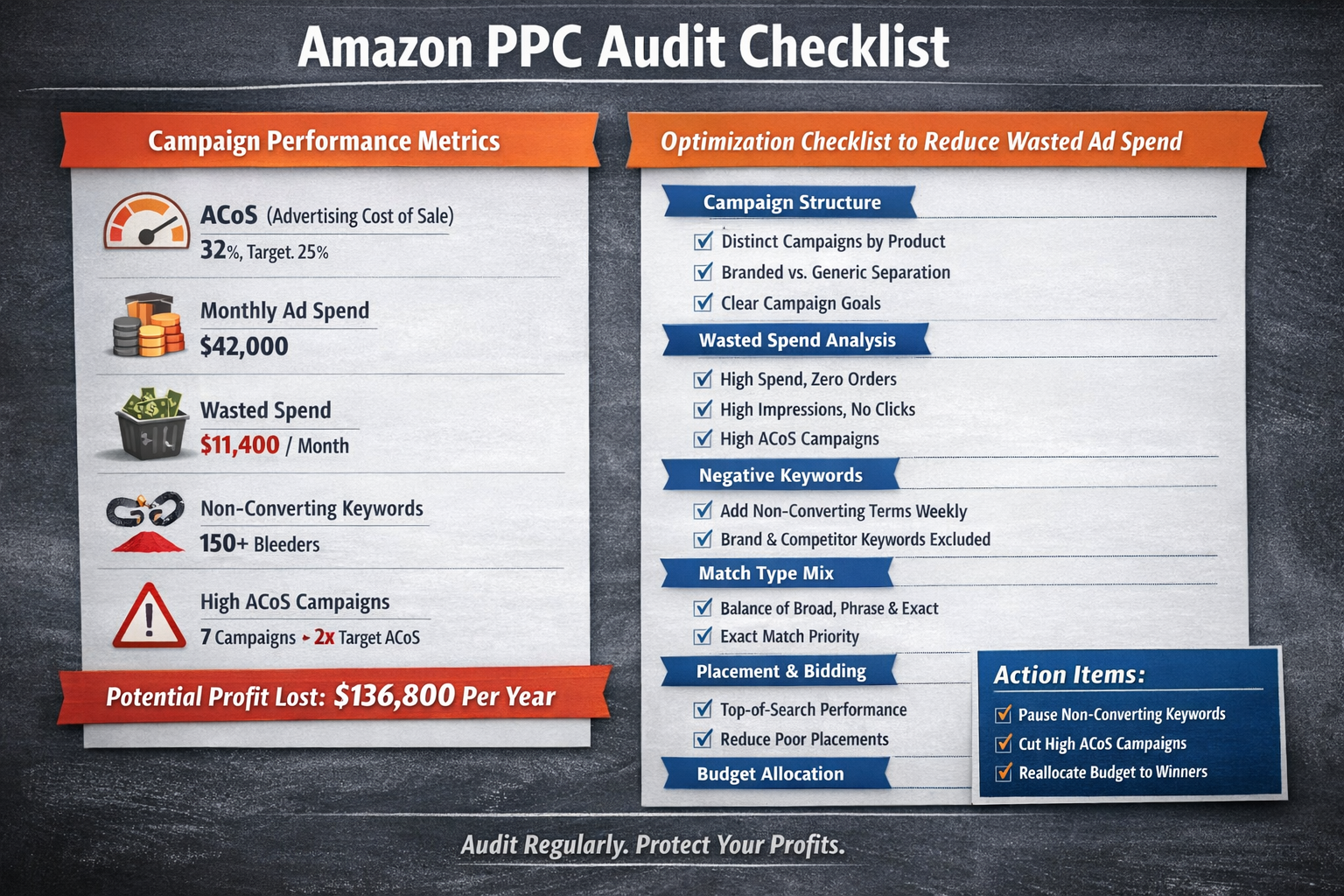
But when the aggregator's analyst opened Seller Central, what they found was chaos. Forty-seven campaigns with no naming logic. Search term reports full of bleeding keywords nobody had touched in months. TACoS swinging 15 points from one month to the next.
The buyer didn't walk—but they repriced the deal. Hard.
That seller left six figures on the table because of problems that would have taken 90 days to fix.
Here's what most Amazon sellers don't realize until the letter of intent is already signed: your PPC account isn't just an advertising tool. It's a financial asset. And sophisticated buyers—the ones writing seven-figure checks—will dissect every campaign, every trend line, every undocumented process before they commit.
I've spent years helping sellers prepare for exactly this moment. What follows is the playbook I wish someone had given me earlier in my career.
Why Aggregators Care So Much About Your Ad Account
Buyers aren't acquiring your products. They're acquiring a profit engine.
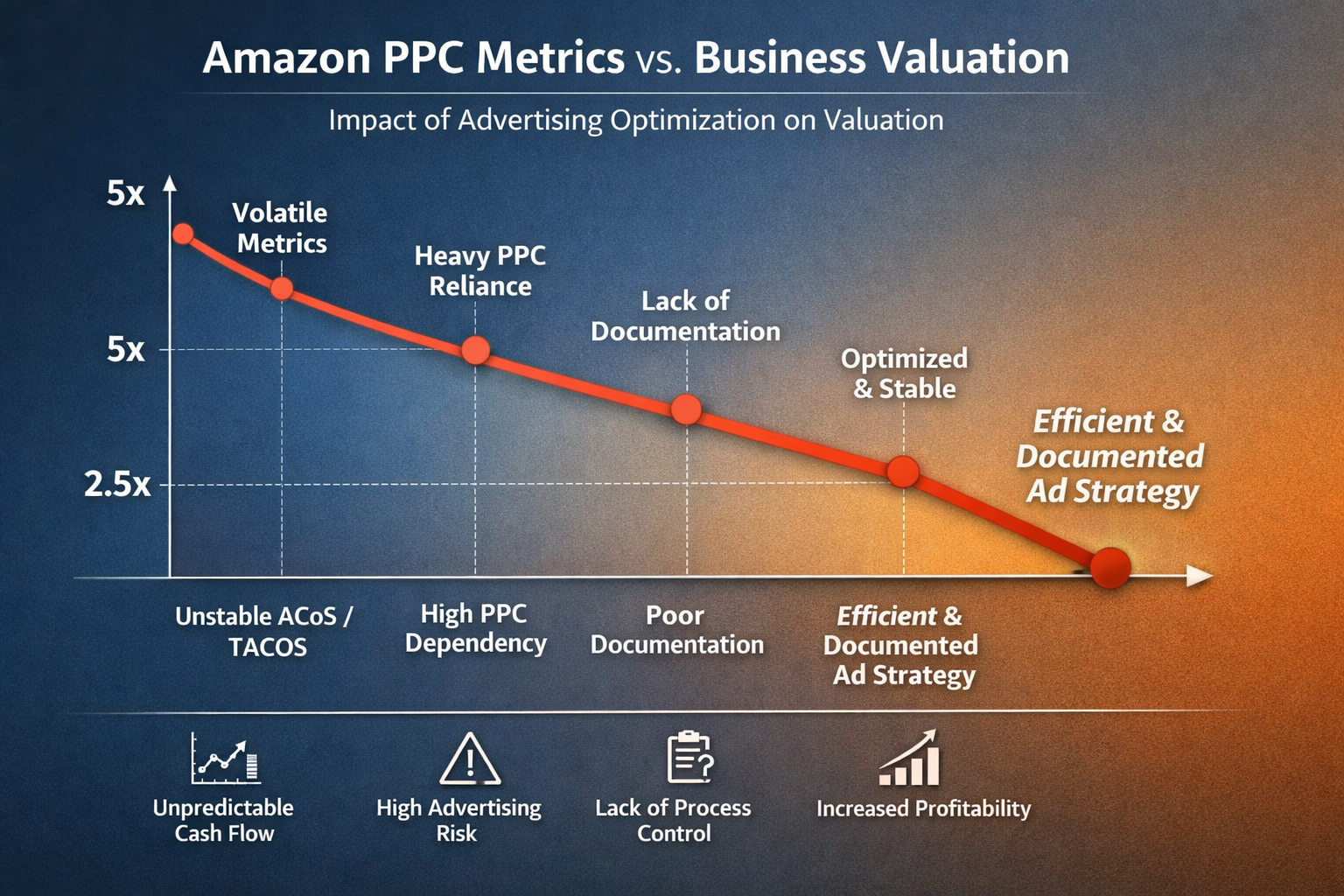
When an aggregator evaluates your business, they're doing one thing above all else: assessing risk. Every inefficiency in your ad account represents a problem they'll inherit. And they will discount your valuation for each one they find.
Consider their perspective for a moment:
Unstable metrics mean unpredictable cash flow. If your ACoS swings wildly month to month, they can't forecast. That uncertainty gets priced into your deal.
Missing documentation means they can't replicate your success. If everything lives in your head, they're buying a black box. That's terrifying for someone writing a large check.
High advertising dependency means organic weakness. If 60% of your sales vanish when you pause campaigns, they're inheriting an expensive life-support system with no end in sight.
Obvious waste means money they'll lose while cleaning up your mess—plus a risk premium for the waste they haven't found yet.
I worked with a seller who was confident their $3M revenue business would command a 4x multiple. But due diligence revealed nearly 40% wasted ad spend across dormant campaigns and zero optimization processes. They closed at 2.8x.
That's not a rounding error. That's real money—money that was fixable with proper preparation.
What Buyers Actually Scrutinize During Due Diligence
Let me walk you through exactly what happens when an aggregator's analyst opens your advertising console.
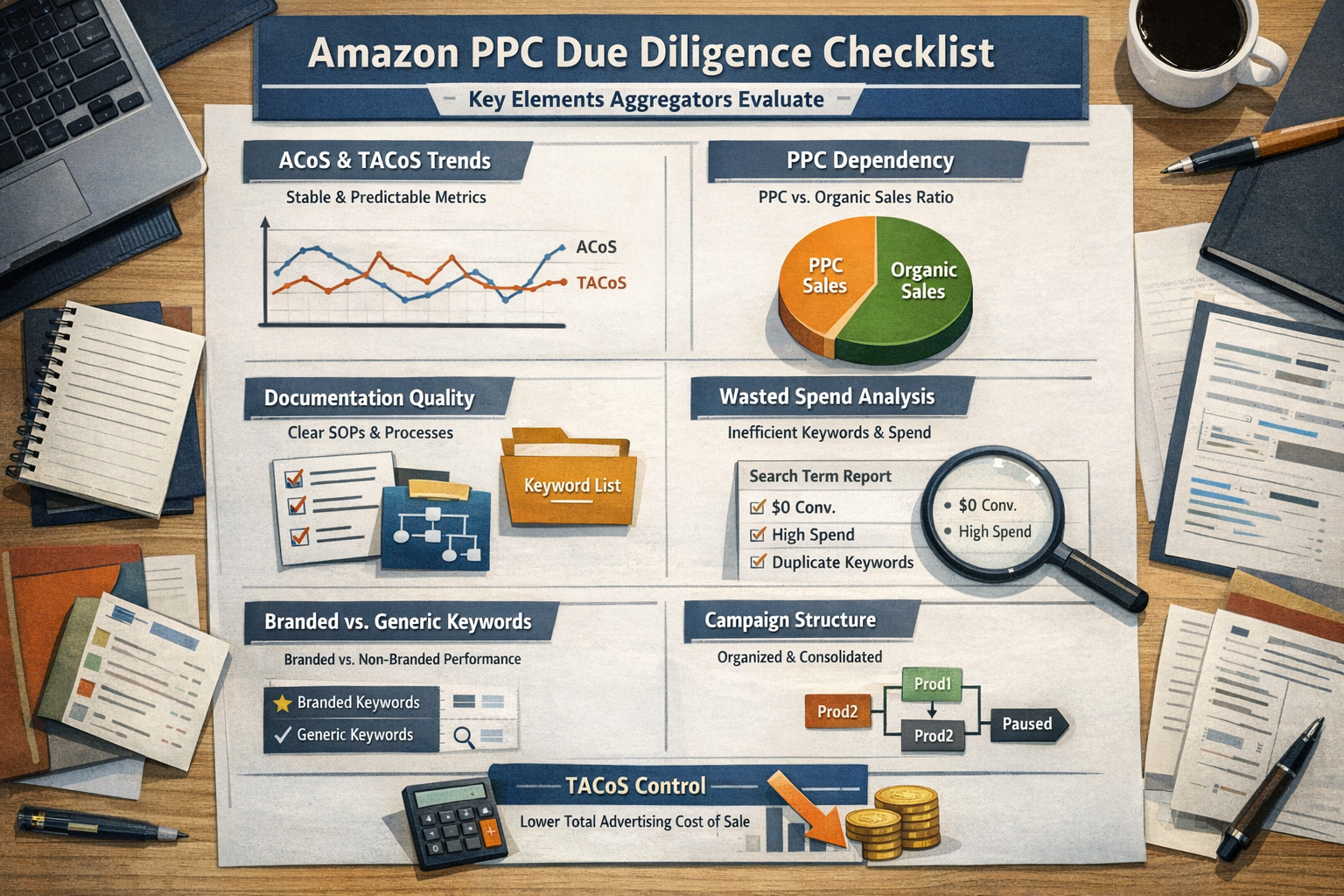
ACoS and TACoS Trend Analysis
They're not looking for the lowest numbers. They're looking for predictability.
A 35% ACoS that holds steady for six months tells a cleaner story than a 25% ACoS that bounces between 18% and 45%. Wild swings signal an account that requires constant intervention—or worse, relies on aggressive promotional tactics that aren't sustainable.
According to industry benchmarks, aggregators typically want to see three to six months of stable or improving advertising efficiency before they'll commit to top-dollar valuations [1].
What they're actually calculating: Can they plug your numbers into a 12-month forecast without hedging for volatility?
PPC Dependency Ratio
This metric reveals how much of your business survives without advertising.
The calculation is simple: what percentage of total sales comes from PPC versus organic traffic?
Industry guidance suggests that keeping PPC dependency below 30% is generally favorable during acquisition discussions—though this varies significantly by category and competitive dynamics [2]. The underlying principle matters more than the specific number: buyers want evidence that you've built organic rank, not just rented visibility.
If most of your sales disappear when you turn off ads, that's a red flag that you haven't built lasting market position. The buyer will be stuck funding expensive campaigns indefinitely just to maintain revenue.
Strong organic rank is a moat. It signals your products have staying power.
Documentation Quality
Here's the uncomfortable question buyers are asking: Can we run this account without you?
Aggregators manage portfolios of brands. They cannot afford to reverse-engineer your campaign logic from scratch. They need to see:
Clear campaign naming conventions that explain themselves
Documented keyword lists with match type rationale
Negative keyword processes and harvesting routines
Weekly and monthly optimization schedules
If this documentation doesn't exist, they're pricing in the cost and risk of building it themselves—or the performance crater that happens during the learning curve.
Wasted Spend Analysis
Sophisticated buyers will pull your search term reports and run their own efficiency audit.
They're hunting for:
Search terms with significant spend and zero conversions
Auto campaigns bleeding money on irrelevant traffic
Duplicate keywords across campaigns competing against each other
Products with underwater unit economics still receiving ad dollars
Every dollar of obvious waste they identify becomes a dollar they'll discount from your valuation—plus a risk premium for inefficiencies they suspect exist but couldn't find in limited due diligence time.
Branded vs. Generic Keyword Performance
Branded keywords—your brand name, product names, variations—signal something valuable: you've built recognition. Customers search for you specifically.
Generic keywords are inherently more volatile. Rankings shift. Costs fluctuate with competitive pressure.
A healthy branded keyword contribution tells buyers this brand has equity beyond paid traffic. That's defensible value they're willing to pay for.
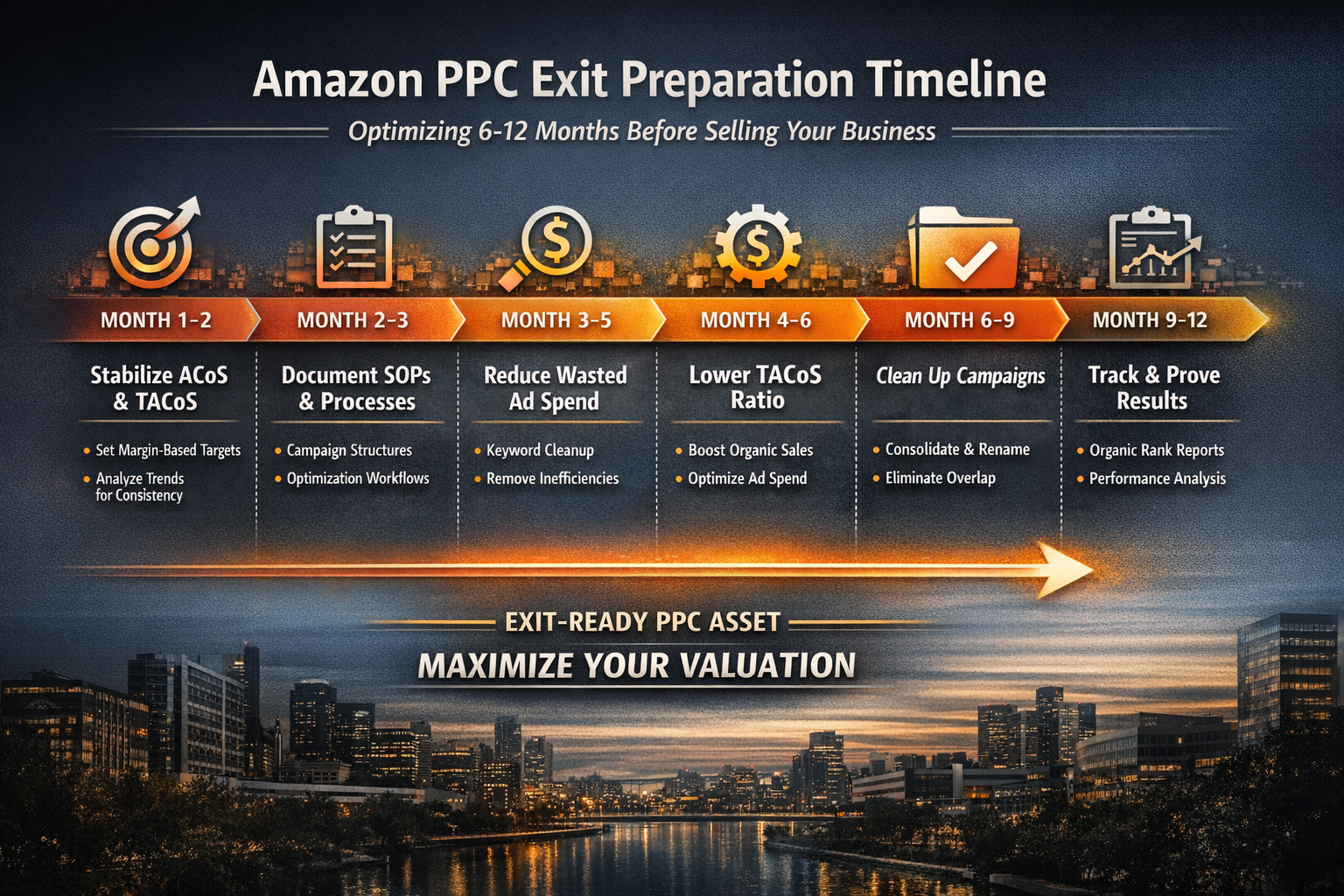
The Pre-Exit PPC Checklist: 6-12 Months Before You List
If you're planning an exit, this is your priority list. Each item directly impacts how buyers perceive your business.
1. Build ACoS Stability (Not Just Low Numbers)
Stop optimizing for the lowest possible ACoS. Start building a consistent, believable trend.
This means:
Set margin-based targets. Your ACoS ceiling should reflect your actual contribution margin—not an arbitrary percentage you read in a blog post.
Avoid aggressive bid swings. Those dramatic adjustments that "fix" performance for a week create the exact volatility buyers hate.
Maintain steady budget levels. The scaling-and-cutting cycles that feel like smart optimization look like instability in a due diligence spreadsheet.
Document your decision logic. When you make changes, note why. Buyers want to see systematic thinking, not reactive scrambling.
The Profit Feedback Loop framework helps here: launch with intent, prune wasted spend quickly, analyze the relationship between TACoS and conversion rate, then iterate. This creates the stable, improving trajectory that commands premium valuations.
2. Document Everything (Yes, Everything)
Create SOPs for every recurring PPC task. I'm talking about the kind of documentation where someone could step into your account tomorrow and know exactly what to do.
Campaign structure documentation:
Why campaigns are organized the way they are
Naming conventions explained with examples
Which campaigns serve ranking vs. profit vs. data collection purposes
Keyword management processes:
Master keyword lists organized by product or product line
Negative keyword identification and implementation routine
Search term harvesting cadence and criteria
Optimization schedules:
Weekly tasks: bid adjustments, budget allocation, search term review
Monthly tasks: campaign performance analysis, structure cleanup
Quarterly tasks: strategy assessment, competitive landscape review
The SOPs hub has templates for processes like cutting underperforming keywords and reducing high ACoS—exactly the kind of documentation that signals operational maturity to buyers.
3. Lower TACoS Without Sacrificing Growth
TACoS (Total Advertising Cost of Sale) matters more than ACoS for exit planning because it accounts for your entire revenue picture—including organic sales that advertising helped build [3].
Here's the framework:
Calculate your TACoS ceiling. If your contribution margin is 25%, your TACoS cannot sustainably exceed 25% without eroding profitability. Know this number cold.
Map organic rank by ASIN. Which products rank on page one organically for important keywords? Those can sustain reduced ad spend. Which products depend entirely on advertising for visibility? Those need ranking-focused campaigns before you sell.
Shift spend strategically. Reduce investment on products with strong organic position. Reallocate toward ranking campaigns for products that need organic momentum before the transaction closes.
The goal: demonstrate that total revenue grows while TACoS stays flat or improves. That's the efficiency story buyers want to see.
4. Clean Up Your Campaign Structure
A messy account structure signals amateur operation during due diligence. Fix these common problems:
Consolidate redundant campaigns. I've audited accounts with dozens of campaigns doing essentially the same thing. Combine them. Simplify.
Implement clear naming conventions. Use a consistent format like: [SKU]_[Campaign Type]_[Targeting]_[Match Type]
Example: PROD001_Ranking_Keyword_Exact
Eliminate self-competition. Multiple campaigns targeting identical keywords bid against each other in the auction. You're inflating your own costs and confusing your data.
Archive rather than delete. Pause historical campaigns instead of removing them. Buyers may want to see what you've tested—paused campaigns demonstrate strategic experimentation.
5. Prove That Advertising Built Something Lasting
This is the ultimate evidence that your PPC investment created durable value.
Document and be prepared to show:
Organic ranking positions for your most important keywords. Use third-party rank tracking tools and keep historical data.
The relationship between ad spend and organic improvement. Can you show that sustained advertising on a keyword correlated with improved organic rank over time?
What happens when you reduce spend. Ideally, you've already tested this: reduced PPC investment on well-ranked products, observed that sales held relatively steady. That's the data point buyers most want to see.
Beyond Sponsored Products: The Full Advertising Picture
Most exit preparation advice focuses exclusively on Sponsored Products campaigns. But sophisticated buyers evaluate your entire advertising ecosystem.
Sponsored Brands and Sponsored Display
If you're running Sponsored Brands (headline search ads) or Sponsored Display campaigns, these need the same documentation and optimization attention.
Sponsored Brands campaigns often drive branded search growth—which contributes to that valuable branded keyword moat. Document the strategy and performance trends.
Sponsored Display campaigns, particularly retargeting, can demonstrate customer lifecycle thinking. But undocumented or poorly performing display campaigns look like waste.
Amazon DSP Considerations
If you've invested in Amazon DSP (demand-side platform) advertising, this requires special attention during exit preparation. DSP campaigns operate differently than self-service advertising and require specific expertise to evaluate.
Some buyers view active DSP programs as sophisticated marketing capability. Others see them as complexity they'll need to manage. Either way, document the strategy, performance, and whether campaigns can be paused without significant impact.
Ad Type Diversity as a Signal
A portfolio that only runs auto campaigns looks less sophisticated than one strategically deploying multiple ad types for different objectives. Buyers notice this.
Seasonality and Data Presentation
Here's something sellers often overlook: how you present your data matters as much as the data itself.
Normalizing for Seasonal Patterns
If your products have seasonal demand cycles, your PPC metrics will reflect those patterns. A TACoS spike in your slow season looks different than the same spike during peak demand.
Prepare year-over-year comparisons that show performance in context. "TACoS increased 5 points in Q1, consistent with prior year seasonal pattern" tells a different story than unexplained volatility.
Identify and explain anomalies. A rough month during a competitor's aggressive launch is different from systemic problems. Document the context.
The Data Package Buyers Expect
Compile a clean presentation that includes:
Monthly ACoS and TACoS trends for at least 12 months
PPC dependency ratio over time
Organic rank tracking for top keywords
Campaign-level performance summary
Known issues and remediation plans
The seller who hands over a polished data package signals operational excellence. The seller who makes buyers dig for basic metrics signals the opposite.
The Transition Period: Setting Up Your Buyer for Success
Most acquisition deals include a transition period—typically 30 to 90 days—where you stay on to train the buyer. This is where inadequate PPC preparation becomes painfully obvious.
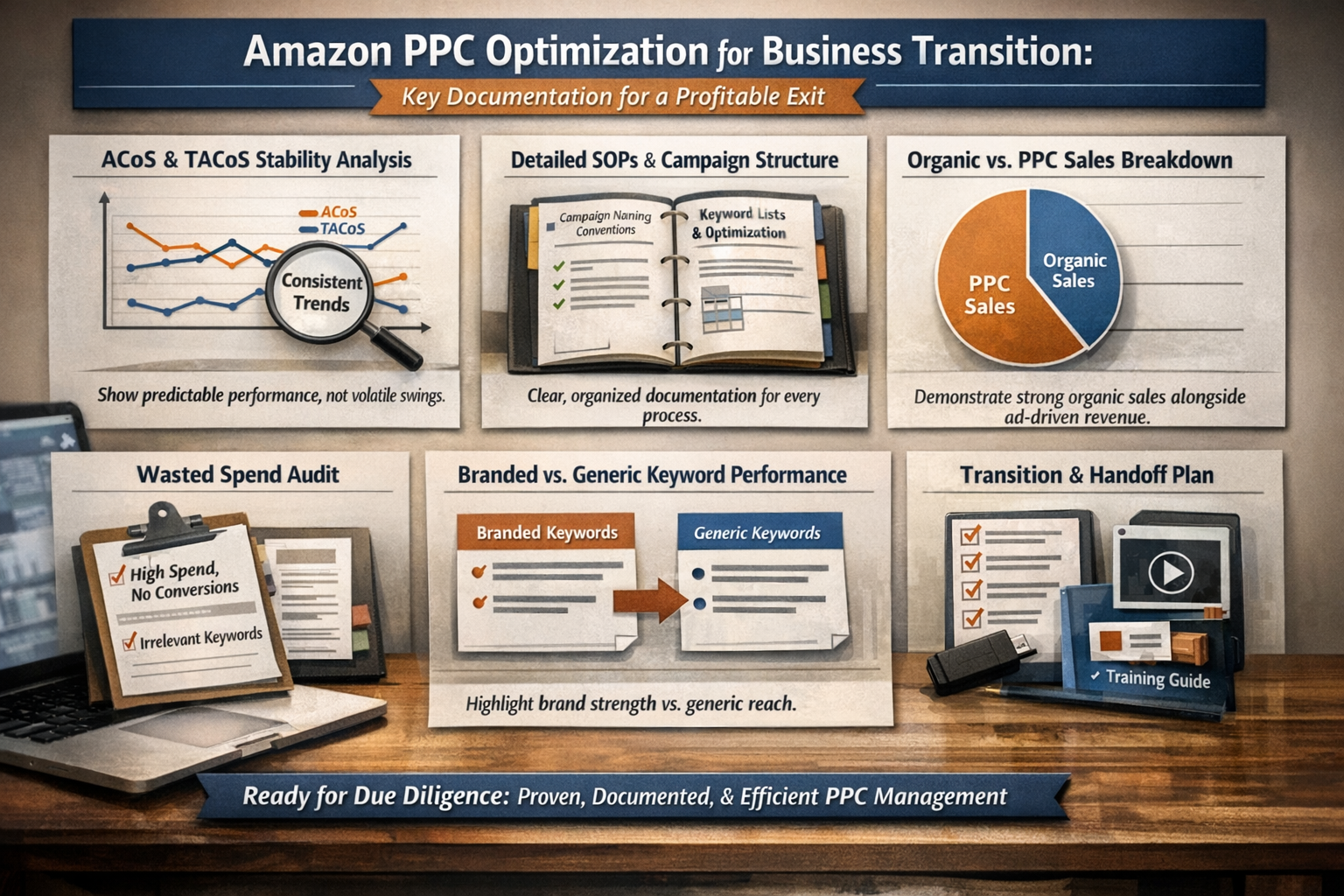
Build a Comprehensive Handoff Package
Before closing, prepare:
Access documentation:
All login credentials and permission levels
Third-party tool access (rank trackers, bid management software, etc.)
Agency contacts if you've outsourced any advertising functions
Campaign walkthrough:
Video recording explaining your campaign structure
Strategic rationale for major decisions
Known issues and how you handle them
Operational playbook:
Weekly task checklist with decision frameworks
Which reports to pull and what to look for
Escalation criteria (when does something require intervention?)
Prepare Them for the Organic Resilience Test
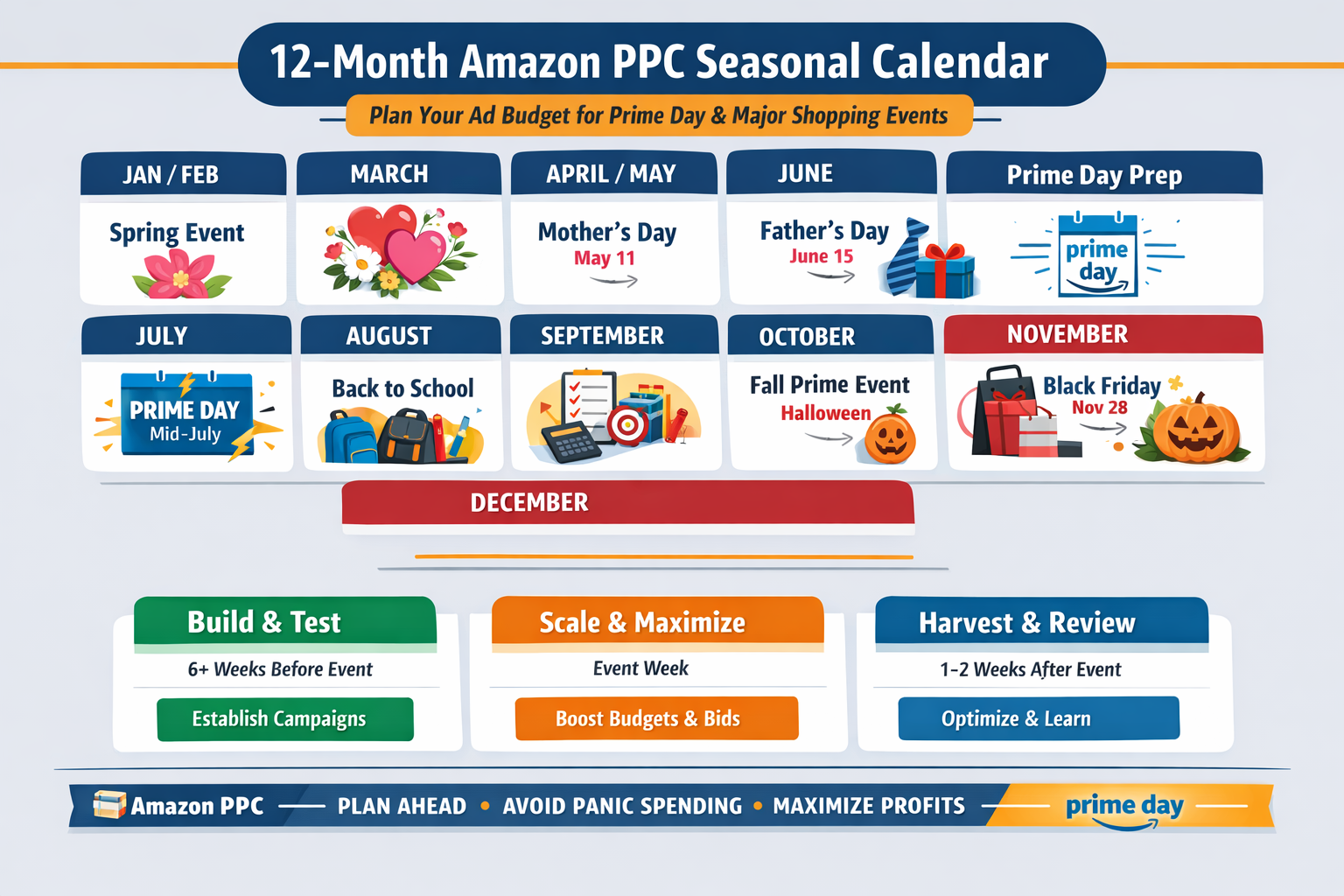
Here's something nobody tells sellers preparing for exit: most buyers will reduce PPC spend significantly in the first few weeks after acquisition.
They're testing what happens. They want to know what percentage of sales survive without advertising support.
If you've done the pre-exit work correctly, organic sales hold reasonably steady. TACoS may actually improve temporarily. The buyer is reassured.
If you haven't? Sales crater. The buyer panics. And if your deal includes performance-based earn-outs, your payout is at risk.
Warn them this test is coming. Show them the data that predicts performance: your organic ranking positions, historical PPC dependency ratios, and ideally, what you've already observed when you reduced spend on ranked products.
The "Set and Forget" Standard
Aggregators manage portfolios of brands. They cannot babysit your account daily. They don't want to.
Your goal is to deliver a PPC operation that:
Runs predictably with weekly maintenance, not daily intervention
Has documented processes that anyone can follow
Produces stable results without constant adjustment
Won't hemorrhage money if attention lapses for a few days
If your account currently requires daily bid changes to stay profitable, that's a problem to solve before you list.
Earn-Outs and Why PPC Performance Matters Post-Close
Many acquisition deals include earn-out provisions—additional payments tied to post-acquisition performance.
This is where your pre-exit PPC work pays dividends beyond the initial purchase price.
If advertising efficiency craters after the transition, buyers may argue that performance-based payments shouldn't be made. Even if contractual terms protect you, the relationship becomes adversarial.
If the PPC machine runs smoothly, earn-out targets become achievable. Everyone wins.
The documentation and stability you build before the sale directly protects your financial interest after the sale.
The Uncomfortable Truth About Exit-Ready PPC
I'll be direct about something: most sellers wait too long to think about this.
They focus on revenue growth, product expansion, maybe improving their listing content. PPC preparation for exit gets pushed to "later"—until suddenly a buyer shows interest and there's no time to fix the problems that have accumulated.
The sellers who command premium valuations don't just have impressive revenue. They have transferable systems that buyers trust to perform without the original owner's constant involvement.
That trust is built through:
Clean documentation that removes knowledge risk
Stable metrics that enable confident forecasting
Low advertising dependency that signals a defensible brand
Obvious operational excellence that reduces buyer anxiety
Every hour invested in PPC optimization during the 6-12 months before your exit pays dividends at the closing table.
Planning an exit in the next 12-24 months? Book a call with our team. We'll identify the gaps that could affect your valuation and build the documentation and stability buyers need to see.
Frequently Asked Questions
How far in advance should I start preparing my PPC for an exit?
Begin serious preparation 6-12 months before you plan to list. You need time to stabilize ACoS trends, build comprehensive documentation, and demonstrate at least 3-6 months of consistent performance. Rushing this work in the final 60 days rarely produces the clean trajectory sophisticated buyers want to see during due diligence.
What PPC dependency ratio makes buyers nervous?
While targets vary by category and buyer, PPC dependency exceeding 50% typically raises concerns—it suggests weak organic rank and forces buyers to maintain expensive advertising indefinitely. Generally, lower dependency signals stronger market position, though the specific threshold depends on your competitive landscape and product category norms.
Do aggregators actually dig into search term reports during due diligence?
Yes. Experienced acquirers conduct thorough PPC audits, often using specialized analysts or agencies. They'll pull search term reports, identify wasted spend patterns, evaluate campaign structure logic, and assess documentation quality. Assume everything in your advertising account will be examined carefully—because it will be.
Can poor PPC preparation really cost six figures in valuation?
Absolutely. Messy PPC creates multiple valuation impacts: direct discounts for identified inefficiencies, risk premiums for undocumented processes, and lower multiples due to metric instability. The compound effect of these adjustments on businesses with significant revenue can easily reach six figures—for problems that were entirely fixable with adequate preparation time.
What typically happens to PPC during the transition period after a sale?
Most buyers immediately test organic resilience by reducing advertising spend significantly—sometimes 30-50%. They want to observe what percentage of sales hold without advertising support. Prepare for this by documenting your organic ranking positions and any historical data showing performance when ad spend decreased. A smooth transition with clear handoff materials protects both the deal structure and any performance-based earn-out provisions.
About PPC Maestro
PPC Maestro is a profit-first Amazon PPC agency founded by Bernard Nader, focused on helping 7-figure private-label sellers maximize profitability and prepare for successful exits. Our team has developed the Profit Feedback Loop framework used by sellers preparing for acquisition, with documented SOPs and systematic approaches that have helped clients significantly reduce wasted spend while building the stable, transferable PPC systems aggregators actively seek. View our client results or book a call to discuss your exit timeline.
Works Cited
[1] Empire Flippers — "How Amazon FBA Businesses Are Valued." https://empireflippers.com/amazon-fba-valuation/
[2] Jungle Scout — "The State of the Amazon Aggregator." https://www.junglescout.com/blog/amazon-aggregators/
[3] Amazon Advertising — "Measure advertising effectiveness with new-to-brand metrics." https://advertising.amazon.com/library/guides/new-to-brand-metrics
[4] Marketplace Pulse — "Amazon Aggregator Tracker." https://www.marketplacepulse.com/aggregators