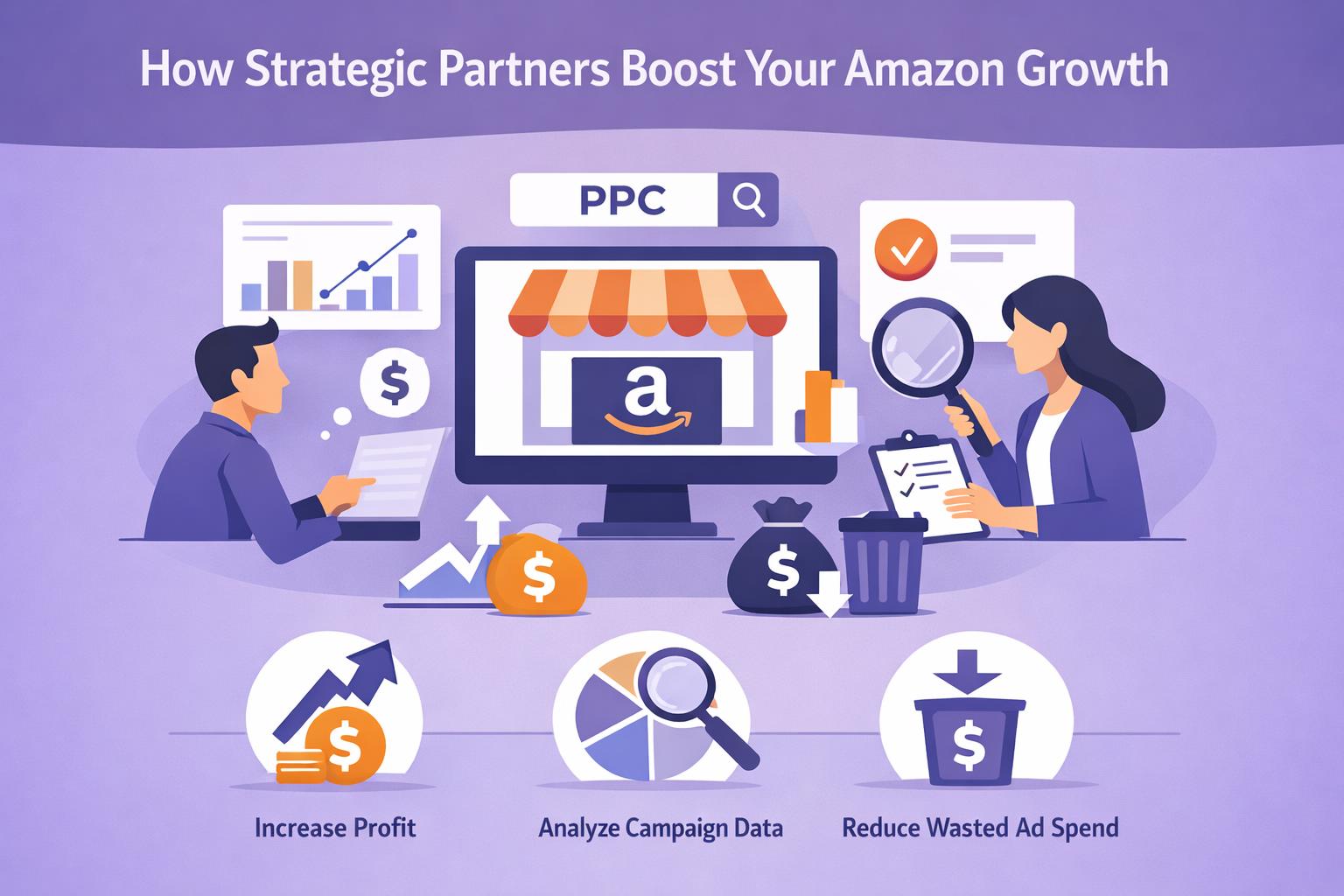
I pulled the numbers on a supplement brand last quarter. $312,000 in annual ad spend. Their previous agency had them running 847 campaigns across 12 SKUs.
Eight hundred forty-seven campaigns.
Know how many were actually driving profitable sales? Forty-three.
That's not campaign management. That's chaos with a dashboard.
Here's the thing most 7-figure sellers learn the hard way: there's a massive difference between an agency that manages your Amazon PPC and one that actually strategizes it. One keeps the lights on. The other builds the house.
If your TACoS keeps climbing while your agency sends you "optimization reports" full of vanity metrics, you don't have a strategy problem. You have a partner problem.
Let's break down what an Amazon PPC strategy agency actually does—and why it matters for sellers serious about profit, not just sales.
Ready to see where your strategy gaps are? Book a free audit call and we'll show you exactly what's leaking.
What an Amazon PPC Strategy Agency Actually Specializes In
A true strategy agency doesn't just touch your campaigns. They touch your entire Amazon business model.
Here's the difference in scope:
| Tactical Agency | Strategy Agency |
| Adjusts bids weekly | Sets TACoS targets by product margin |
| Launches campaigns when asked | Builds campaign architecture aligned to business goals |
| Sends ACoS reports | Tracks profit per click and contribution margin |
| Reacts to performance drops | Anticipates seasonal shifts and inventory constraints |
| Optimizes keywords | Builds full-funnel keyword isolation systems |
Strategy agencies obsess over why before what. They ask questions like:
What's your exit timeline?
Which SKUs actually deserve ad spend based on margin?
How does your inventory velocity affect what we can bid?
This is the foundation of the Profit Feedback Loop—launching with intent, pruning waste fast, and iterating based on real profit data. Not ACoS. Profit.
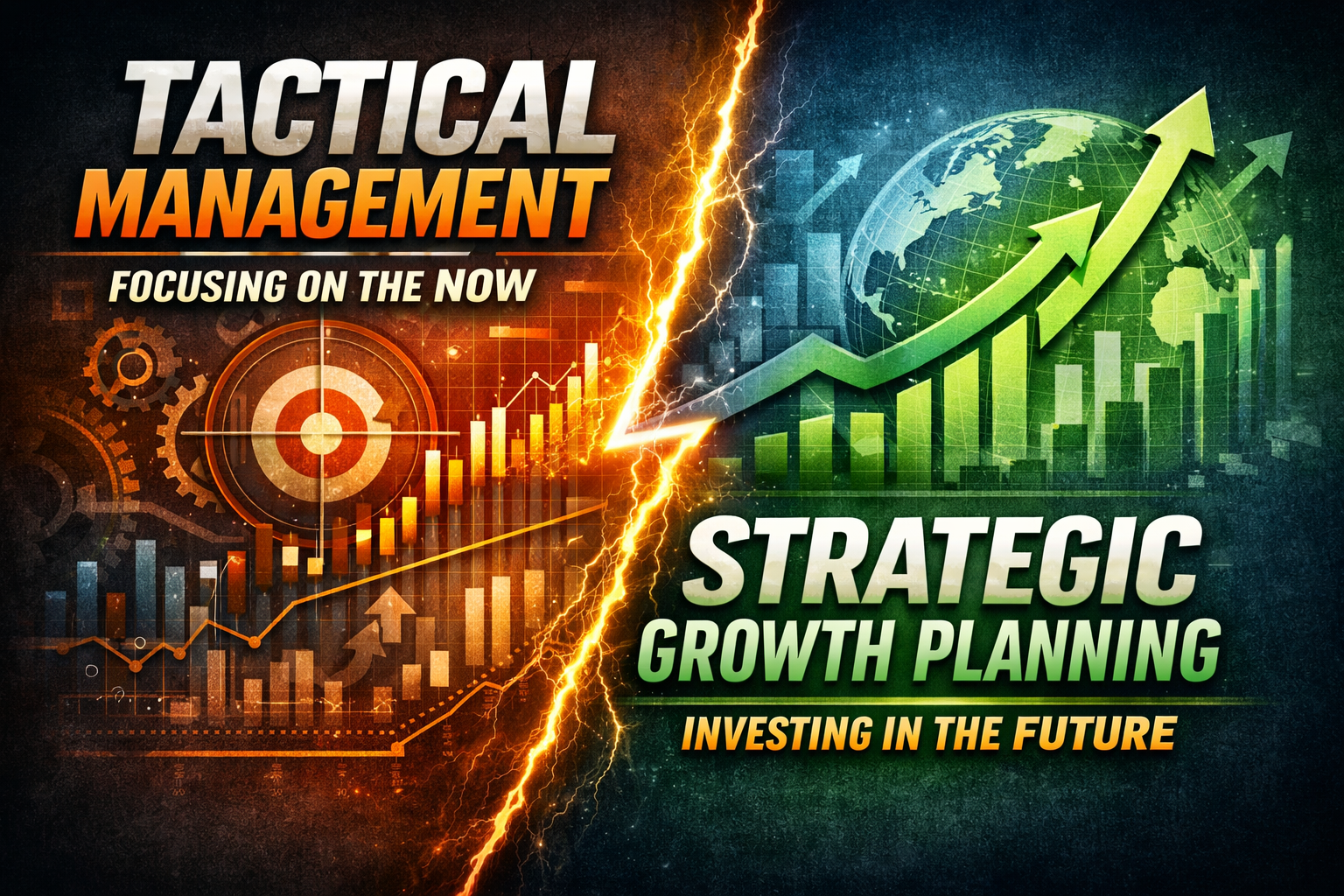
Tactical Management vs. Strategic Growth Planning
Most agencies sell you "PPC management." What you actually get is someone logging into your account, adjusting bids, maybe adding some negatives, and calling it a day.
That's tactical work. Necessary. But not sufficient.
Strategic growth planning looks completely different:
Tactical Work (The Floor)
Daily bid adjustments
Search term harvesting
Negative keyword additions
Budget pacing
Placement modifications
Strategic Work (The Ceiling)
Defining TACoS targets by product margin tier
Building campaign structures that separate ranking, profit, and data-collection goals
Aligning ad spend with inventory forecasting
Creating systematic SOPs for cutting bleeders before they drain budget
Planning promotional periods around contribution margin, not just sales velocity
Here's a real example.
I worked with a home goods brand doing $4.2M annually. Their agency had been "managing" campaigns for 18 months. ACoS looked fine—22% blended. Everyone seemed happy.
Until we dug in.
Their highest-margin products (45%+ gross margin) were getting 8% of total ad spend. Their lowest-margin products (18% gross margin) were getting 61% of spend.
They were literally advertising themselves into lower profitability. Every "good ACoS" report was a lie by omission.
Strategic work fixes that. Tactical work never even sees it.
Agency Pricing Models: What Incentivizes Growth?
Before you sign with any agency, understand how they get paid. Pricing structure shapes behavior—and not every model aligns with your profit goals.
Flat Fee Retainer
The agency charges a fixed monthly rate regardless of your ad spend.
Pros: Predictable costs. No incentive to inflate your budget.
Cons: If the fee is too low, you may get junior-level attention. Some agencies stack too many clients per manager.
Percentage of Ad Spend
The agency takes a cut (commonly 10–20%) of your total monthly ad spend.
Pros: Simple to calculate. Scales with your business.
Cons: Creates a perverse incentive. The more you spend, the more they earn—even if that spend is wasteful. This model can quietly encourage budget bloat instead of profit optimization.
Performance-Based or Hybrid
The agency ties some compensation to hitting agreed-upon targets (profit, TACoS, revenue thresholds).
Pros: Alignment. They win when you win.
Cons: Harder to structure. Requires trust and clear baseline metrics.
The bottom line: Ask how your agency makes money. If their incentive is to grow your ad spend, not your profit, expect spend to grow—and margins to shrink.
A strategy-first agency will be transparent about pricing and explain exactly why their model aligns with your outcomes.
The Benefits of a Cohesive Long-Term Plan
Spray-and-pray PPC is expensive. Not just in wasted spend—in opportunity cost.
When you have a strategic partner building cohesive plans, you get:
1. Business Alignment
Your PPC doesn't exist in a vacuum. A strategy agency connects ad spend to inventory turns, cash flow, and exit multiples. They know that ranking a low-margin SKU might look good on a sales report but destroy your unit economics.
2. Predictable Scaling
Random campaign launches create random results. Systematic campaign architecture—separating exact match winners from broad match discovery—lets you scale what works and kill what doesn't. Fast.
3. Profit Protection
The Profit Feedback Loop exists because most sellers optimize for the wrong metric. ACoS tells you nothing about whether you're making money. TACoS by margin tier does. See how the system works.
4. Compounding Improvements
Strategy builds on itself. When you have SOPs for reducing high ACoS campaigns and systematic negative mining, every optimization compounds. Month over month. Quarter over quarter.
5. Exit-Ready Accounts
Acquirers don't want to buy chaos. They want clean campaign structures, documented processes, and predictable profit margins. Strategic PPC management builds enterprise value, not just revenue.

Case Example: How Strategy-Led Campaigns Drive Real Results
Let me tell you about Dan.
Dan runs a supplements brand. When he came to us, his ad spend was $47,000/month. His TACoS was climbing. His previous agency kept telling him to "be patient" while his profit margins eroded.
We didn't touch a single bid for the first two weeks.
Instead, we mapped every SKU to its true contribution margin. We identified which products deserved aggressive ranking spend, which needed profit-protection campaigns, and which shouldn't be advertised at all.
Then we restructured everything.
The strategic changes:
Killed campaigns on three SKUs with sub-15% margins
Reallocated that spend to two hero products with 52% margins
Built search term isolation to separate converting terms from testing terms
Set TACoS targets by margin tier, not blended averages
Implemented weekly SOP-driven negative mining
The results over 90 days:
Ad spend decreased 23%
Total revenue held steady
Net profit increased significantly
TACoS dropped from 14.2% to 9.8%
Dan didn't need more campaigns. He needed the right campaigns, structured around a strategy that aligned with his actual business goals.
How to Identify a Strategy-First Agency
Not every agency that claims strategy actually delivers it. Here are the red flags:
They focus on ACoS, not TACoS or profit per click.ACoS in isolation is meaningless. If your agency doesn't talk about total advertising cost of sale relative to margin, they're not thinking strategically.
They can't explain their campaign structure logic."We run auto campaigns and manual campaigns" isn't a strategy. Ask them why a specific SKU has a specific campaign type with a specific bid strategy. If they can't answer clearly, run.
They don't ask about your business beyond advertising.Inventory levels. Margin tiers. Exit timeline. Promotional calendar. A strategy agency needs this information. If they never asked, they're managing in a vacuum.
They send reports but not insights.Weekly reports with numbers are worthless without "here's what this means and here's what we're doing about it."
They won't clarify data ownership.A major agency trap: they hold your campaign data, bulk files, or account access hostage. A strategic partner ensures you own your account, your data, and your historical performance records—no matter what happens to the relationship.
They dodge questions about pricing structure.If they can't explain how their fee model aligns with your profit goals, assume it doesn't.
The right partner will sound like an operator, not a vendor. They'll push back on bad ideas. They'll connect ad spend to outcomes that matter.

What to Expect From a Strategic Partnership
Working with a true Amazon PPC strategy agency should feel different from day one.
Expect an audit before action. Any agency that starts launching campaigns before understanding your margins is doing it wrong. The first step is always diagnosing where money is leaking.
Expect hard conversations. If every SKU deserved ad spend, you wouldn't need an agency. Strategic partners tell you which products to stop advertising.
Expect systems, not heroes. The best agencies don't rely on one "genius" making gut calls. They run SOPs. Documented, repeatable processes that work whether or not any individual is having a good day.
Expect profit-first thinking. Every recommendation should tie back to "will this increase net profit?" Not impressions. Not clicks. Not even sales. Profit.
Expect transparency on contracts. Watch for long lock-in periods with no performance guarantees, or vague termination clauses. A confident agency doesn't need to trap you—they retain clients by delivering results.
Call to Action
If your current PPC setup feels more like whack-a-mole than a growth engine, it's time for a different approach.
We've helped 7-figure Amazon sellers cut wasted spend by 30% or more—and reinvest that money into campaigns that actually build profit and exit value.
Book a free strategy call and we'll show you exactly where your ad dollars are leaking—and what a real strategy looks like.
Frequently Asked Questions
What's the difference between an Amazon PPC agency and an Amazon PPC strategy agency?
A standard PPC agency manages campaigns—adjusting bids, adding keywords, sending reports. A strategy agency builds the entire system: campaign architecture aligned to business goals, TACoS targets by margin tier, and SOPs that compound improvements over time. Strategy work connects ad spend to profit, not just performance metrics.
How do I know if my current agency is strategic or just tactical?
Ask them why specific SKUs have specific campaign structures. Ask how they set bid targets. If they can't connect their decisions to your margin tiers and business goals, they're managing reactively. Strategic agencies proactively build systems that align with your exit timeline and profit targets.
Why does TACoS matter more than ACoS for Amazon sellers?
ACoS only measures advertising efficiency within campaigns. TACoS—total advertising cost of sale—shows how much of your total revenue goes to advertising. A "good" ACoS can hide declining organic rank and increasing ad dependency. TACoS reveals the full picture of advertising health and business sustainability.
How quickly can a strategy-focused agency improve profitability?
Most sellers see measurable improvements within 30–60 days when waste is identified and reallocated. The Profit Feedback Loop is designed to cut bleeding spend fast, then reinvest strategically. Long-term compounding takes 90+ days, but the initial profit gains often happen quickly.
What should I prepare before talking to a PPC strategy agency?
Know your product margins by SKU, your current TACoS, your exit timeline (if any), and your biggest frustrations with current performance. The more context you provide, the faster a strategic partner can diagnose problems and build solutions that actually fit your business.
Why Trust PPC Maestro
PPC Maestro was built by Bernard Nader specifically for 7-figure Amazon sellers who are tired of agencies optimizing vanity metrics while profit erodes. With the Profit Feedback Loop framework, documented SOPs, and a track record of measurable results, our approach is systems-driven and profit-first. We don't just manage campaigns—we build strategic infrastructure that compounds over time and increases exit value.