
A seller I worked with last quarter watched $31,000 in monthly revenue vanish. Not from a listing suppression. Not from a competitor undercutting price. From his own brand search results—where three competitors had parked their ads directly above his products.
He was paying for brand awareness. They were collecting the sales.
This happens constantly. And if you're a 7-figure seller without brand defense campaigns running right now, competitors are siphoning your customers while you read this.
Here's the uncomfortable truth: Amazon doesn't care who converts on your brand name. They get paid either way. The only person protecting your branded traffic is you.
Let me show you exactly how to set up brand defense campaigns that block competitors, protect your margins, and deliver the lowest ACoS in your entire account.
Why Brand Defense Is Non-Negotiable for Established Sellers
Most sellers think brand awareness solves everything. Build recognition, earn loyalty, watch organic sales roll in.
That logic worked five years ago.
Today, Amazon's ad placements have multiplied. Sponsored Products appear above organic results. Sponsored Brands dominate the top of search. Product display ads cover your detail pages like wallpaper.
Every single one of those placements is available to your competitors—on YOUR brand name searches.
According to Amazon's own advertising data, shoppers who search for a specific brand convert at significantly higher rates than generic keyword searchers [1]. Your branded traffic represents your highest-intent, most profitable customers.
And competitors know it.
They're running campaigns right now targeting your brand name, your product names, and your ASINs. They're not trying to win new customers. They're trying to intercept yours.
The math is brutal. You spent months (or years) building brand recognition through reviews, social proof, and external marketing. A competitor spends $0.50 per click to redirect that customer at the moment of purchase.
Without brand defense, you're funding their customer acquisition.
Want to see exactly where your branded traffic is leaking? Get a free profit audit and we'll map your exposure points.
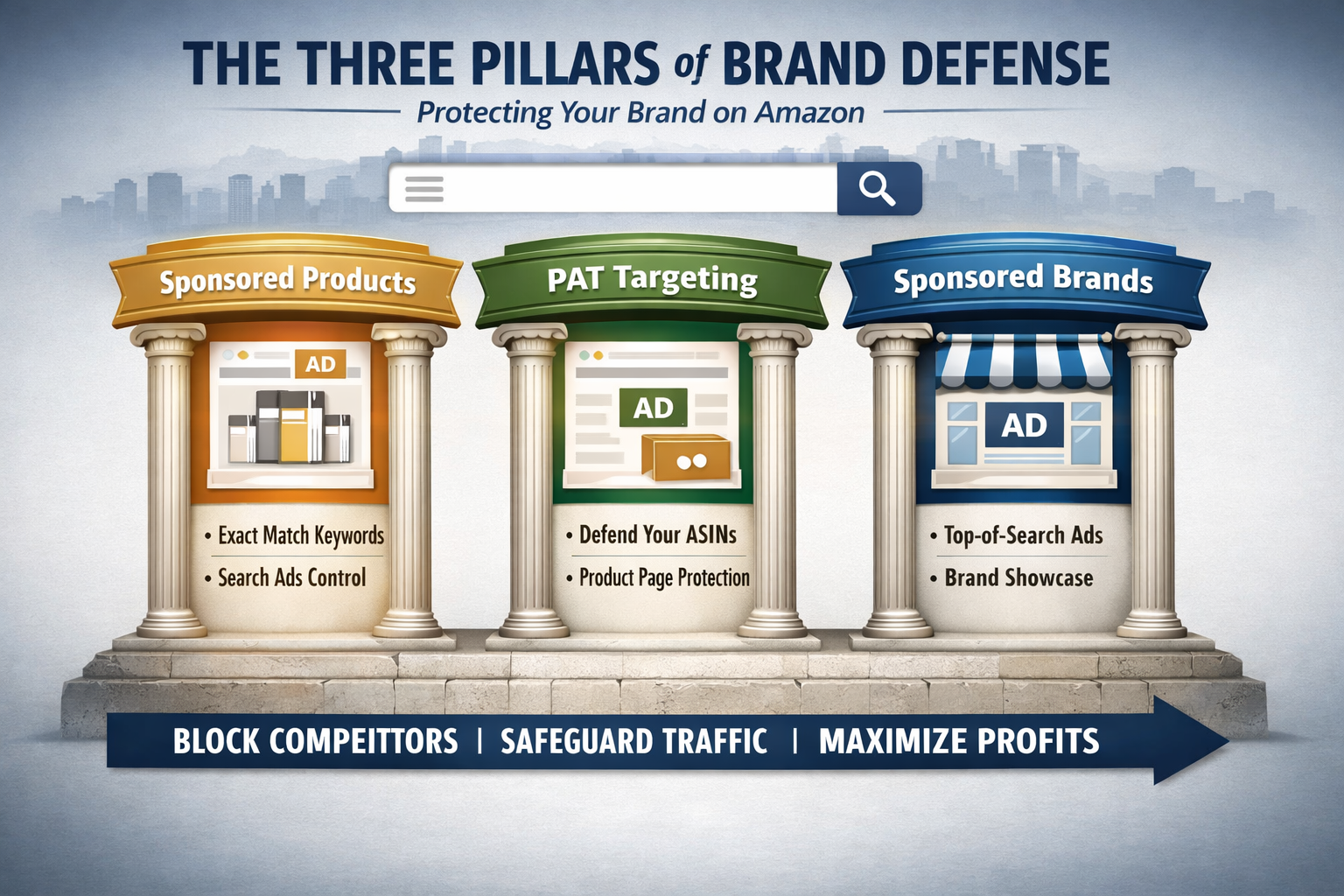
The Three Pillars of Brand Defense
Effective brand defense requires controlling three territories:
Search results for your brand name and product terms
Your own product detail pages (PDPs)
Top-of-search real estate that competitors covet
Miss any one of these, and you're leaving a door open.
Let me walk you through the setup for each.
Pillar 1: Sponsored Products Exact Match on Branded Keywords
This is your foundation. Non-negotiable.
Step-by-Step Setup
Identify your branded keywords:
Your brand name (exact spelling and common misspellings)
Product line names
Branded product terms (e.g., "BrandName Vitamin D3")
Brand + category combinations ("BrandName supplements")
Create a dedicated brand defense campaign:
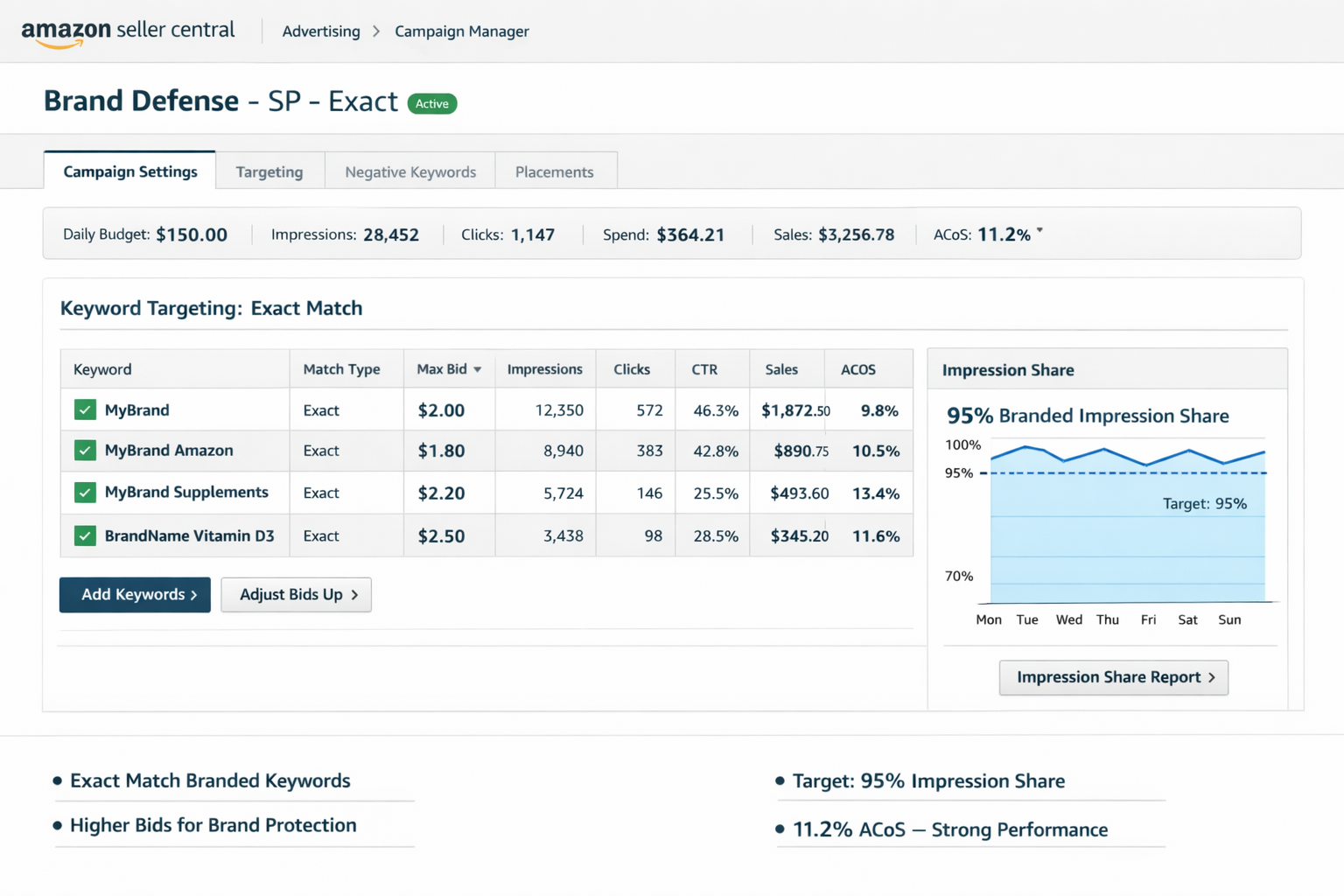
Campaign name: Brand Defense – SP – Exact
Targeting type: Manual
Match type: Exact only
Add your keyword list:Start with 15-25 branded terms. Include:
[brand name]
[brand name] amazon
[brand name] [product category]
[product name]
Common misspellings
Set your bid strategy:This is where most sellers mess up. They bid conservatively on branded terms because "organic should handle it."
Wrong.
Your goal is 100% impression share on branded searches. Period.
Start with bids 20-30% higher than your non-branded keywords. Yes, it feels aggressive. But consider: you're bidding against competitors who will happily pay premium CPCs to steal your customers. Underbidding means they win the placement.
The beautiful part? Branded keyword ACoS typically runs 5-15% because conversion rates are so high. You're not overpaying—you're protecting high-margin revenue.
Monitor impression share weekly:In your Search Term Report, filter for branded terms. If you're not appearing for 95%+ of branded impressions, increase bids. Losing even 10% impression share on branded searches means competitors are intercepting 10% of your highest-intent traffic.
What This Looks Like in Practice
I set up brand defense for a supplements brand doing $2.1M annually. Their branded keyword ACoS? 7.3%. Their competitor acquisition ACoS? 34%.
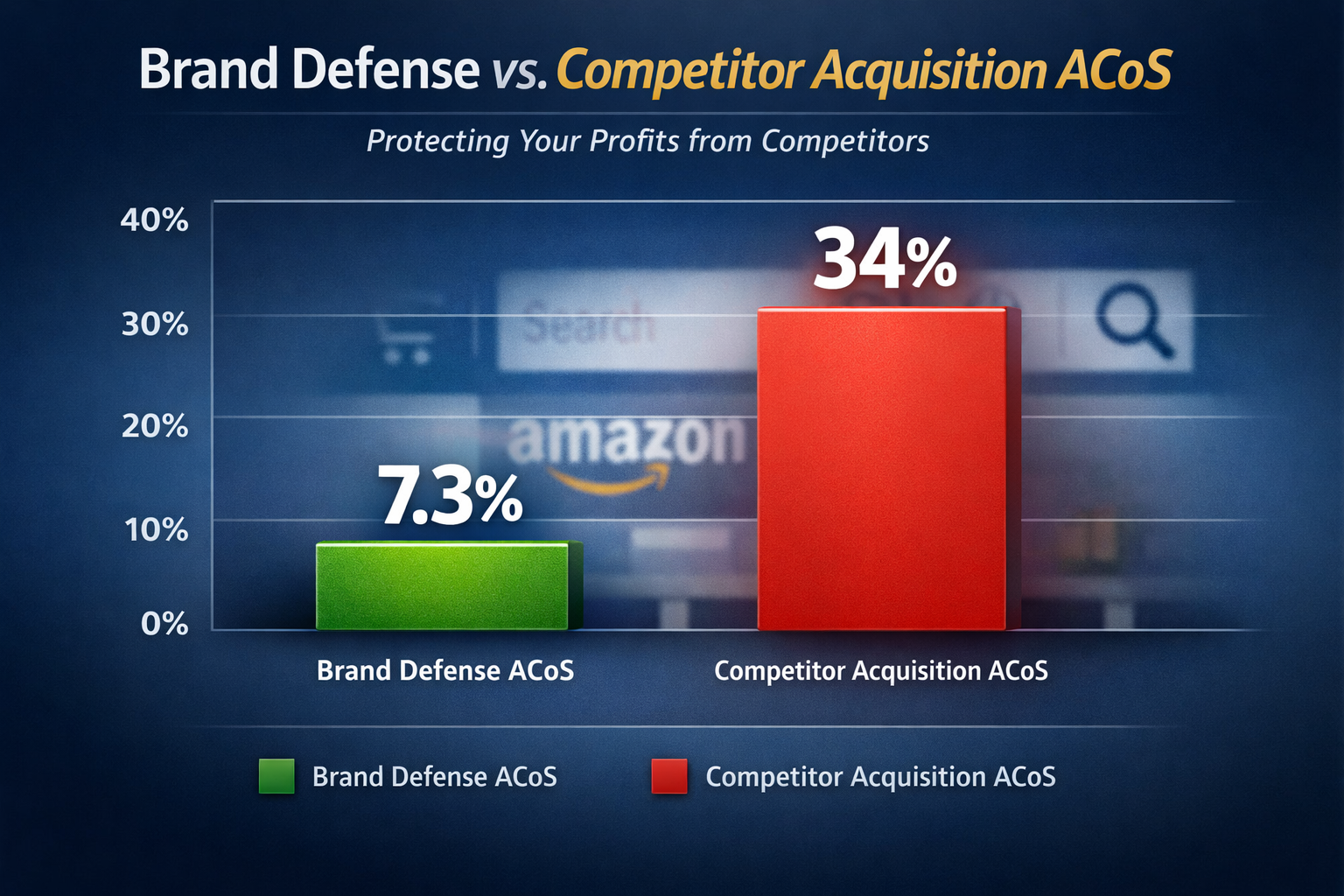
The brand defense campaigns weren't a cost center. They were protecting the most profitable traffic in the entire account.
Pillar 2: Product Attribute Targeting (PAT) on Your Own ASINs
Here's something most sellers never consider: competitors can target your specific product pages with their ads.
When a customer lands on your PDP ready to buy, they see a carousel of "similar products"—all sponsored by competitors trying to redirect them.
The fix? Target your own ASINs first.
Step-by-Step Setup
Create an ASIN defense campaign:
Campaign name: Brand Defense – PAT – Own ASINs
Targeting type: Product targeting
Select "Individual products"
Add all your ASINs:Every ASIN you sell should be included. Don't skip variations—competitors target those too.
Targeting strategy:You're not trying to cross-sell here (though that's a bonus). You're trying to occupy the sponsored placement on YOUR page before a competitor does.
Bid strategy for PAT defense:Start with bids equal to your branded keyword bids. Adjust based on performance, but prioritize maintaining placement over minimizing cost.
Think about it this way: if a competitor wins the sponsored placement on your PDP and converts that customer, you've lost a sale AND they've gained a customer who might have become your repeat buyer.
The defensive value exceeds the CPC.
Advanced Move: Negative Targeting
Once your PAT defense campaigns are running, add competitor ASINs as negative targets in your regular product targeting campaigns. This prevents your ads from showing on competitor pages where conversion probability is lower, funneling that budget back into defense and offense.
Pillar 3: Sponsored Brand Campaigns for Top-of-Search Domination
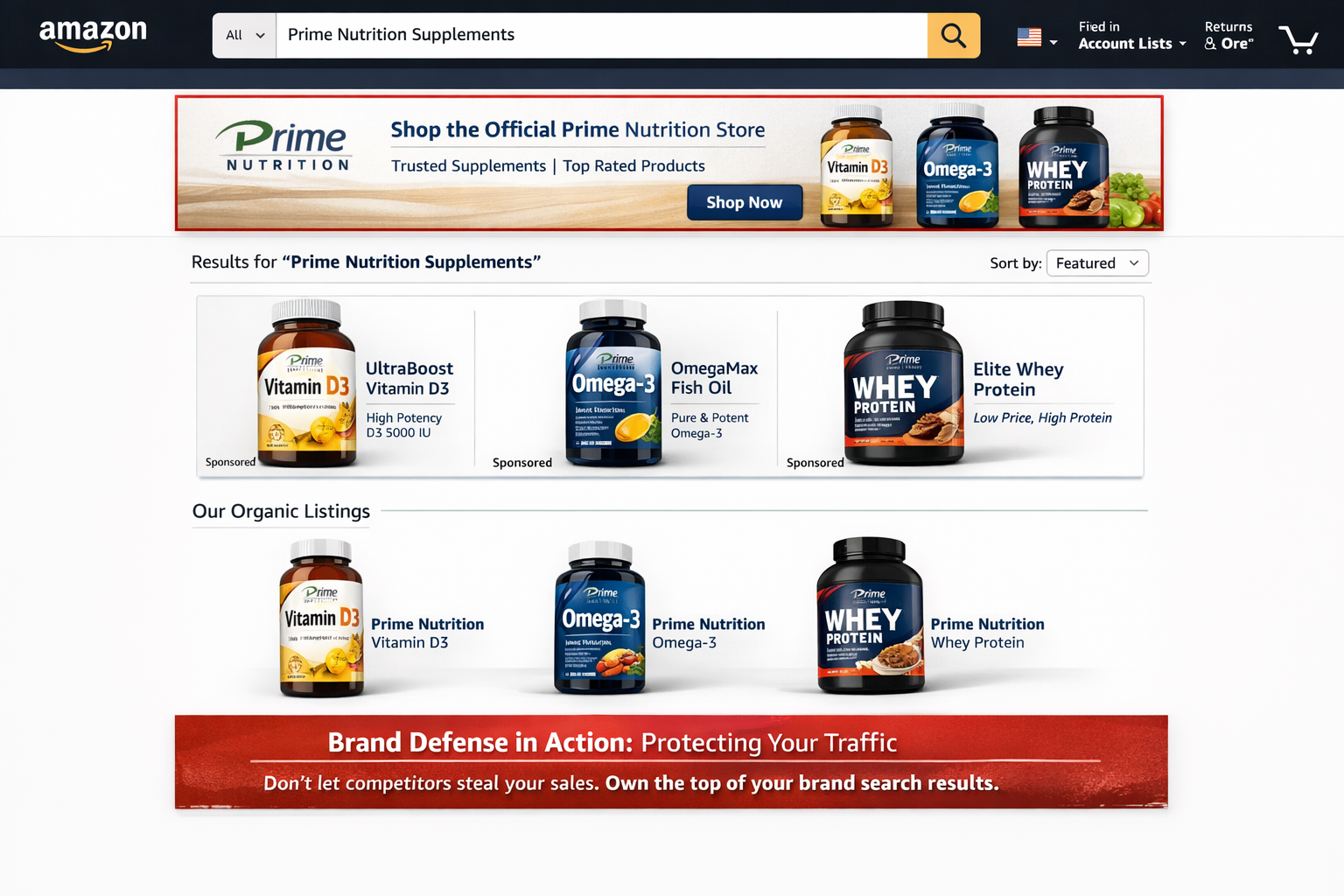
Sponsored Products protect the middle and bottom of search results. Sponsored Brands own the top.
That banner placement above all search results? If you're not filling it on your branded searches, a competitor is.
Step-by-Step Setup
Create a branded Sponsored Brand campaign:
Campaign name: Brand Defense – SB – Branded
Creative type: Product collection or Store spotlight
Keyword targeting:Mirror your Sponsored Products brand defense keywords. Exact match only for brand defense purposes.
Creative requirements:
Use your brand logo prominently
Feature your best-selling products (highest review counts)
Direct to your Amazon Store or a curated landing page
Bid strategy:Sponsored Brand CPCs typically run higher than Sponsored Products. For brand defense, this is acceptable. You're buying insurance on your most valuable real estate.
Start with bids 30-40% higher than your SP branded keyword bids. The impression share matters more than efficiency here.
Why Store Spotlight Works for Defense
Directing Sponsored Brand traffic to your Amazon Store keeps customers in your branded environment. They see only your products, your branding, your story. No competitor ads.
The Store acts as a walled garden. Customers who enter through a Store Spotlight ad convert at higher rates and have higher average order values because they're not being distracted by alternatives [2].
Bid Strategy: Aggressive Enough Without Overpaying
Let's talk numbers.
The goal of brand defense isn't efficiency. It's coverage.
But that doesn't mean you throw money away.
The framework I use:
| Campaign Type | Starting Bid Approach | Target ACoS Range |
| SP Exact Brand | 20-30% above non-brand | 5-15% |
| PAT Own ASINs | Equal to branded SP | 8-18% |
| SB Branded | 30-40% above branded SP | 10-20% |
Week 1-2: Launch at aggressive bids, prioritize impression share
Week 3-4: Analyze Search Term Reports for impression share gaps
Monthly: Adjust bids to maintain 95%+ impression share while minimizing waste
The "overpaying" test:If your branded ACoS climbs above 20%, investigate. Either you're bidding too high, or your listing has a conversion problem. Branded traffic should convert at 20-40%+ for established products. If it's not, fix the listing before blaming the ads.
The ROI of Brand Defense
I get pushback from sellers who see brand defense as "paying for traffic I'd get anyway."
Let's kill that myth.
A home goods brand I worked with ran a test: they paused brand defense for two weeks to "save money."
Results:
Branded impression share dropped from 97% to 61%
Three competitors filled the gaps
Branded conversion rate dropped 23% (customers got redirected)
Total branded revenue fell 31%
The "savings" from pausing brand defense cost them $47,000 in lost revenue over 14 days.
They turned brand defense back on. Permanently.
Brand defense doesn't cost money. It protects money.
The campaigns typically deliver your lowest ACoS because conversion rates are highest on buyers already searching for you. You're not persuading anyone—you're just preventing interception.
Common Brand Defense Mistakes
Mistake 1: Broad match on branded keywords
Never use broad or phrase match for brand defense. You'll match irrelevant queries and waste budget. Exact match only.
Mistake 2: Single campaign for everything
Separate SP, PAT, and SB into distinct campaigns. You need different bid strategies and budgets for each. Combining them creates blind spots.
Mistake 3: Set-and-forget mentality
Competitors adjust their strategies. New players enter. Your impression share fluctuates. Check Search Term Reports weekly and adjust bids to maintain coverage.
Mistake 4: Ignoring mobile placements
Mobile ad placements differ from desktop. Review placement reports and ensure you're winning mobile impressions—that's where most Amazon shopping happens.
Mistake 5: No negative keywords
Even in brand defense campaigns, add negative keywords for irrelevant branded queries (e.g., "[brand name] complaints" or "[brand name] alternatives"). Don't pay for traffic that's shopping around.
Connecting Brand Defense to the Profit Feedback Loop
Brand defense campaigns aren't isolated tactics. They're part of a systematic approach to Amazon PPC profitability.
In the Profit Feedback Loop framework, brand defense serves a specific function: protecting your highest-margin traffic while you optimize everything else.
Think of it as defensive line in football. You can't score if you're constantly losing possession.
Once brand defense is locked in, you can:
Allocate aggressive bids to conquest campaigns (targeting competitor ASINs)
Test broader keywords knowing your base is protected
Scale overall ad spend without fear of cannibalization
Brand defense creates the stability that allows offensive growth.
Your Brand Defense Checklist
Before you close this article, make sure you have:
[ ] Sponsored Products Exact Match campaign on all branded keywords
[ ] Bids set 20-30% above non-branded keywords
[ ] PAT campaign targeting all your own ASINs
[ ] Sponsored Brand campaign for top-of-search on branded queries
[ ] Store Spotlight or curated landing page as SB destination
[ ] Weekly impression share monitoring in place
[ ] Negative keywords added for irrelevant branded queries
Miss any of these, and you're leaving profit on the table.
Take Action Now
Every day without brand defense is a day competitors are stealing your customers. Not hypothetically—literally. They're running those campaigns right now.
If you want to see exactly where your branded traffic is leaking, book a free profit audit. We'll identify your exposure points, show you the competitor campaigns targeting your brand, and build a defense strategy that protects your margins.
Or start with our Wasted Ad Spend Calculator to quantify what undefended branded traffic is actually costing you.
Your brand. Your traffic. Time to defend it.
Frequently Asked Questions
How much should I spend on brand defense campaigns?
Brand defense typically requires 10-20% of your total PPC budget, but the exact amount depends on competitor aggression and your branded search volume. The key metric isn't budget—it's impression share. Spend whatever's necessary to maintain 95%+ impression share on branded searches. Since these campaigns deliver your lowest ACoS (often 5-15%), increasing spend here usually improves overall account profitability.
Won't I show up organically for my own brand name anyway?
You will—but below the ads. Amazon displays up to four Sponsored Products and a Sponsored Brand banner before the first organic result. If competitors own those placements, customers see their products first. Studies show significant percentages of clicks go to above-the-fold results [3]. Relying on organic means surrendering your highest-intent traffic to competitors willing to pay for it.
How do I know if competitors are targeting my brand?
Search your brand name on Amazon while logged out or in incognito mode. Note every sponsored result that isn't yours. Check your Search Term Report for branded queries—if your impression share is below 95%, competitors are filling the gap. You can also review product detail page traffic in Brand Analytics to see which competitor products are winning clicks from your PDPs.
Should I target competitor brand names in response?
Offensive targeting (conquesting competitor brands) is a separate strategy from brand defense. Yes, you can target competitor brand names—Amazon allows it. But understand the economics: conversion rates on competitor brand searches are much lower than your own branded traffic. Master defense first. Then consider offense once your foundation is protected.
What's the difference between brand defense and branded keywords in regular campaigns?
Brand defense campaigns are dedicated, isolated campaigns with aggressive bids and 100% impression share as the goal. Branded keywords mixed into regular campaigns compete for budget with non-branded terms and often get underbid. Separating brand defense ensures your most profitable traffic gets priority bidding and dedicated budget allocation.
About PPC Maestro
PPC Maestro is a profit-first Amazon PPC agency founded by Bernard Nader. Specializing in 7-figure private-label brands, we've managed millions in ad spend and developed the Profit Feedback Loop—a systematic framework for cutting wasted spend and scaling profitable campaigns. Our approach prioritizes contribution margin and TACoS over vanity metrics, helping sellers protect and grow their bottom line. Explore our case studies and SOPs to see the methodology in action.
Works Cited
[1] Amazon Advertising — "Reach shoppers with Sponsored Products." https://advertising.amazon.com/solutions/products/sponsored-products
[2] Amazon Advertising — "Build your brand with Stores." https://advertising.amazon.com/solutions/products/stores
[3] Jungle Scout — "The State of the Amazon Seller Report." https://www.junglescout.com/amazon-seller-report/