
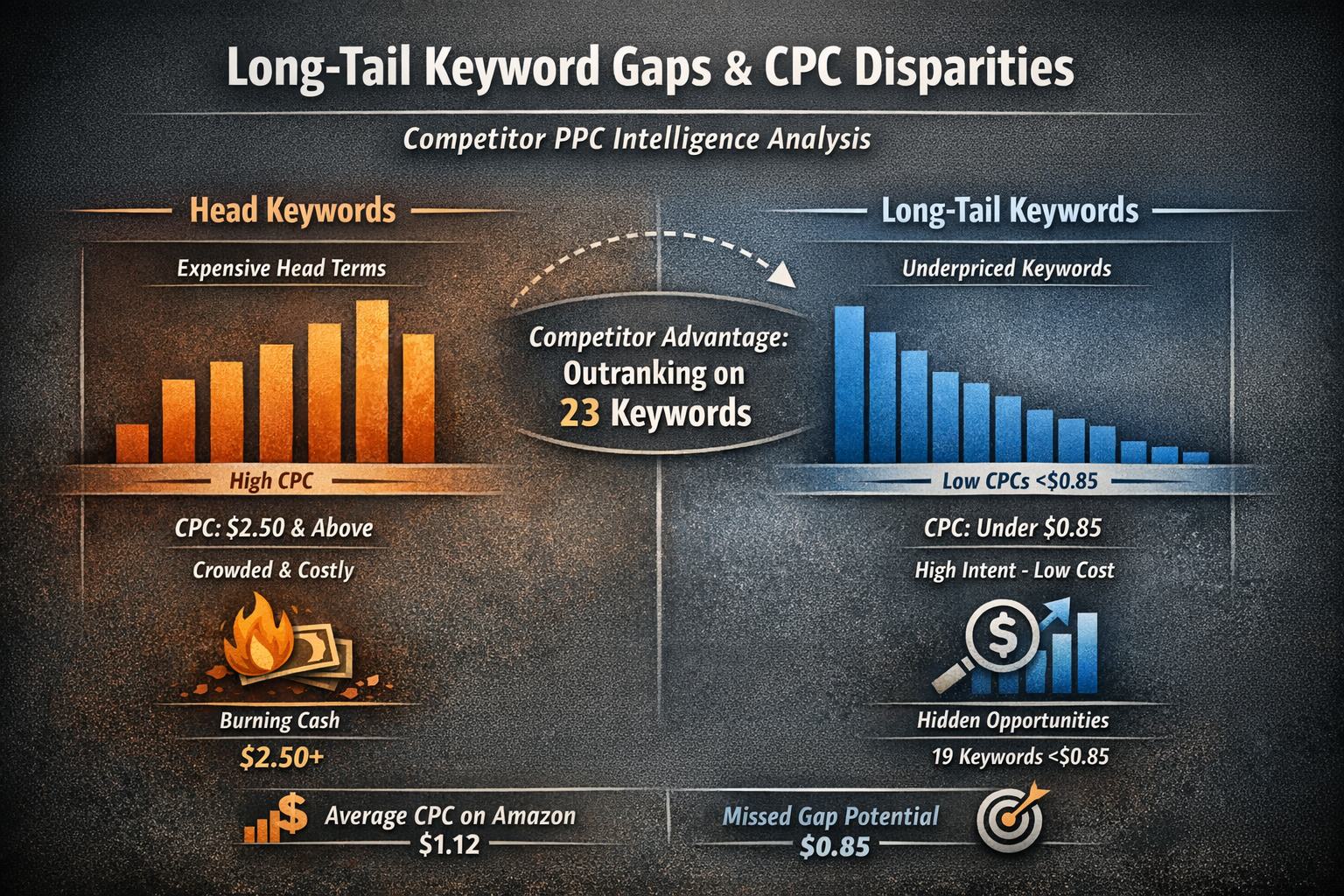
Last week I pulled a competitor analysis for a supplements brand doing $4.2M annually. Their main competitor was outranking them on 23 high-intent keywords—but here's the thing: 19 of those keywords had CPCs under $0.85.
They'd been fighting over the same five expensive head terms for months. Meanwhile, their competitor quietly dominated the profitable long-tail.
That's the game in 2025. Average CPCs on Amazon hit $1.12 this year [1]. Blindly bidding on obvious keywords is expensive. But reverse-engineering what your competitors actually bid on? That's where you find the gaps they're leaving wide open.
Competitor PPC intelligence isn't about copying their strategy. It's about finding where they're spending—and where they're not—so you can win cheaper clicks and steal market share without lighting money on fire.
Why Competitor Intelligence Matters More Than Ever
Here's the brutal math: Amazon advertising costs increased significantly over the past year, with some categories seeing CPC jumps of 15-20% [2]. If you're bidding blind, you're paying a premium for every click.
Most sellers approach PPC like a slot machine. Throw money at broad keywords, hope something sticks. That's how you end up with a $44k wasted spend problem like the account I audited last month.
Competitor intelligence flips that approach. Instead of guessing, you're making informed decisions based on actual market data.
What competitor analysis reveals:
Which keywords drive their sales (and which ones drain their budget)
Where they're bidding aggressively vs. where they've pulled back
ASIN targeting opportunities they're ignoring
Long-tail gaps where you can rank cheaper
The goal isn't to outspend your competitors. It's to outmaneuver them.
Ready to see exactly where your ad spend is leaking? Grab the free Wasted Ad Spend Calculator and find out.
Method 1: Mining Amazon Brand Analytics for Competitor Keywords
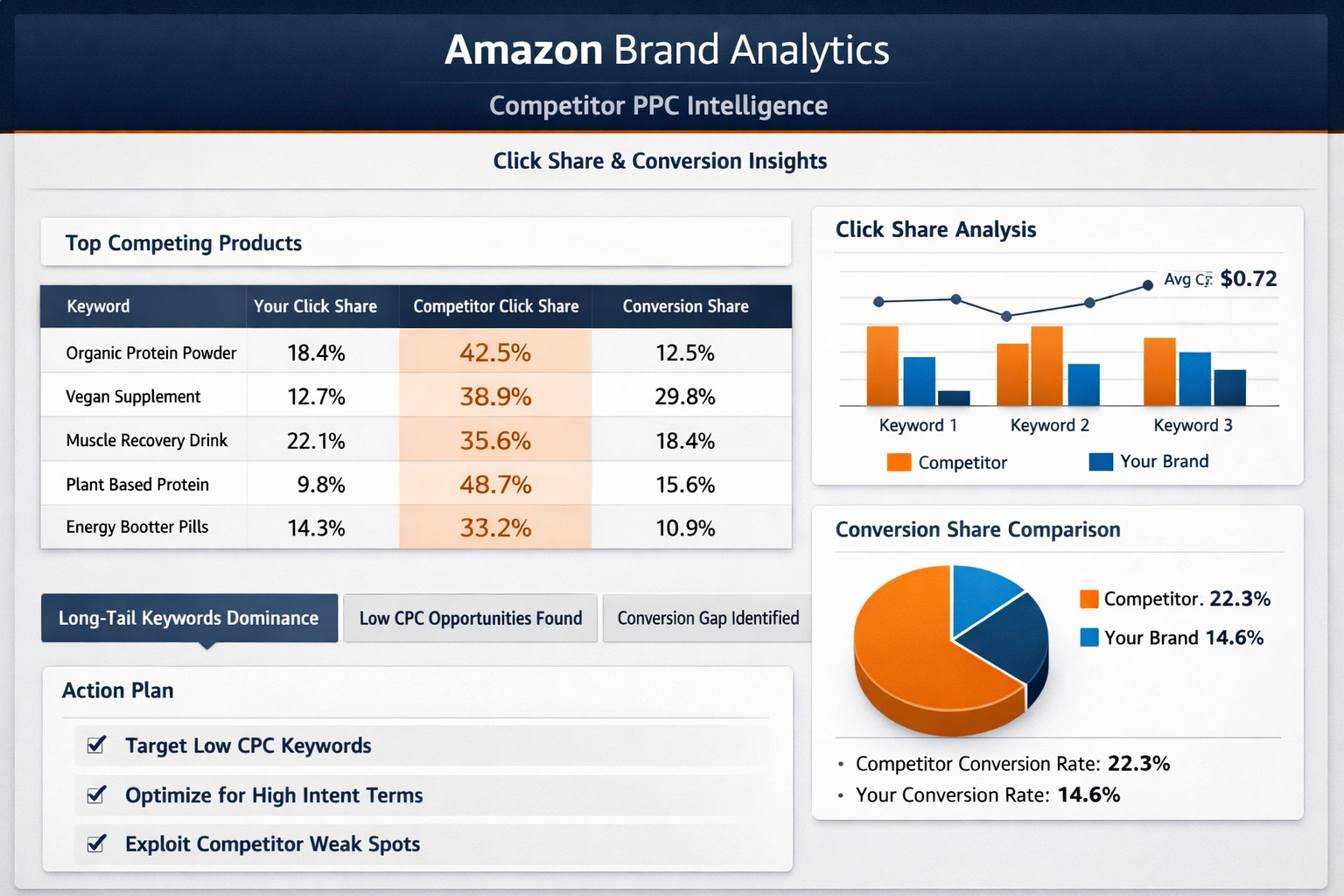
Brand Analytics is criminally underused. If you're brand registered, you have access to data most sellers ignore completely.
The Search Query Performance report shows you exactly which search terms drive clicks and conversions in your category—including terms your competitors rank for that you don't.
Here's how to extract competitor intelligence:
Pull the Top Search Terms report for your category
Identify terms where competitors appear in the top 3 click share positions
Cross-reference against your own campaigns—which of these terms are you missing entirely?
Note the conversion share percentages to prioritize high-intent keywords
The click share and conversion share metrics are gold. A competitor might own 40% click share on a term, but if their conversion share is only 15%, that keyword is vulnerable. Their listing isn't resonating. Yours might.
I did this analysis for a home goods brand last quarter. Found 31 keywords their top competitor ranked for with mediocre conversion rates. We targeted those specifically. Within 60 days, we'd captured significant market share on 12 of them at CPCs well below category average.
Method 2: Search Term Report Reconnaissance
Your own Search Term Report tells you more about competitors than you'd think.
Every time a shopper's search triggers your ad, Amazon logs it. When you analyze patterns in these search terms, you can reverse-engineer what's happening in your competitive landscape.
What to look for:
Brand name searches: If competitor brand terms are triggering your ads, customers are actively comparing. That's an offensive opportunity.
Product-specific modifiers: Terms like "[competitor product] alternative" or "[competitor] vs" reveal purchase intent you can capture.
Emerging keyword patterns: New search terms appearing in your report often indicate shifting demand—sometimes before competitors notice.
The tactical move:
Export 90 days of search term data. Filter for terms with clicks but low or no conversions on your end. Now ask: are these bad keywords, or is your listing the problem?
Sometimes a keyword looks like a loser because your main image or title doesn't match the search intent. Your competitor might be crushing it on that exact term because their listing is optimized for it.
Don't just negative match everything that doesn't convert. Investigate first.
Method 3: Manual ASIN Targeting Reconnaissance
This one takes 20 minutes and costs nothing.
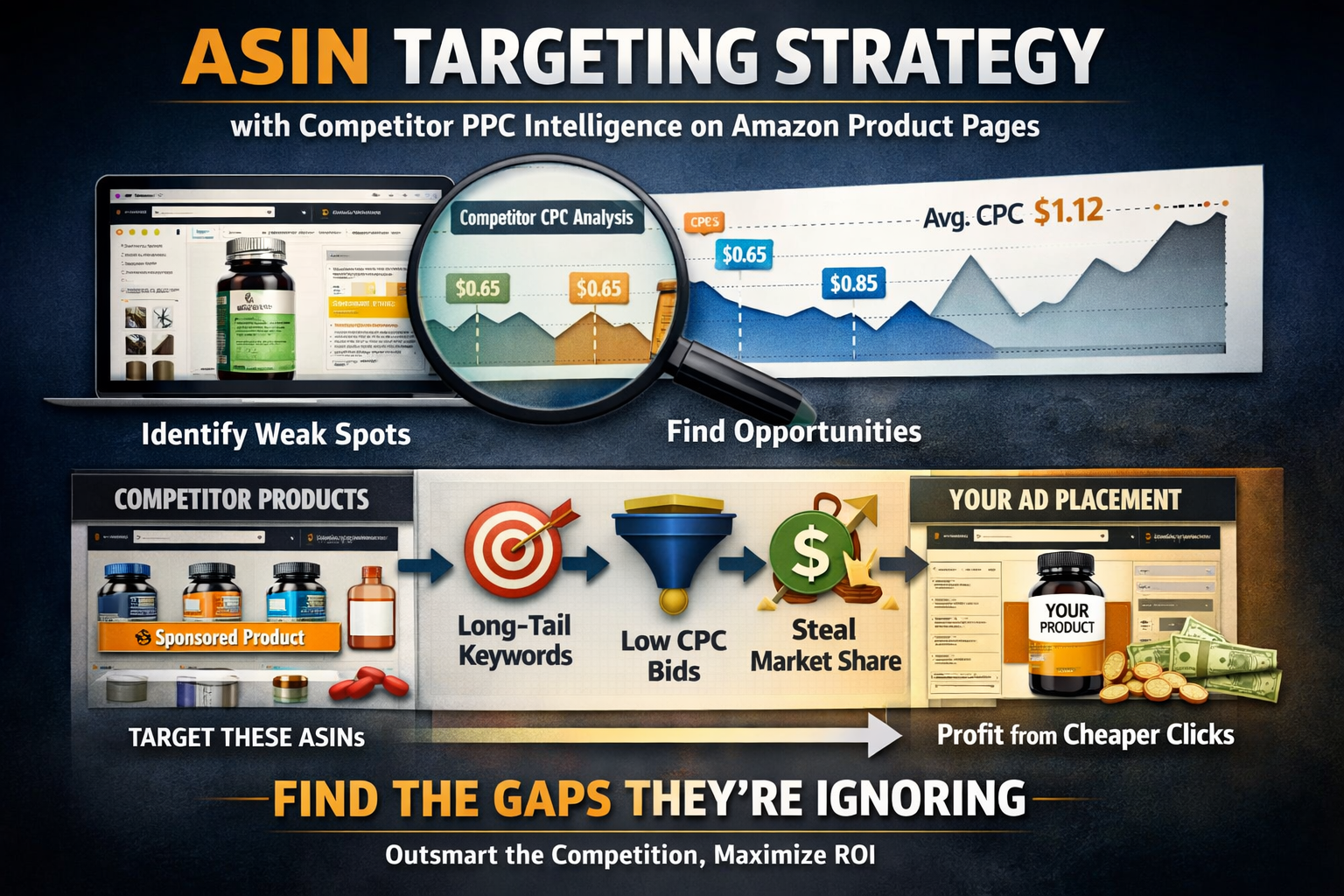
Search your top 5-10 category keywords on Amazon. Note which competitors consistently appear in Sponsored Products placements—especially the "Sponsored products related to this item" carousel.
Document everything:
Which ASINs appear most frequently in sponsored placements
What position they occupy (top of search vs. product page vs. bottom)
Whether they're running Sponsored Brand ads (indicates higher budget commitment)
Their creative angles and pricing positioning
Now search your competitor's actual product pages. Scroll down. Who's advertising on their listing? Those brands are running ASIN targeting campaigns—and it's working well enough that they keep spending.
The insight:
If nobody's advertising on a competitor's high-traffic listing, that's a gap. You can show up there relatively cheaply while everyone else fights over search placements.
If lots of brands are advertising there, the competitor is probably running defensive campaigns on their own ASINs. Different strategy required—you'll need sharper creative and pricing to convert those clicks.
Method 4: Third-Party Tools for Keyword Overlap Analysis
Tools like Helium 10 and AMZScout can accelerate competitor keyword research [3]. They're not magic, but they compress weeks of manual analysis into hours.
What these tools reveal:
Estimated keyword rankings for competitor ASINs
Search volume and competition scores
Keyword overlap between you and specific competitors
Historical ranking changes (shows where they're investing)
The profit-first approach:
Don't just export every keyword a competitor ranks for. Filter ruthlessly.
Focus on terms where:
Search volume is decent (500+ monthly searches)
Competition score is moderate or low
You have a realistic shot at ranking (your listing relevance matches the term)
The goal is finding underpriced opportunities, not joining every bidding war your competitors started.
I ran this analysis for a pet supplies brand. Their competitor ranked for 847 keywords. Sounds overwhelming. But filtered down to terms with moderate competition and strong purchase intent? Just 43 keywords worth targeting. We prioritized those, ignored the rest.
Defensive vs. Offensive Strategy: Know When to Use Each
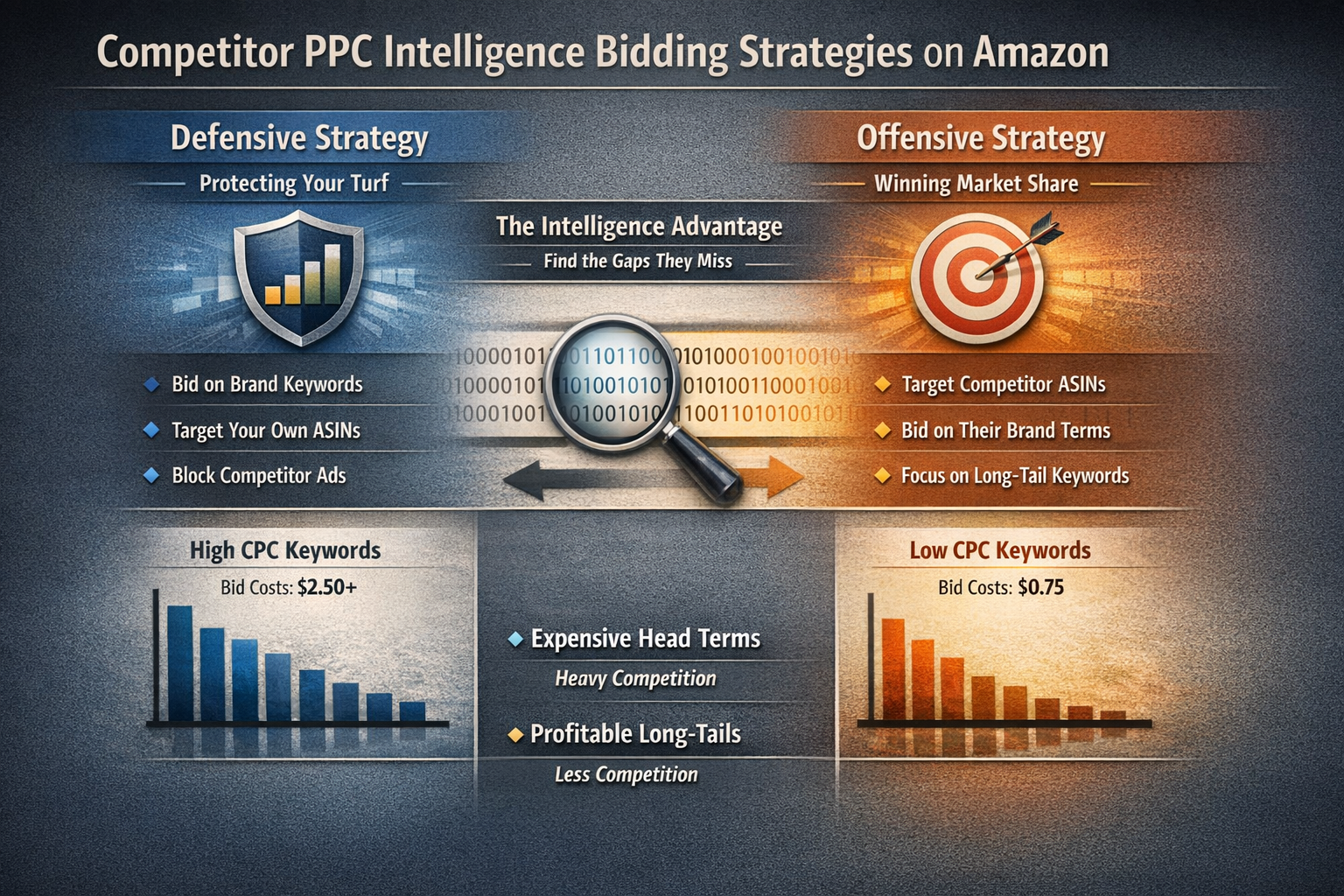
Not all competitor intelligence leads to the same playbook. You need to know when to defend your turf and when to go on offense.
Defensive Bidding
When to use it: You have an established brand, loyal customers, and competitors are targeting your ASINs or brand terms.
Tactics:
Bid on your own brand name keywords (yes, you should—otherwise competitors will)
Run Sponsored Display campaigns targeting your own product pages
Use Product Targeting campaigns on your own ASINs to block competitor ads
The math: Defensive clicks on your own brand terms typically convert at 2-3x your category average. The CPC might feel wasted since those shoppers were probably buying anyway. But if a competitor captures that click instead? That's a lost sale and their algorithm gets positive conversion data.
Offensive Bidding
When to use it: You have a competitive product and want to steal market share.
Tactics:
Target competitor ASINs directly with Sponsored Products
Bid on competitor brand name variations (if your product genuinely compares)
Target the long-tail keywords where competitors rank but don't optimize
The math: Offensive ASIN targeting typically converts at lower rates than keyword targeting. But the customers you do convert are often high-value—they were about to buy from a competitor and chose you instead.
The Profit-First Priority
Here's what most agencies won't tell you: offensive strategies look sexier but defensive strategies often have better ROI.
Protecting your existing customers is usually cheaper than acquiring new ones from competitors. If you're bleeding market share on your own brand terms, fix that before trying to steal someone else's lunch.
At PPC Maestro, this is exactly what the Profit Feedback Loop addresses—prioritizing where your dollars actually multiply.
Finding Cheaper Long-Tail Alternatives
The real money in competitor intelligence isn't finding what your rivals bid on. It's finding what they don't.
Head terms in most categories are saturated. "Protein powder" might cost $2.50+ per click. But "plant based protein powder for smoothies" might be $0.65—with higher purchase intent.
How to find these gaps:
Expand competitor keywords: Take their ranking keywords and add modifiers (color, size, use case, problem-solution)
Analyze Search Query Performance: Look for long-tail terms with high conversion rates but low competition
Check autocomplete: Type competitor product types into Amazon search and note the autocomplete suggestions—these are real searches people make
Review competitor Q&A sections: Customers literally tell you their problems and language. Those become keyword opportunities.
I found a $180k/year keyword opportunity for a kitchenware brand this way. Their competitor dominated "silicone baking mat." But "silicone baking mat for macarons" had 30% of the search volume at 18% of the CPC. Nobody was seriously competing for it.
Putting Intelligence Into Action
Data without execution is just trivia. Here's how to operationalize competitor intelligence:
Weekly cadence:
Review Search Term Report for new competitor activity
Check 2-3 competitor ASINs for advertising changes
Update negative keyword lists based on findings
Monthly cadence:
Pull Brand Analytics reports and analyze shifts
Run keyword gap analysis against top 3 competitors
Adjust ASIN targeting campaigns based on performance
Quarterly cadence:
Full competitive audit across all methods
Strategic realignment of defensive vs. offensive budget
Identify new market entrants worth monitoring
This is exactly the kind of systematic approach we document in our SOPs library—repeatable processes that compound over time.
Stop Guessing, Start Winning
Competitor PPC intelligence separates profitable brands from the ones burning cash on hope.
You don't need to outspend your rivals. You need to outthink them. Find the keywords they're ignoring. Defend the turf they're attacking. Target the gaps they've left wide open.
The sellers who win in 2025 aren't the ones with the biggest budgets. They're the ones who know exactly where every dollar goes—and why.
Want to see where your competitors are beating you (and where you can strike back)?
Book a free profit audit and we'll map your competitive landscape, find the gaps, and build a strategy that actually grows profit—not just ad spend.
Frequently Asked Questions
How often should I analyze competitor PPC activity?
At minimum, review competitor activity monthly. Markets shift fast on Amazon—new competitors enter, existing ones change strategies, and CPCs fluctuate seasonally. For highly competitive categories, weekly monitoring of your Search Term Report reveals competitor moves in near real-time. The goal is catching changes early enough to respond before they cost you significant market share.
Is ASIN targeting competitors worth the lower conversion rates?
It depends on your margins and goals. ASIN targeting typically converts 30-50% lower than keyword targeting, but the customers you win are strategic acquisitions—they were actively considering a competitor. If your contribution margin supports the higher cost-per-acquisition, offensive ASIN targeting builds market share over time. Always test with controlled budgets first and measure actual profitability, not just ACoS.
Should I bid on competitor brand names?
You can, but proceed carefully. Bidding on trademarked brand names in ad copy violates Amazon's policies, but bidding on them as keywords is generally permitted [4]. Conversion rates on competitor brand searches tend to be lower since shoppers have existing intent. Focus on terms where your product offers a genuine advantage—better price, more reviews, or superior features—otherwise you're paying for clicks that won't convert.
How do I know if competitors are targeting my ASINs?
Check the "Sponsored products related to this item" section on your own product pages. If competitor products consistently appear there, they're running ASIN targeting campaigns against you. You can also monitor your brand term performance in Search Query Performance—declining conversion share on your own brand terms often indicates increased competitor activity. Defensive campaigns become essential when you spot these patterns.
What's the biggest mistake sellers make with competitor analysis?
Copying competitor strategy instead of exploiting their gaps. If a competitor bids heavily on a keyword, most sellers assume they should too. That's backwards. High competitor spend often means inflated CPCs and saturated placements. The profitable move is finding where competitors aren't investing and dominating those spaces at lower cost. Think chess, not checkers.
About PPC Maestro
PPC Maestro is a profit-first Amazon PPC agency founded by Bernard Nader. We specialize in helping 7-figure private-label sellers cut wasted ad spend and scale profitably using the Profit Feedback Loop framework. Bernard has managed millions in Amazon ad spend and shares proven strategies through educational content, SOPs, and speaking engagements at Amazon industry events. Our approach prioritizes contribution margin and net profit over vanity metrics—because what matters isn't how much you spend, but how much you keep.
Works Cited
[1] Jungle Scout — "The State of Amazon Advertising." https://www.junglescout.com/resources/articles/amazon-advertising-statistics/
[2] Marketplace Pulse — "Amazon Advertising Costs Rise." https://www.marketplacepulse.com/articles/amazon-advertising-costs
[3] Helium 10 — "Amazon Keyword Research Tools." https://www.helium10.com/tools/
[4] Amazon Advertising — "Sponsored Products Policies." https://advertising.amazon.com/resources/ad-policy/sponsored-ads-policies