
Last month, I got on a call with a seller doing $3.2M annually. Sharp operator with a strong product line. But his ad account was a disaster.
He'd cycled through three freelancers in 18 months. Each one came in hot, made some changes, then disappeared when things got complicated. His TACoS had climbed from 14% to 23%. That's not growth—that's bleeding out slowly while everyone watches.
Here's the thing most sellers miss: hiring an Amazon PPC expert on retainer isn't about paying more money. It's about buying continuity. You're paying for someone who actually learns your catalog, your margins, your seasonality—and sticks around long enough to optimize against all of it.
But is a retainer worth it for your business? That depends on your ad spend, your complexity, and what you're actually getting for the monthly fee. Let's break down exactly what a retainer relationship looks like, when it makes sense, and how to avoid getting locked into a bad one.
What Does Hiring a PPC Expert on Retainer Actually Mean?
A retainer arrangement means you're paying a fixed monthly fee for ongoing, dedicated PPC management. No per-project pricing. No hourly tracking. Just consistent, focused work on your account week after week.
Think of it like this: project-based work is hiring a contractor to fix your roof once. A retainer is hiring a property manager who prevents problems before they start—and actually knows where the pipes are when something breaks.
But "ongoing management" is vague. Here's what a quality retainer engagement actually includes in terms of specific deliverables and workflows:
Weekly Optimization Cycles
A retained expert should be inside your account multiple times per week, not once a month. The typical weekly cadence includes bid adjustments based on 7-day performance windows, budget reallocation between campaigns, and search term analysis to identify new negatives or potential keyword graduates.
This isn't "set it and forget it" automation. It's systematic human review of what's working and what's bleeding money.

Search Term Isolation and Negative Keyword Mining
One of the biggest differentiators between amateur and expert PPC management is how they handle search term data. A retained expert runs bulk sheet operations—downloading search term reports, filtering for high-spend/zero-conversion terms, and systematically adding negatives at the campaign and ad group level.
This process, done properly, typically uncovers 20-40% of ad spend going to search terms that will never convert. We document our exact methodology in our Cutting Bleeders SOP.
Campaign Architecture and Restructuring
Beyond weekly maintenance, a retained expert handles the bigger structural work: building new campaigns for product launches, restructuring legacy campaigns that have become bloated, and creating proper single-keyword campaigns for your top performers.
This includes placement adjustments (Top of Search vs. Product Pages vs. Rest of Search), dayparting strategies for accounts with clear conversion patterns, and match type segmentation that prevents cannibalization.
Reporting Tied to Profit Metrics
The deliverable most sellers forget to ask about: what exactly are you reporting on? A quality retainer includes regular reporting—usually bi-weekly or monthly—tied to metrics that actually matter: TACoS trends, contribution margin by campaign, profit per click, and Share of Voice for your key terms.
If your current expert only reports ACoS, that's a red flag. ACoS without context is a vanity metric that tells you nothing about actual business health [1].
Direct Access to Your Strategist
Finally, a retainer should include direct communication access—typically via Slack, email, or scheduled calls. You shouldn't be submitting support tickets and waiting 72 hours when a competitor drops price or your best-seller goes out of stock.
→ Want to see exactly how this systematic approach works? Check out our Profit Feedback Loop framework.
Freelancer vs. Agency vs. Dedicated Retainer Expert
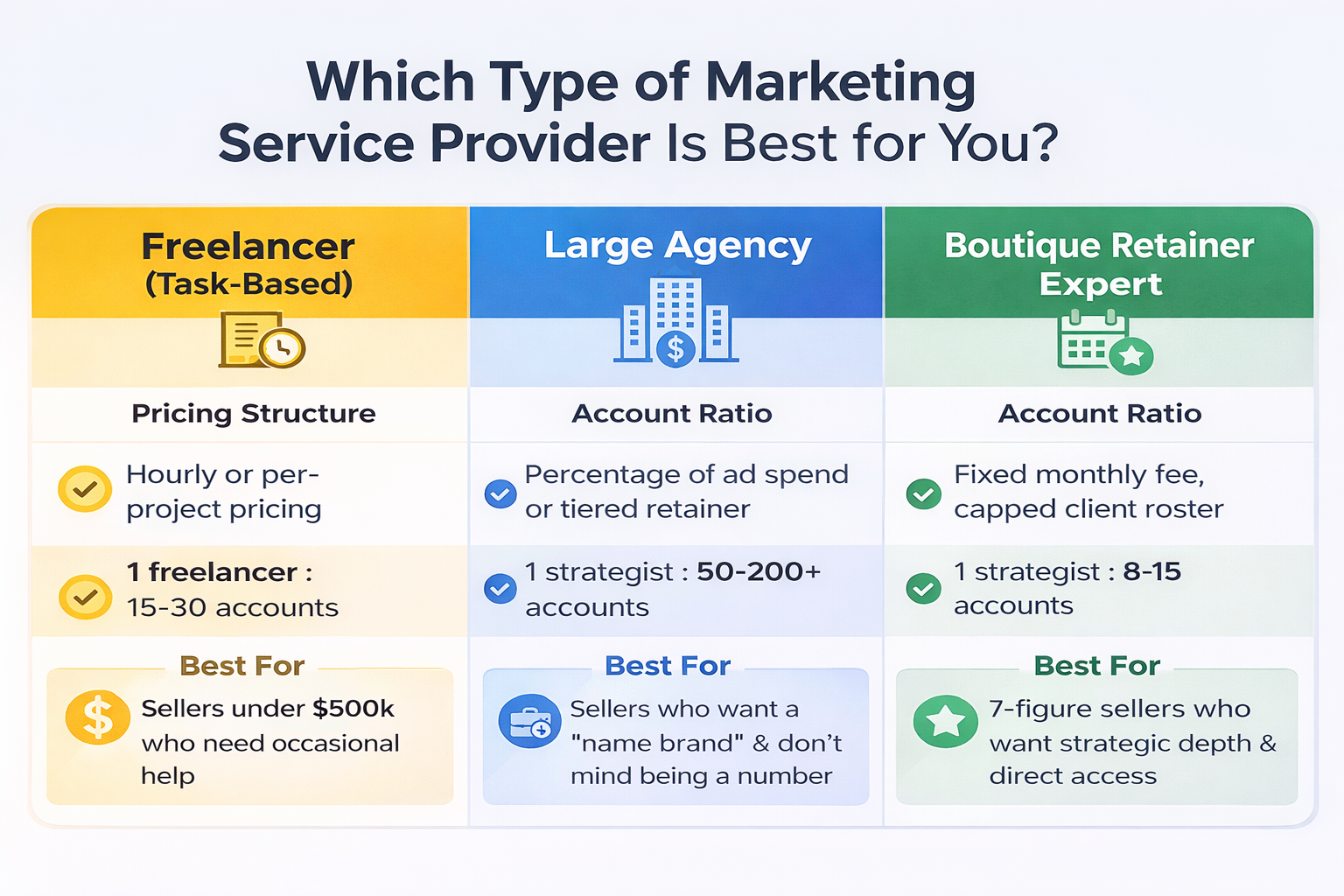
Before diving into pros and cons, it's worth understanding the three main models for outsourcing Amazon PPC—because "retainer" can mean very different things depending on who's offering it.
| Model | Typical Structure | Account Ratio | Best For |
| Freelancer (Task-Based) | Hourly or per-project pricing | 1 freelancer : 15-30 accounts | Sellers under $500k who need occasional help |
| Large Agency | Percentage of ad spend or tiered retainer | 1 strategist : 50-200+ accounts | Sellers who want a "name brand" and don't mind being a number |
| Boutique Retainer Expert | Fixed monthly fee, capped client roster | 1 strategist : 8-15 accounts | 7-figure sellers who want strategic depth and direct access |
The boutique retainer model is what we're really discussing in this article—and it's fundamentally different from the other two. The capped client roster is what allows for actual institutional knowledge. When a strategist manages 200 accounts, they can't remember what you tried last Black Friday. When they manage 10, they can.
The Pros of Hiring a PPC Expert on Retainer
1. Dedicated Focus That Compounds Over Time
When you hire someone on a dedicated retainer with a capped roster, you're not competing with 47 other clients for their attention. You get priority. You get depth.
I've seen the difference firsthand. One client came to us after working with a large agency that managed 200+ accounts per strategist. The result was cookie-cutter campaigns with zero customization. Their high-margin SKUs were getting the same bid strategy as their loss leaders—which is like treating a $50 product and a $5 product identically.
Within 60 days on a dedicated retainer model, we restructured their campaigns around actual contribution margin. TACoS dropped from 19% to 12%. Profit jumped accordingly.
That kind of work requires someone who knows your catalog—not someone Googling your brand name before each call.
2. Institutional Knowledge That Prevents Repeated Mistakes
Amazon PPC is iterative. The insights from Q1 inform your Q2 strategy. The search term data from a product launch feeds into your next one. The placement adjustments that worked during Prime Day become your baseline for Black Friday.
When you churn through freelancers or agencies, you lose all of that. Every new hire starts from zero. They make the same mistakes. Test the same keywords. Waste the same budget discovering what the last person already knew.
A retained expert builds on previous work. They remember which ASINs respond to Sponsored Brand video and which don't. They know your seasonal patterns. They've seen how your conversion rate fluctuates with inventory levels.
That institutional knowledge is worth more than most sellers realize—until they've paid for the same lessons three times.
3. Speed When It Actually Matters
Markets shift fast on Amazon. A competitor drops price. A listing gets suppressed. Your best-seller goes out of stock and you need to reallocate budget immediately.
With a retained PPC expert who has direct access protocols, you're pinging them directly. They adjust bids same-day. They pause bleeding campaigns before the damage compounds. They shift budget to backup ASINs while you fix the inventory issue.
Speed matters enormously when you're spending $50k+ monthly on ads. A 48-hour delay in responding to a stock-out can cost thousands in wasted spend on a product you can't actually sell.
4. Aligned Incentives Around Profit
This one's underrated.
A project-based consultant gets paid whether your campaigns succeed or fail. They deliver a "strategy doc," invoice you, and move on. A percentage-of-ad-spend agency actually benefits when you spend more—regardless of whether that spend is profitable.
A retained expert on a fixed monthly fee? Their reputation—and their renewal—depends on your results. They're invested in your profit because their livelihood is tied to your success. There's no incentive to inflate budgets or chase volume for volume's sake.
That alignment changes everything. It's the difference between someone optimizing for a deliverable and someone optimizing for your bottom line.
→ See how this alignment has played out for our retained clients. Check out our Results page.

The Cons of Hiring a PPC Expert on Retainer
Retainers aren't perfect for everyone. Here's where they can go wrong:
1. Higher Upfront Commitment
Retainer fees for quality Amazon PPC management typically range from $2,500 to $10,000+ monthly, depending on ad spend and catalog complexity [2].
For a seller doing $500k annually with thin margins, that's a significant chunk of profit. You need enough scale—and enough ad spend—to justify the investment.
The math usually works once you're spending $15k+ monthly on Amazon ads. At that level, even a 10% reduction in wasted spend generates $1,500+ monthly in recovered profit—which can offset most or all of the retainer cost. Below that threshold, you might not generate enough return to justify the investment.
2. Initial Commitment Periods Require Trust
Most retainers come with initial commitment periods—often 90 days—before moving to month-to-month. That's reasonable because real optimization takes time. The first 30 days involve auditing, restructuring, and cutting obvious waste. Months two and three are where compounding improvements kick in.
But it also means you can't bail after week two if you don't see instant results. This requires vetting upfront (more on that below) and realistic expectations about timelines.
The good news: the industry has shifted toward shorter initial periods followed by month-to-month arrangements. If someone demands a 12-month contract with no performance outs, that's a red flag.
3. Not All Retainers Deliver Equal Value
Here's the dirty secret: some agencies call it a "retainer" but treat you like a number anyway. They run the same playbook across every account. They've got junior staff doing the actual work while the senior strategist you met in the sales call is nowhere to be found.
A bad retainer is worse than no retainer. You're paying premium prices for mediocre execution while believing you have "expert help."
The difference between a good retainer and a bad one comes down to: Who actually touches your account? How many other accounts are they managing? And do they have documented systems, or are they just winging it?
The Hybrid Model: Retainer Expert + Internal Team
One scenario worth addressing: what if you already have an in-house team handling PPC?
Many 7-figure sellers use retained experts as strategic partners alongside internal staff. The model works like this: the external expert brings specialized Amazon knowledge, stays current on platform changes, and handles high-level strategy and optimization frameworks. Your internal team handles day-to-day execution, brand-specific context, and implementation.
This isn't redundancy—it's leverage. The external expert can audit your internal team's work, identify blind spots, and introduce best practices they've developed across multiple accounts. Your internal team gets better over time because they're learning from someone who lives and breathes Amazon PPC.
The key is clear role definition. The retained expert shouldn't be duplicating your internal team's work. They should be elevating it.

Questions to Vet a Retained PPC Expert Before Signing
Before you commit to any retainer, ask these questions—and pay attention to how they answer:
1. "Who will actually be working on my account day-to-day?"
If they dodge this question or give a vague answer about "the team," run. You need to know if you're getting the person you met in the sales call or someone three levels down.
2. "How many accounts does that person manage?"
There's no magic number, but anything over 20 accounts per strategist should raise questions. At 50+, it's impossible to provide the depth that justifies retainer pricing.
3. "How do you define success?"
The right answer involves profit, TACoS, and contribution margin. The wrong answer is "we'll lower your ACoS." ACoS in isolation tells you nothing—you can have a 10% ACoS and still be losing money if your margins don't support it [1].
4. "What's your optimization cadence, and what specifically happens each week?"
Weekly is the minimum for active optimization. Daily bid adjustments should happen during launches or promotions. If they're only touching your account monthly, that's not management—that's neglect. Push for specifics: What reports do they pull? What filters do they use? What's the decision tree for adding negatives?
5. "Can I see results from similar accounts?"
Specifically, ask for sellers in your revenue range with similar catalog complexity. A case study from a single-SKU brand doesn't mean much if you're managing 200 ASINs across multiple categories.
6. "How do you handle search term isolation and negative keyword mining?"
This is where the pros separate from the amateurs. A retained expert should have systematic processes—documented SOPs, bulk file workflows, clear thresholds for when a term becomes a negative. If they can't explain their process clearly, they probably don't have one. We publish our exact processes in our SOPs library so clients know exactly what we're doing.
7. "What happens when something goes wrong?"
Stock-outs, listing suppressions, algorithm changes—stuff happens. You want an expert who has a playbook for chaos, not someone who panics. Ask about specific scenarios: "My top ASIN goes out of stock for two weeks—what do you do?"
8. "What's your communication structure?"
You should know when you'll get reports, how you'll communicate between reports, and what your escalation path looks like for urgent issues.
When a Retainer Model Makes the Most Sense
A retainer isn't right for everyone. But it's often the best choice in these scenarios:
You're Spending $20k+ Monthly on Ads
At this scale, even small efficiency gains translate to thousands in recovered profit. A 10% reduction in wasted spend on a $30k monthly budget is $3k per month—$36k annually. Most retainers pay for themselves at this level, often multiple times over.
You're Preparing for an Exit
Acquirers scrutinize ad efficiency heavily. High TACoS, messy campaign structures, and inconsistent performance are red flags that directly tank valuation multiples [3].
A retained expert can clean up your account, document your systems, and present a "buttoned-up" PPC operation that makes buyers confident. This isn't cosmetic work—it directly impacts your exit valuation. Clean, well-structured campaigns with documented SOPs signal a business that will transfer smoothly.
You've Burned Through Freelancers
If you've hired three PPC contractors in two years and you're still frustrated, the problem isn't the individuals. It's the model.
Project-based relationships don't incentivize long-term thinking. The freelancer gets paid whether your campaigns succeed or fail. They have no stake in what happens after they deliver and move on. A retainer changes that dynamic completely.
Your Catalog Is Complex
Multiple product lines. Different margin profiles. Seasonal fluctuations. International markets. Parent-child variations with different profitability.
Complex catalogs require complex strategies. You can't manage that with a "one-size-fits-all" approach. You need someone who understands the nuances of bidding differently on your 60% margin hero SKU versus your 15% margin accessory. That understanding takes time and continuity to develop.
You Want Your Time Back
This is the one nobody talks about.
Most 7-figure sellers I work with didn't get into e-commerce to stare at campaign manager all day. They want to focus on product development, supply chain, expansion—the strategic work that actually grows the business.
A retained PPC expert gives you leverage. They handle the tactical grind so you can focus on strategic growth. That's not laziness; that's proper resource allocation.
How the Profit Feedback Loop Changes the Retainer Game
Most PPC managers optimize for the wrong thing. They chase low ACoS like it's the Holy Grail, celebrating a 15% ACoS while the account bleeds profit because the margin structure doesn't support it.
Low ACoS doesn't mean anything if you're not profitable.
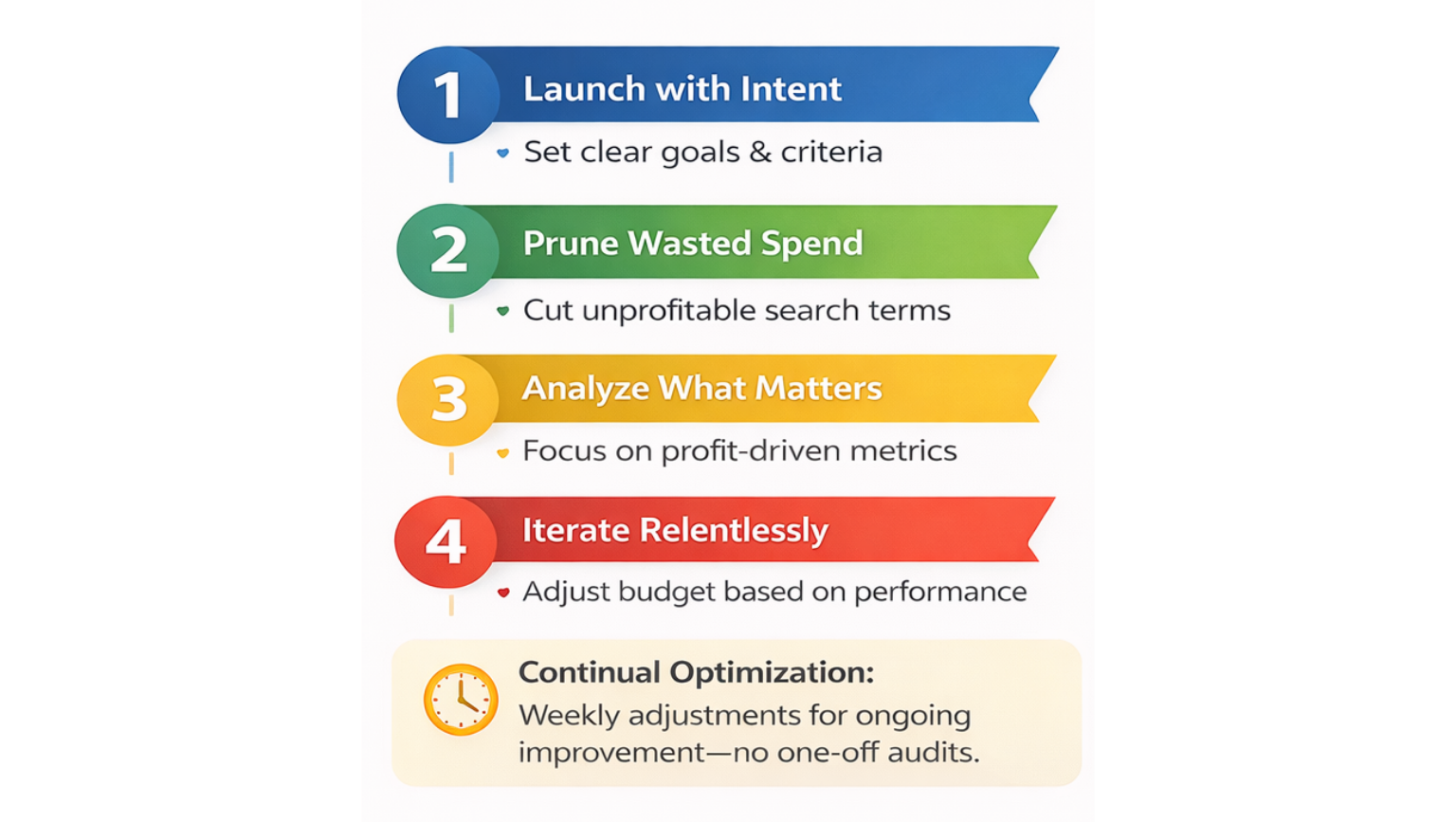
That's why we built the Profit Feedback Loop—a framework specifically designed for retained client relationships. Here's how it works:
Step 1: Launch with Intent
Structure campaigns around specific goals—ranking, profit, and data collection—not just "let's see what works." Every campaign has a purpose and success criteria defined before it launches.
Step 2: Prune Wasted Spend Fast
Identify and cut "bleeders" within the first 30 days using bulk file analysis and systematic negative keyword mining. We typically find 20-40% of spend going to search terms that will never convert. This step alone often pays for the entire retainer.
Step 3: Analyze What Actually Matters
TACoS trends. Contribution margin by campaign. Profit per click. Share of Voice for priority keywords. Not vanity metrics that look good in a report but don't connect to business outcomes.
Step 4: Iterate Relentlessly
Use the data to reallocate budget from losers to winners. Adjust bids based on actual profit performance. Scale what's working. Kill what isn't. Rinse and repeat weekly.
This isn't something you can do with a one-off audit. The loop only works with ongoing, dedicated attention. That's why the retainer model exists—it's the structure that makes continuous improvement possible.
The Real Cost of NOT Having a Retained Expert
Let's flip the question: what's it costing you to not have someone dedicated to your account?
I audited a 7-figure account last quarter. The seller had been managing PPC themselves with occasional freelancer help. The numbers:
$86k spent in 90 days
$44k wasted on search terms with zero conversions
Campaigns still running on out-of-stock ASINs
Broad match keywords bleeding money that should've been negated weeks earlier
That's not advertising. That's arson.
And the seller didn't even know. Because nobody was watching. Nobody was running the search term reports, filtering for high-spend/low-conversion terms, and systematically adding negatives.
A retained expert would've caught that in week two. They would've cut the bleeders, reallocated to winners, and protected the profit margin. The retainer fee? A fraction of the wasted spend.
Making the Decision: A Framework
Here's my honest assessment based on hundreds of conversations with Amazon sellers:
If you're under $1M in revenue with simple campaigns: Start with project-based help. Get an audit. Build a foundation. See if you like working with someone before committing to a monthly relationship.
If you're doing $1M+ with $15k+ monthly ad spend: A retainer is almost certainly worth it. The math works. The compounding works. The peace of mind works.
If you're preparing for an exit or scaling aggressively: A retained expert isn't optional. It's infrastructure. You wouldn't go into due diligence with messy financials; don't go in with messy ad accounts.
The question isn't whether you can afford a retainer.
The question is whether you can afford to keep bleeding without one.
Ready to see what a profit-first retainer relationship looks like?
Book a call with our team and we'll walk through your account, identify the waste, and show you exactly what a retained engagement would look like for your business.
No fluff. No pressure. Just math.
Frequently Asked Questions
How much does it cost to hire an Amazon PPC expert on retainer?
Quality retainers typically range from $2,500 to $10,000+ monthly, depending on your ad spend level and catalog complexity. The investment usually makes sense once you're spending $15k+ monthly on Amazon ads—at that scale, even modest efficiency gains of 10-15% cover the retainer cost and generate net profit. Below that threshold, project-based help may be more cost-effective.
What's the difference between a retainer and a percentage-of-ad-spend model?
A retainer is a fixed monthly fee regardless of spend. Percentage models charge based on how much you spend on ads (typically 10-15% of ad spend). The fundamental problem with percentage models is incentive misalignment—they reward more spending, not better spending. Retainers align your expert's incentives with profit, not volume, which changes how they approach optimization decisions.
How long should I commit to a PPC retainer before expecting results?
Most meaningful optimization takes 60-90 days to show clear results. The first 30 days involve auditing, restructuring, and cutting obvious waste—you might see quick wins here, but sustainable improvement takes longer. Months two and three are where compounding improvements kick in as the expert learns your account and iterates on initial changes. Be wary of anyone promising dramatic results in week one.
Can I hire a retained PPC expert if I also have an in-house team?
Absolutely. Many 7-figure sellers use retained experts as strategic partners alongside internal staff. The external expert brings specialized Amazon knowledge, stays current on platform changes, and handles high-level strategy. Your internal team handles day-to-day execution and brand-specific context. It's a force multiplier, not a replacement—and your internal team often improves faster with external expertise to learn from.
What should I expect in terms of communication and reporting?
A quality retainer includes weekly optimization cycles, regular strategy calls (usually bi-weekly or monthly), transparent reporting tied to profit metrics like TACoS and contribution margin, and direct access to your strategist for urgent issues. You should feel like you have a true partner who understands your business, not a vendor checking boxes and sending generic reports.
About PPC Maestro
PPC Maestro is led by Bernard Nader, a profit-first Amazon PPC specialist who's managed millions in ad spend for 7-figure sellers. Unlike agencies that optimize for vanity metrics, we focus exclusively on what matters: cutting wasted spend and increasing net profit. Our Profit Feedback Loop framework has helped clients recover tens of thousands in wasted ad spend—often within the first 30-60 days. Bernard regularly shares strategies and insights through YouTube tutorials, industry summits, and our comprehensive SOP library.
Works Cited
[1] Amazon Advertising — "Measure Your Advertising Performance." https://advertising.amazon.com/library/guides/measure-advertising-performance
[2] Jungle Scout — "Amazon PPC Management: Costs and What to Expect." https://www.junglescout.com/resources/articles/amazon-ppc-management/
[3] Empire Flippers — "How to Sell an Amazon FBA Business." https://empireflippers.com/how-to-sell-amazon-fba-business/