You're leaving money on the table.
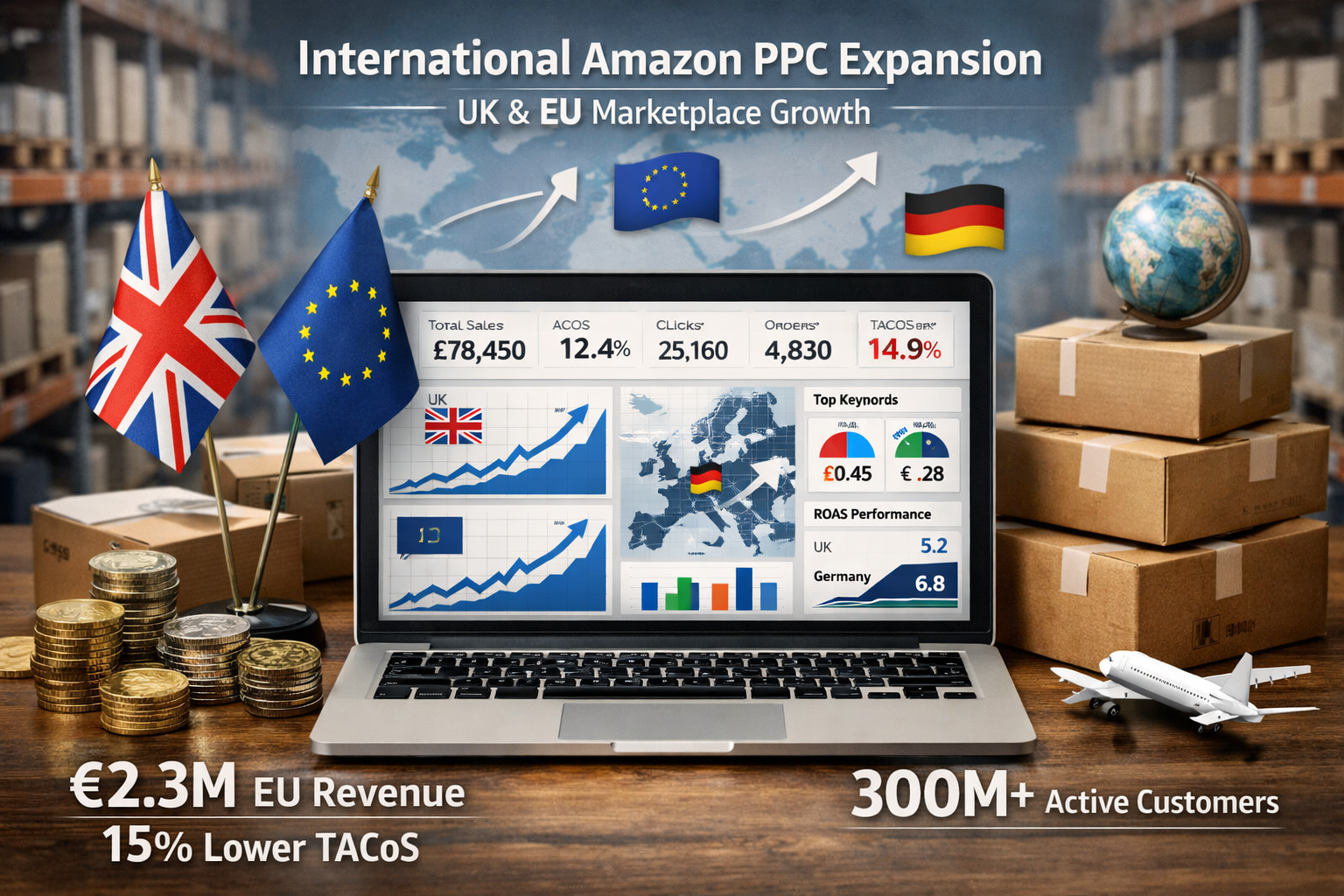
I ran an audit last quarter for a 7-figure US seller who'd been "meaning to expand to Europe" for two years. Meanwhile, their competitors had quietly built €2.3M in annual EU revenue—at a 15% lower TACoS than their US campaigns.
International PPC expansion isn't some distant goal for Amazon sellers who've "made it." It's a profit lever hiding in plain sight.
The UK and EU marketplaces represent over 300 million active Amazon customers [1]. That's not a nice-to-have. That's a second business waiting to happen.
But here's where most sellers get it wrong: they treat international expansion like a logistics project. Ship inventory. Check the VAT box. Copy-paste US campaigns.
Then they wonder why their German ads burn €5,000 in the first month with nothing to show for it.
International PPC requires a completely different playbook. The keywords change. The bidding logic changes. The competitive landscape changes. Even the advertising regulations differ.
Get it right, and you diversify revenue, lower blended ACoS, and build a more valuable, exit-ready brand. Get it wrong, and you're funding an expensive education in European advertising compliance.
Let me show you how to get it right.
Why International Expansion Actually Matters for Profit
If you're already doing seven figures in the US, expanding to UK and EU markets isn't about vanity metrics or "going global."
It's about three things:
1. Revenue diversification. Putting all your eggs in one marketplace is risky. Supply chain issues, algorithm changes, or increased competition in the US can tank your business overnight. Multiple markets = multiple safety nets.
2. Lower blended ACoS. Here's what most sellers don't realize: CPCs in some European markets are significantly lower than the US. Less competition means cheaper clicks. Cheaper clicks mean better margins—if you know what you're doing.
3. Exit valuation. Aggregators and buyers pay premiums for brands with proven international traction. Multi-market presence signals scalability and reduces perceived risk [2].
The UK is the easiest entry point. Same language. Familiar platform. Mature marketplace with high purchase intent.
Germany is the profit play. Largest EU market. Highest purchasing power. More complexity—but that complexity keeps the amateurs out.
The Setup Foundation: Unified European Account, VAT, and Fulfillment
Before you touch a single campaign, you need the infrastructure right.
Unified European Account
Amazon's Unified European Account lets you manage UK plus seven EU countries from one Seller Central login [3]. This is non-negotiable for efficient PPC management.
One account. Multiple marketplaces. Centralized campaign control.
Without this, you're logging into separate accounts, managing separate budgets, and losing visibility across markets. That's a recipe for wasted spend.
VAT Registration: The Step-by-Step Reality
Post-Brexit, VAT is a mess. There's no sugarcoating it. But here's the actual process:
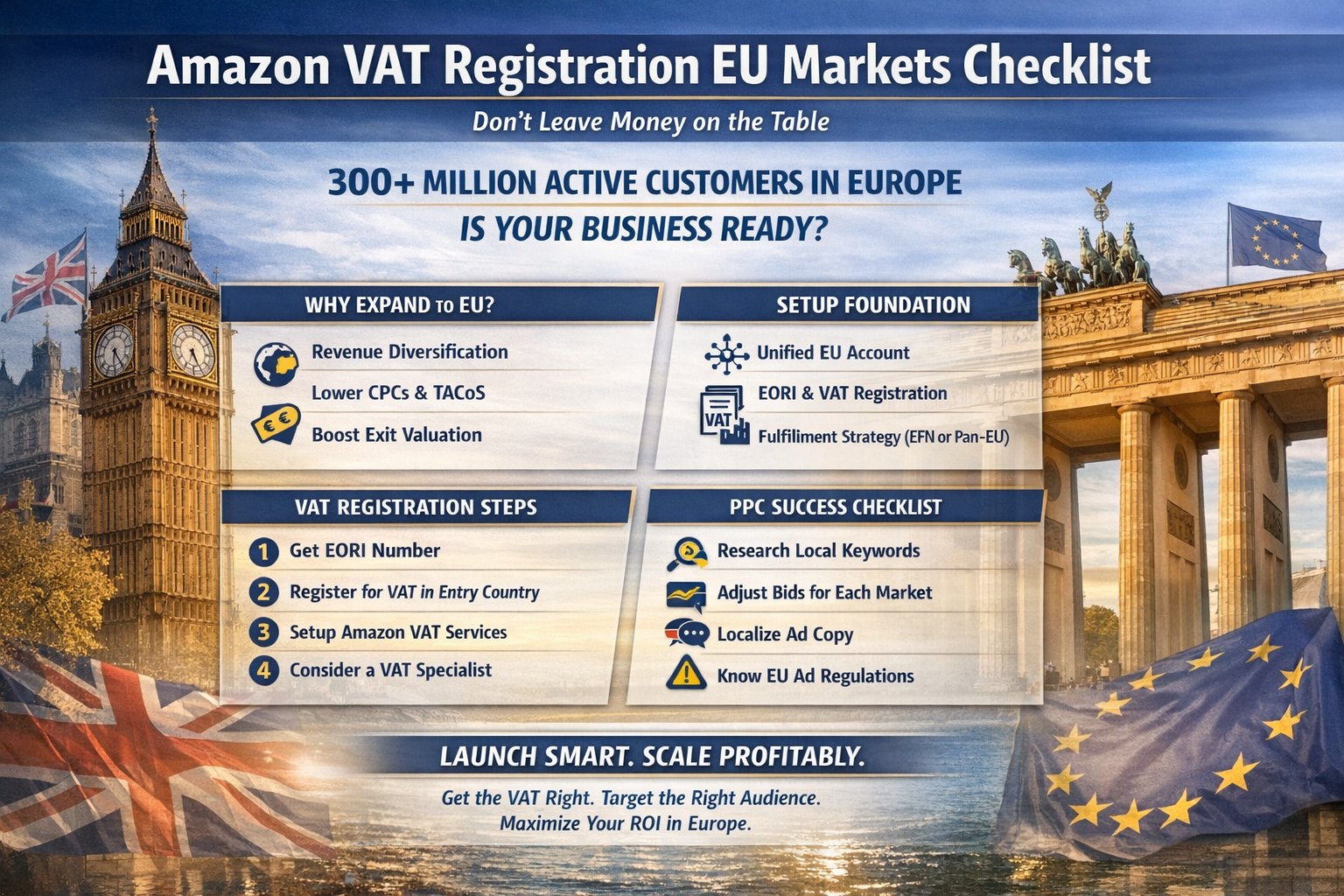
Step 1: Apply for an EORI number. This is your Economic Operators Registration and Identification number—required for importing goods into the UK or EU. Apply through the relevant country's customs authority.
Step 2: Register for VAT in your entry country. For the UK, you need UK VAT registration if you're storing inventory there or selling above threshold limits [4]. Germany requires VAT registration before you can sell there—period [5].
Step 3: Set up tax calculation services in Seller Central. Amazon offers VAT Calculation Services that automate invoicing and reporting. Enable this before your first sale to avoid compliance headaches.
Step 4: Consider a VAT specialist. Each EU nation has its own requirements. A specialist can handle filings across multiple countries and keep you compliant as you scale.
Budget for this upfront. Don't figure it out "later."
Fulfillment Strategy
You have two main options:
Pan-European FBA: Amazon distributes your inventory across multiple fulfillment centers automatically. Lower shipping costs to customers. Faster delivery. But you'll need VAT registration in every country where inventory is stored [3].
European Fulfillment Network (EFN): Store inventory in one country, fulfill across borders. Simpler VAT situation. Higher per-unit fulfillment costs. Slower delivery times.
For most 7-figure sellers testing international waters, starting with EFN and scaling to Pan-European FBA makes sense. Prove the market before complicating your tax situation.
Technical Execution: Setting Up Your First International Campaigns
This is where most guides stop and tell you to "consult an expert." Here's the actual click-path to get your campaigns live.
Linking Your Accounts in Seller Central
Log into your US Seller Central account
Navigate to Settings → Account Info → Your Seller Profile
Click Manage under "Sell in Another Marketplace"
Select Europe and follow the prompts to create your Unified European Account
Once approved, access your European account through the marketplace switcher in the top navigation
Using Build International Listings (BIL) vs. Manual Creation
Build International Listings is Amazon's tool for syncing your US listings to other marketplaces. It sounds convenient. It's also dangerous for PPC.
BIL copies your US listing content and translates it automatically. This creates two problems:
Machine-translated keywords won't match how locals actually search
Your listing copy may not resonate culturally
My recommendation: Use BIL for initial listing creation to save time, then immediately revise:
Go to Inventory → Build International Listings
Select your target marketplace
Choose products to sync
Once created, manually update titles, bullets, and backend keywords with native-speaker research
For high-volume products, create listings manually from scratch using localized keyword research. The extra time investment pays back in conversion rates.
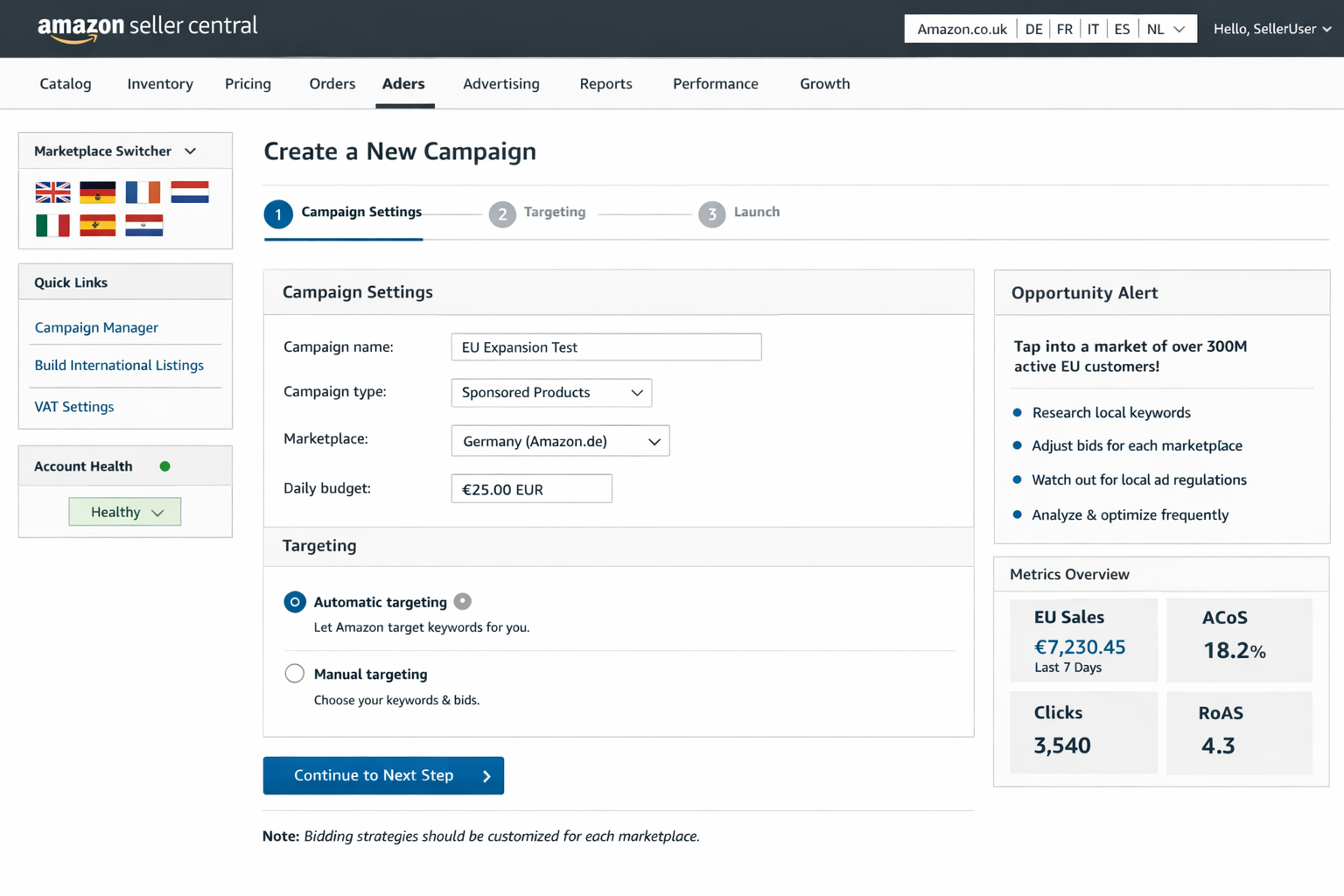
Creating Your First Campaign Shell
In your European Seller Central:
Navigate to Advertising → Campaign Manager
Click Create Campaign → Sponsored Products
Select Automatic Targeting for your first campaign—you need local search term data
Set daily budget conservatively (start at €20-30/day per market)
Set a default bid 20-30% below your US equivalent (you'll adjust based on data)
Run automatic campaigns for 2-3 weeks before building manual campaigns. The search term report data is worth more than any keyword tool for understanding local search behavior.
The PPC Playbook: Where US Sellers Get Burned
Your US campaigns are irrelevant here. Don't copy them. Don't translate them. Start fresh with international-first thinking.
Keyword Translation Pitfalls
This is where I see the most money wasted.
Machine translation doesn't work for Amazon PPC. Full stop.
Here's a real example of what happens when sellers skip native-speaker research:
| English (US) | Direct Translation (Bad) | Native Search Term (Good) | Why It Matters |
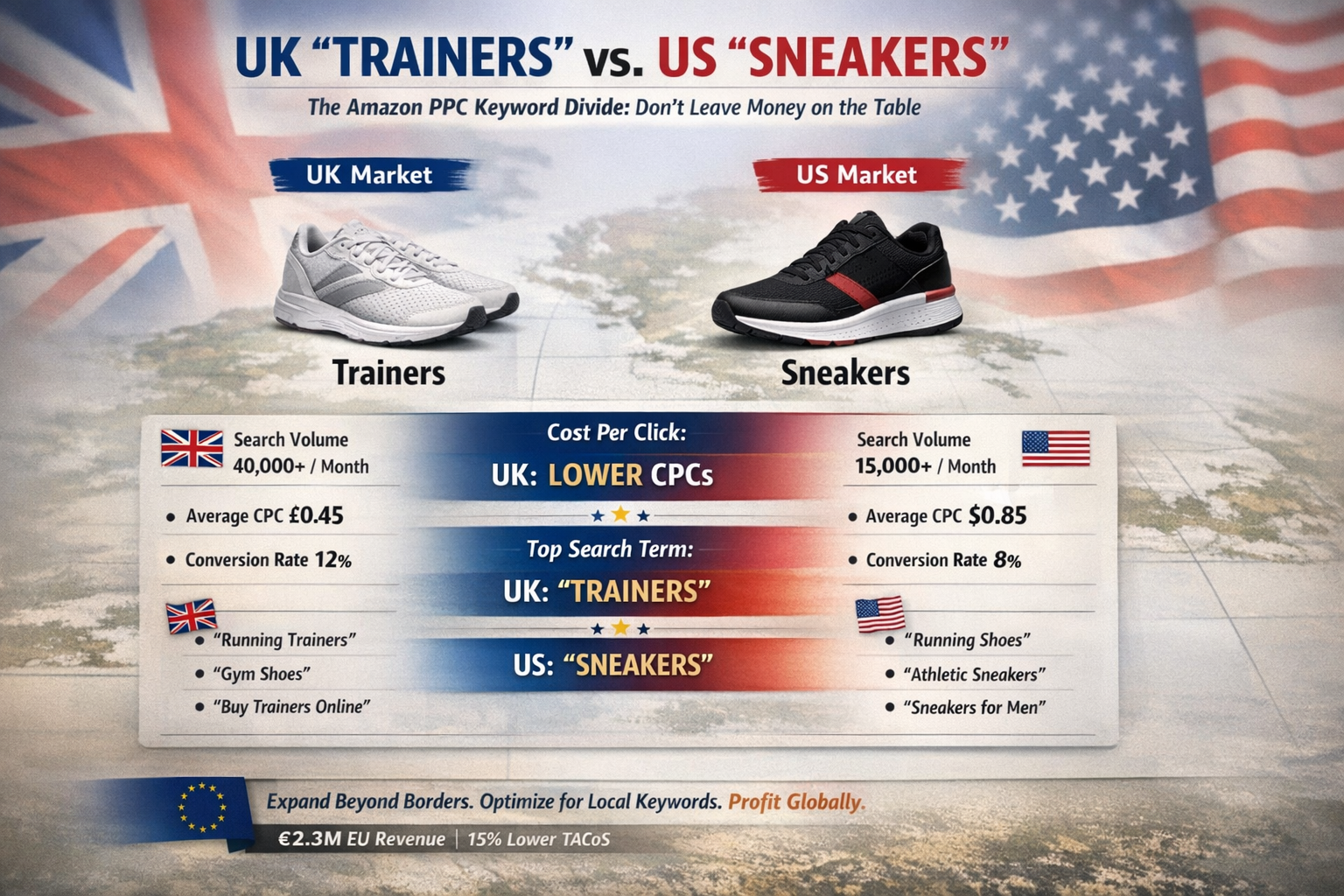
| Sneakers | Sneakers (UK) | Trainers | UK shoppers search "trainers" 4x more often |
| Pacifier | Schnuller (DE) | Beruhigungssauger / Nuckel | Regional variations exist; "Schnuller" is correct but regional terms vary |
| Band-aids | Pflaster (DE) | Pflaster | Direct translation works here—but you won't know without checking |
| Stroller | Kinderwagen (DE) | Buggy / Kinderwagen | Both terms used; missing one loses half your traffic |
I worked with a home goods seller who spent £3,200 on UK campaigns before realizing their primary keyword had a completely different meaning in British English. Three months of traffic. Zero conversions.
The fix: Invest in native-speaker keyword research. Tools like Helium 10 offer localization features, but always verify with a human who actually lives in that market [7].
Currency and Bid Adjustments
CPCs vary dramatically by market.
German CPCs often run higher than UK CPCs for equivalent products—more purchasing power means more competition for high-intent keywords [8].
Smaller EU markets like Spain or Italy? Often significantly lower CPCs. Less competition. Potentially higher margins if your product fits the market.
Your US bid strategy won't translate. You need to rebuild your bid logic from scratch based on local market data.
Your US bid strategy won't translate. You need to rebuild your bid logic from scratch based on local market data.
Competitive Landscape Variations
The US Amazon marketplace is a knife fight. Saturated categories. Aggressive bidding. Razor-thin margins on many products.
Some EU markets are still relatively open.
I've seen sellers achieve 40% lower ACoS in emerging EU markets simply because fewer competitors were bidding on the same keywords. That arbitrage won't last forever, but early movers capture it.
Research your category's competition level in each target market before launching. What looks impossible in the US might be wide open in Italy.
EU Advertising Regulations You Can't Ignore
The intro mentioned "European advertising regulations" as a risk. Here's what that actually means for your campaigns:
Germany: Comparative Advertising RestrictionsGerman law (UWG - Unfair Competition Act) restricts how you can compare your product to competitors. Claims like "better than Brand X" require documented proof. Vague superiority claims can trigger legal action.
UK: Health and Wellness ClaimsPost-Brexit, the UK maintains strict ASA (Advertising Standards Authority) rules. Health claims require specific substantiation. Phrases like "clinically proven" need actual clinical evidence you can produce on request.
EU-Wide: GDPR ImplicationsIf you're running Sponsored Display ads that use audience targeting, GDPR applies. Amazon handles most compliance, but your own retargeting or off-Amazon ads need proper consent mechanisms.
Product-Specific RulesSupplements, cosmetics, and electronics face additional advertising restrictions that vary by country. Check category-specific regulations before launching campaigns.
Ignorance isn't a defense. Budget for compliance review if you're in a regulated category.
Cultural Ad Copy Nuances
Your A+ content and product listings need localization, not translation.
German buyers expect precision and detailed specifications. UK buyers respond to different humor and phrasing than Americans. Spanish buyers have different trust signals [9].
Formality matters. In Germany, overly casual ad copy can undermine credibility. In the UK, being too stiff can make you seem out of touch.
This affects click-through rates, which affects quality scores, which affects CPCs, which affects profit.
Don't skip localization because it seems "soft." It directly impacts your bottom line.
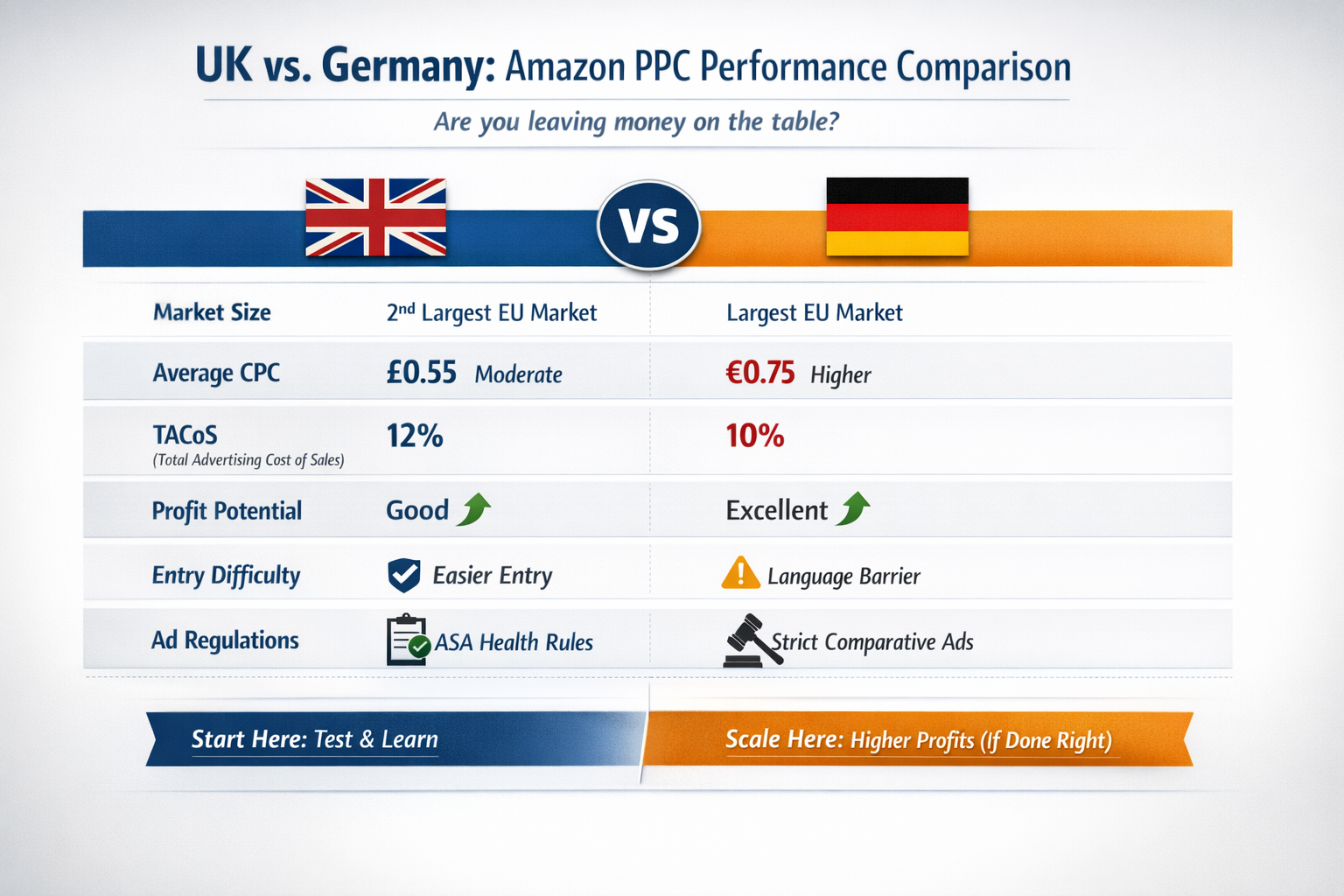
UK vs. Germany: A Market Comparison
| Factor | UK | Germany |
| Language | English (minor localization needed) | German required (no shortcuts) |
| Market Size | 2nd largest EU market | Largest EU market |
| Competition Level | High (mature marketplace) | Moderate-High (growing) |
| Average CPCs | Moderate | Higher than UK |
| Purchasing Power | Strong | Very strong |
| VAT Complexity | Post-Brexit complications | Complex but well-documented |
| Entry Difficulty | Easiest for US sellers | Moderate (language barrier) |
| Profit Potential | Good | Excellent (if executed well) |
| Ad Regulations | ASA oversight; health claims scrutinized | Strict comparative advertising rules |
The bottom line: Start with UK to test your international operations with minimal friction. Scale to Germany once you've proven your fulfillment and learned the European PPC landscape.
The Profit-First International Launch Framework
Here's how we approach international expansion:
Phase 1: Launch with Intent (Weeks 1-2)
Set up Unified European Account
Complete VAT registration for target markets
Build localized keyword lists (native speaker verified)
Launch conservative test campaigns with clear TACoS targets by product margin
Start with automatic campaigns to gather search term data
Phase 2: Prune Wasted Spend Fast (Weeks 3-4)
Download search term reports
Identify non-converting terms immediately
Add negatives aggressively
Cut bleeders before they become expensive lessons
Phase 3: Analyze and Iterate (Weeks 5-8)
Compare performance against US benchmarks
Identify market-specific winning keywords
Scale winners, cut losers
Adjust bids based on actual local CPC data
Phase 4: Scale Profitably (Month 3+)
Expand to additional marketplaces
Build Sponsored Brand and Sponsored Display campaigns
Test video ads where available
Reinvest profits into inventory and ad scaling
This isn't complicated. It's systematic.
Common International PPC Mistakes That Kill Profit
Mistake #1: Copying US campaigns directly. Your keyword list is worthless internationally. Rebuild from scratch.
Mistake #2: Ignoring VAT until it's a problem. Tax authorities don't care that you "didn't know." Get compliant before you launch.
Mistake #3: Using machine translation for keywords. You'll bid on nonsense and wonder why nothing converts.
Mistake #4: Applying US bid logic to EU markets. CPCs are different. Start conservative and let the data guide you.
Mistake #5: Skipping localization. Your American ad copy doesn't work in Germany. Invest in proper localization.
Mistake #6: Launching everywhere at once. Focus on one market, prove profitability, then expand. Spreading too thin kills margins.
Mistake #7: Ignoring local advertising regulations. Comparative claims, health statements, and product-specific rules vary by country. Non-compliance can get your listings suspended.
Tying International Expansion to Exit Value
If you're thinking about exit in the next 12-24 months, international presence matters.
Aggregators evaluate risk. A brand generating revenue across US, UK, and Germany presents lower risk than a US-only operation [2].
But here's what they really look at: profitability by market.
Expanding internationally just to say you did it means nothing. Expanding profitably with documented systems and clear TACoS performance?
That's valuation premium territory.
Clean data. Repeatable processes. Proof that the international revenue isn't accidental.
Your Next Move
International PPC expansion is a profit multiplier—when done right.
The UK and EU represent massive untapped potential for most US-focused Amazon sellers. Lower CPCs in some markets. Less competition in others. Revenue diversification that protects your business and increases exit value.
But it requires a different approach than your US campaigns.
Different keywords. Different bids. Different cultural context. Different regulations. Different systems.
If you're doing seven figures and haven't seriously explored international expansion, you're leaving money on the table. Period.
Ready to see if international expansion makes sense for your brand? Book a call and we'll map out a profit-first international strategy tailored to your products and margins.
Frequently Asked Questions
How much does it cost to start selling on Amazon UK or EU?
Initial costs include VAT registration (varies by provider and number of countries), localized keyword research, product listing translation, and initial inventory. The investment pays back quickly if campaigns are managed with profit-first principles and proper negative keyword hygiene from day one. Expect EORI applications to be free but VAT registration services to carry ongoing compliance fees.
Should I use Pan-European FBA or fulfill from one country?
Start with European Fulfillment Network (single country storage) to simplify VAT requirements while testing market viability. Once you've proven profitable sales in multiple markets, transition to Pan-European FBA for better delivery times and lower per-unit fulfillment costs. The added VAT complexity becomes worthwhile at scale—typically once you're generating consistent sales across three or more EU countries.
How different are CPCs in UK and Germany compared to the US?
CPCs vary significantly by category and market maturity. German CPCs often match or exceed US levels due to high purchasing power and growing competition. UK CPCs tend to run slightly lower than US equivalents in many categories. Smaller EU markets like Spain or Italy frequently offer lower CPCs due to less competition—but search volume is also lower. Always gather local data before scaling budgets.
Can I use the same keywords in UK and US campaigns?
Some keywords overlap, but assuming equivalence is dangerous. British English uses different terms (trainers vs. sneakers, plasters vs. band-aids, dummy vs. pacifier). Backend search terms also differ. Always conduct UK-specific keyword research and verify with native speakers before launching campaigns. The search term report from UK automatic campaigns is your best source of local data.
How long until international campaigns become profitable?
With proper setup and aggressive negative keyword management, most sellers see positive ROI within 60-90 days—though this varies significantly by product category, competition level, and starting CPC assumptions. The first 2-4 weeks focus on data gathering through automatic campaigns. Weeks 5-8 involve optimization based on that data. Rushing this timeline by scaling too fast before you understand local search behavior usually means burning money.
About PPC Maestro
PPC Maestro specializes in profit-first Amazon PPC management for 7-figure private label sellers. Founded by Bernard Nader, we've managed millions in ad spend across US, UK, and EU markets. Our approach focuses on cutting wasted spend, reallocating to winners, and protecting contribution margin—often seeing profit improvements within the first 30-60 days. We teach our systems publicly through SOPs, YouTube tutorials, and industry speaking engagements because transparent methodology builds trust.
Cited Works
[1] Amazon — "About Amazon: Company Facts." https://www.aboutamazon.com/about-us
[2] Forbes — "What Amazon Aggregators Look For When Acquiring Brands." https://www.forbes.com/sites/forbesbusinesscouncil/
[3] Amazon Seller Central — "Unified European Account and Pan-European FBA." https://sellercentral.amazon.com/help/hub/reference/G201468320
[4] UK Government — "VAT Registration for Overseas Sellers." https://www.gov.uk/guidance/vat-registration-for-overseas-sellers
[5] German Federal Central Tax Office — "VAT Registration Requirements for E-Commerce." https://www.bzst.de/EN/Businesses/VAT/
[6] Jungle Scout — "Selling on Amazon UK: A Complete Guide for US Sellers." https://www.junglescout.com/blog/selling-on-amazon-uk/
[7] Helium 10 — "International Keyword Research for Amazon Sellers." https://www.helium10.com/blog/
[8] Marketplace Pulse — "Amazon Europe Market Analysis." https://www.marketplacepulse.com/
[9] eMarketer — "Cross-Border Ecommerce in Europe."
https://www.emarketer.com/