You've got a new product sitting in FBA. Zero reviews. Zero organic rank. Zero sales history.
Amazon's algorithm doesn't care about your product quality. It cares about velocity.
Without structured PPC, your launch dies in the warehouse. I've seen it happen dozens of times—sellers dump $15k into a product launch with no framework, watch ACoS hit 200%, panic, slash budgets, and wonder why they're stuck on page 47.
Here's the truth: launching a product on Amazon isn't a guessing game. It's a system.
This is the exact product launch PPC playbook we use to take new ASINs from invisible to ranked in 60 days. It's built on four campaign types, leverages Amazon's honeymoon period, and includes realistic expectations about what "success" actually looks like in the launch phase.
Why Most Product Launches Fail Before They Start
New products face a brutal chicken-and-egg problem.
Amazon's A9 algorithm ranks products based on sales velocity, conversion rate, and relevance signals [1]. But without rank, you don't get visibility. Without visibility, you don't get sales. Without sales, you don't get rank.
PPC breaks this cycle. It's not optional for launches—it's the ignition system.
The mistake most 7-figure sellers make? They treat launch PPC like maintenance PPC. Same bid strategies. Same ACoS targets. Same "set it and forget it" mentality.
That approach works for established products with organic momentum. For launches, it's a death sentence.
I audited a supplement brand last quarter. They launched four SKUs using their standard campaign structure—broad match keywords, $50/day budgets, 35% ACoS target. Sixty days later: combined organic rank of zero on their target keywords. They'd spent $18k generating sales Amazon's algorithm essentially ignored because there was no keyword-level velocity concentration.
Launch PPC requires a different playbook entirely.
Before You Spend a Dollar: The Pre-Launch Checklist
Running aggressive PPC on a product with zero reviews is like pouring gasoline on wet wood. You'll burn through cash without ignition.
Before launching campaigns, complete these prerequisites:
Enroll in Amazon Vine
Amazon Vine gets your product into the hands of trusted reviewers [2]. For most categories, you can request up to 30 Vine reviews per parent ASIN.
Why this matters for PPC: A listing with 10-15 reviews converts dramatically better than a listing with zero. The same $50/day budget generates more sales—and more algorithmic signal—when shoppers see social proof.
Enroll in Vine the moment your inventory hits FBA. Don't wait for "enough stock." The review clock needs to start ticking before you scale ad spend.
Optimize Your Listing for Conversion
No amount of PPC spend fixes a 6% conversion rate. If your listing doesn't convert, you're just paying Amazon to show shoppers a product they don't want to buy.
Before turning on ads, confirm:
Main image is click-worthy (test against competitors)
Title includes primary keyword naturally
Bullet points address objections and highlight benefits
A+ Content is live (if Brand Registered)
Price is competitive for your position
Minimum viable conversion rate: 12-15% before scaling PPC. Below that, fix the listing first.
Understand the Honeymoon Period
Amazon gives new ASINs a discovery boost during roughly the first 30-45 days [3]. The algorithm tests your product against various search terms and placements to gauge relevance and conversion potential.
This window is your launch advantage. Waste it with unstructured campaigns, and you're fighting uphill for months. Capitalize on it with concentrated velocity, and you can establish organic rank that compounds.
The honeymoon period is why the first 60 days matter so much—and why this playbook is time-bound.
The 4-Part Launch Framework
This framework comes from analyzing hundreds of successful product launches and reverse-engineering what separates the winners from the money pits.
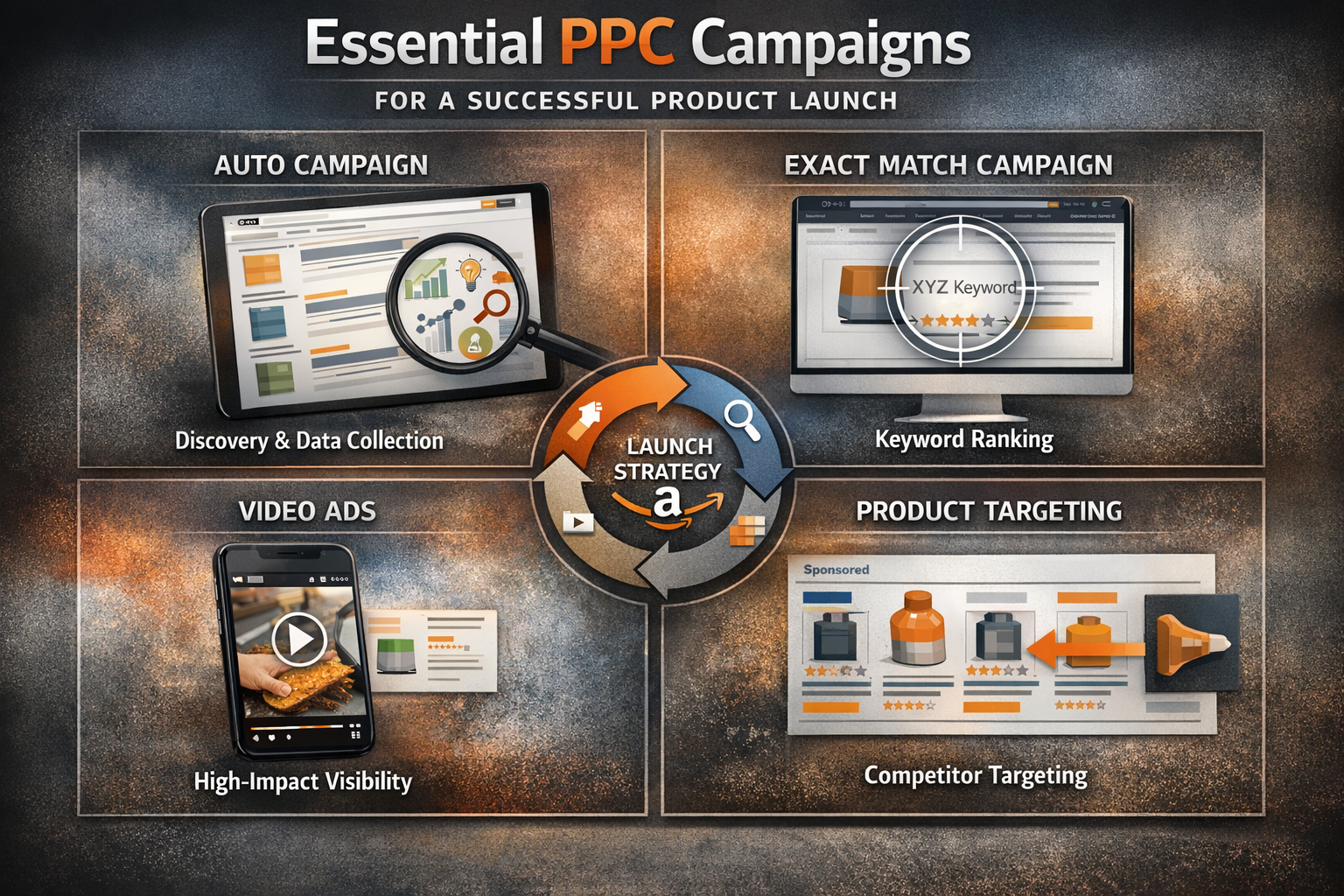
Four campaign types. Each serves a distinct purpose. Run all four simultaneously from Day 1.
Campaign 1: Auto Campaign (Discovery + Data Collection)
Budget: $10–30/dayPurpose: Keyword and ASIN discovery
Auto campaigns are your reconnaissance mission. Amazon's algorithm tests your product against search terms and competitor ASINs it thinks are relevant [4].
Your job isn't to generate profitable sales here. It's to collect data.
Set bids low—start at $0.50–0.75 for most categories. You want impressions and clicks without hemorrhaging cash. The auto campaign feeds intelligence to your manual campaigns.
Key settings:
Use "close match" and "loose match" targeting
Enable "complements" and "substitutes" for ASIN discovery
Set negative exact matches on your branded terms (you'll capture those elsewhere)
Within 7–10 days, you'll have search term data showing which queries Amazon associates with your product. Some will be gold. Most will be garbage. Both are valuable information.
Campaign 2: Manual Exact Match (Rank Building)
Budget: $30–75/day (scale as you validate winners)Purpose: Concentrated velocity on launch keywords
This is your rank-building engine. Everything else supports this campaign.
Select 5–10 "launch keywords"—high-relevance terms where you want to establish organic position. Pull these from:
Brand Analytics (Top Search Terms report for your category) [5]
Helium 10 or similar tools (search volume + relevance scoring)
Competitor listing analysis (what are ranked competitors targeting?)
The criteria: high relevance to your product, meaningful search volume, and achievable competition. Don't chase "wireless headphones" on Day 1. Find the specific long-tail terms where you can realistically hit page 1 within 60 days.
Bid aggressively on these keywords. I mean 30–50% above Amazon's suggested bid to start. You need top-of-search placement to generate the click velocity that builds rank [6].
Yes, this is expensive. Yes, your ACoS will be ugly. We'll address that in the expectations section.
Campaign 3: Sponsored Brands Video (High-Impact Visibility)
Budget: $15–30/dayPurpose: Higher CTR, lower CPC, visual differentiation
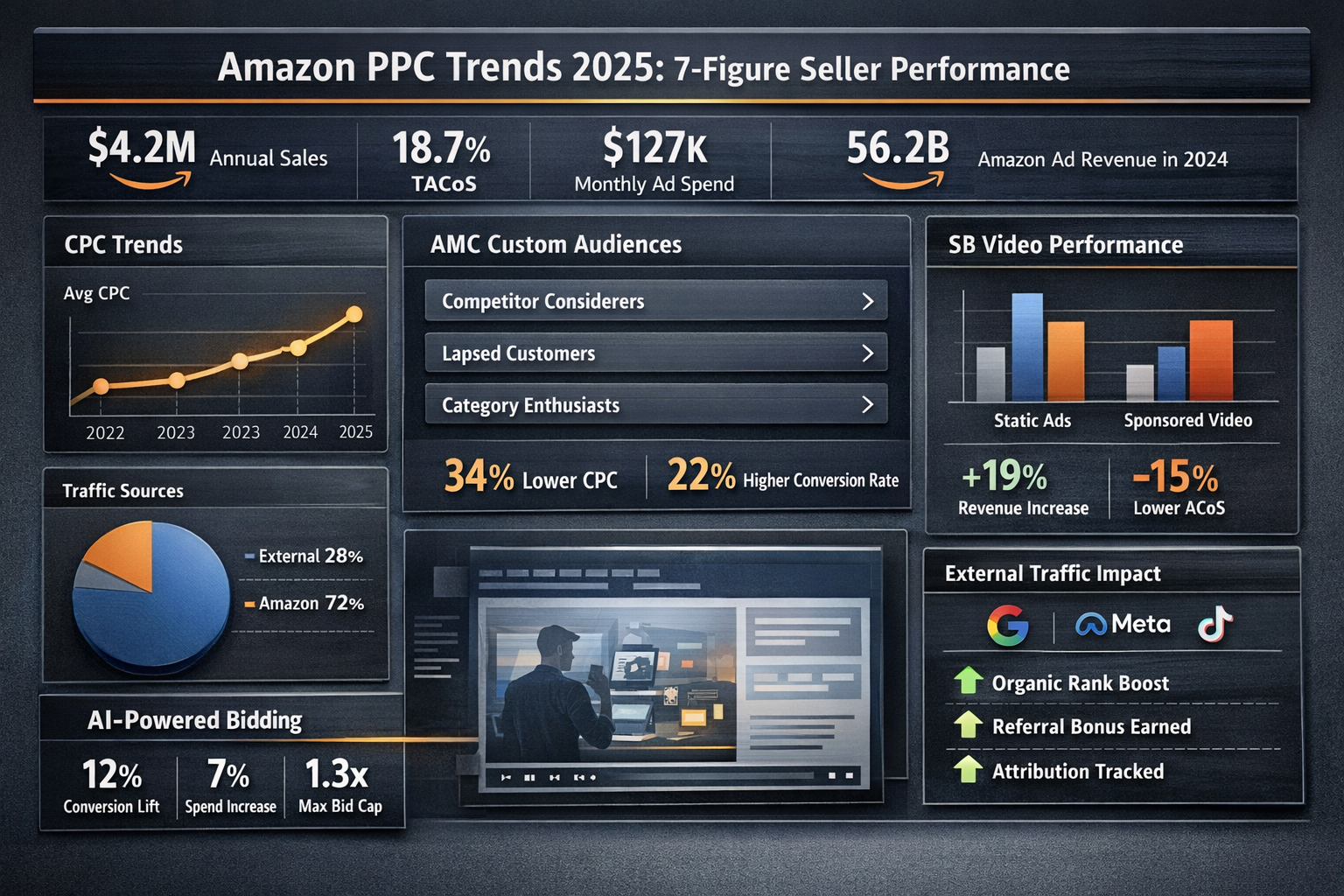
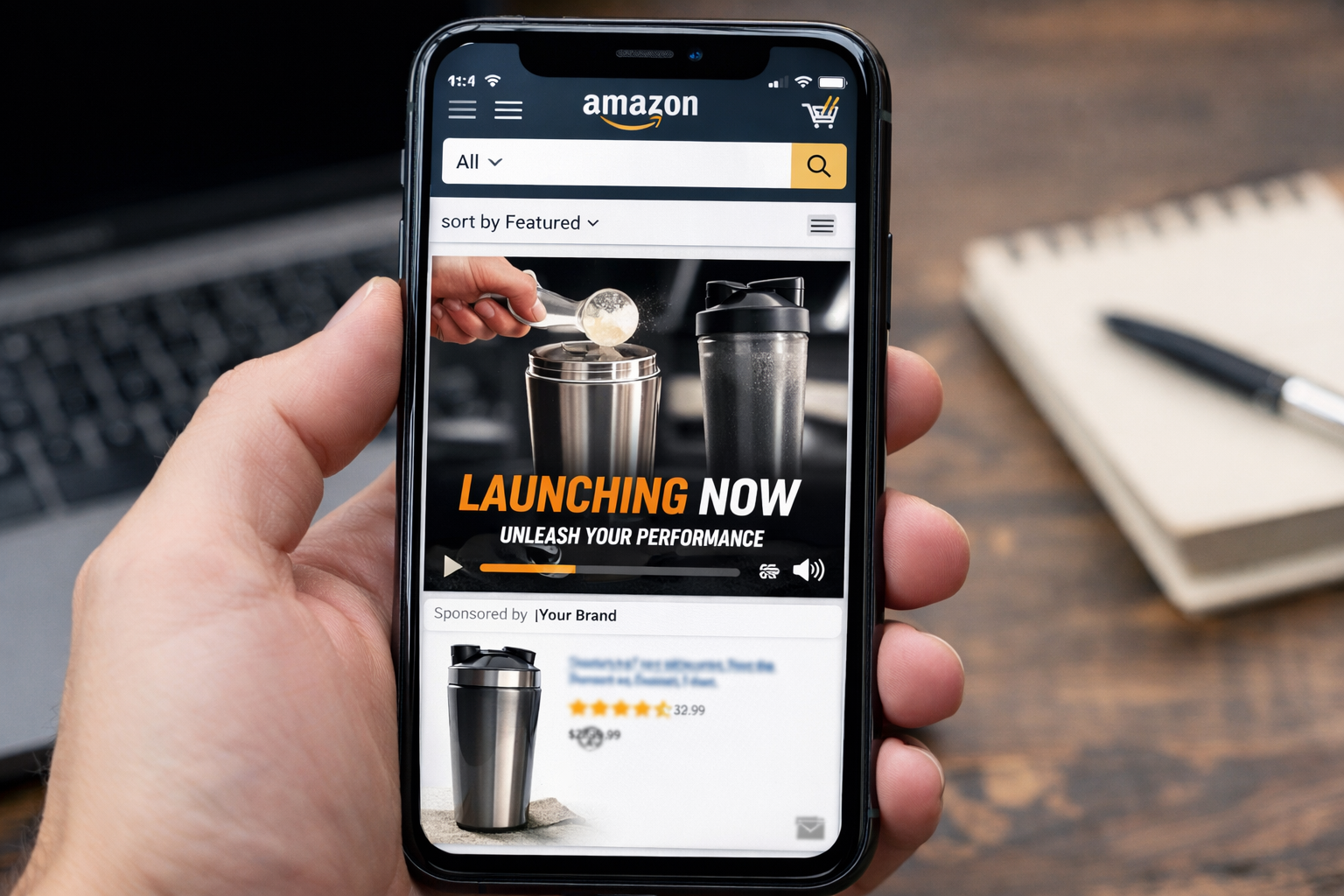
Here's what most launch guides miss: Sponsored Brands Video (SBV) often outperforms Sponsored Products for new ASINs [7].
Why? Video ads auto-play in search results. They capture attention in ways static images can't. For launches where you're fighting for every click, video can deliver:
2-3x higher CTR than standard Sponsored Products
Lower CPCs (less competition in video placements)
Better conversion through product demonstration
Video requirements:
15-30 seconds optimal length
Show the product in use
No external URLs or pricing claims
Mobile-optimized (most shoppers are on phones)
You don't need Hollywood production. A clean product demonstration shot on a smartphone works. The key is showing your product solving a problem—which builds purchase confidence for a listing with limited reviews.
Target your top 3-5 launch keywords with SBV. The combination of exact match Sponsored Products + Sponsored Brands Video on the same keywords creates visibility dominance.
Campaign 4: Product Targeting (Traffic Acquisition)
Budget: $15–40/dayPurpose: Steal visibility from established competitors
Product targeting puts your listing in front of shoppers already browsing competitor products. You appear in "Compare with similar items" and "Customers who viewed this also viewed" placements [8].
Two targeting approaches:
Complementary ASINs: Products your customer buys alongside yours. If you're launching a yoga mat, target yoga blocks, straps, and carrying bags. These shoppers are in-market and your product makes sense as an add-on.
Competitor ASINs: Direct competitors where you have an advantage. Lower price. Better imagery. Superior feature set. Don't target the #1 Best Seller with 15,000 reviews—target the mid-tier competitors where you can actually convert.
Start with 15–25 ASINs across both categories. You'll quickly identify which convert and which drain budget.
Week-by-Week Execution Plan
Theory is worthless without execution. Here's the exact timeline we use with clients launching new products.
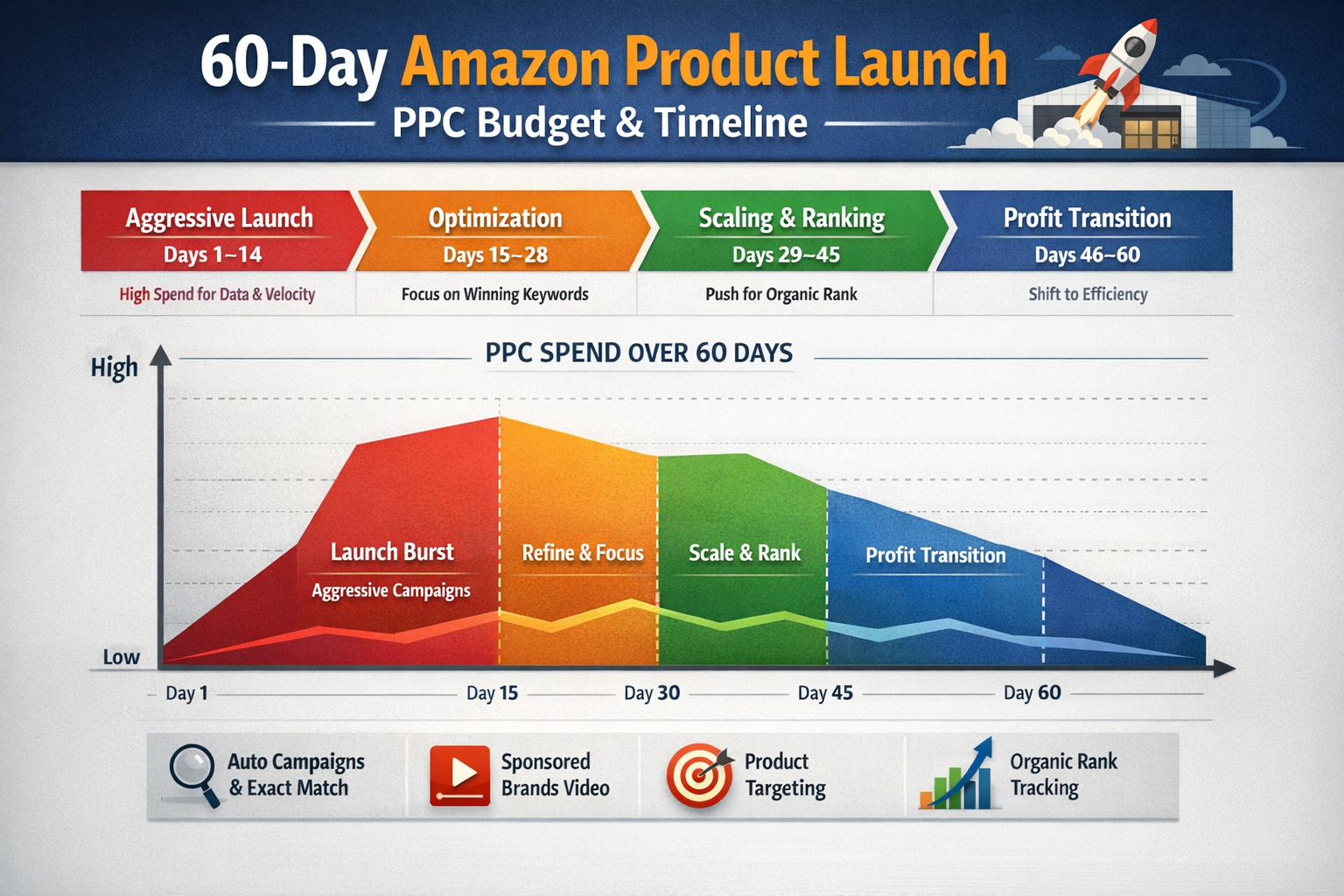
Weeks 1–2: Launch + Rapid Learning
Primary Goal: Generate data, establish initial velocity, capitalize on honeymoon period
Actions:
Launch all four campaign types simultaneously
Set auto campaign bids at $0.50–0.75
Set exact match bids at 30–50% above suggested
Set SBV bids at $0.40–0.60 (often cheaper than SP)
Set product targeting bids at $0.60–0.90
Check search term reports every 3 days
Negative exact match irrelevant terms from auto campaign immediately
Track CTR closely—aim for 0.35%+ [9]
In the first two weeks, you're not optimizing for profit. You're optimizing for signal quality. Which keywords generate clicks? Which convert? Which ASINs send relevant traffic?
Expect chaos in your metrics. ACoS will be all over the map. That's normal.
Red flags to watch:
CTR below 0.20% (listing issue—revisit main image and title)
Zero conversions after 50+ clicks on a keyword (relevance mismatch)
Auto campaign spending on completely irrelevant terms (tighten negatives faster)
SBV getting no impressions (video may need creative refresh)
Weeks 3–4: Consolidation + Scaling Winners
Primary Goal: Concentrate budget on proven performers
Actions:
Pause keywords with 30+ clicks and zero conversions
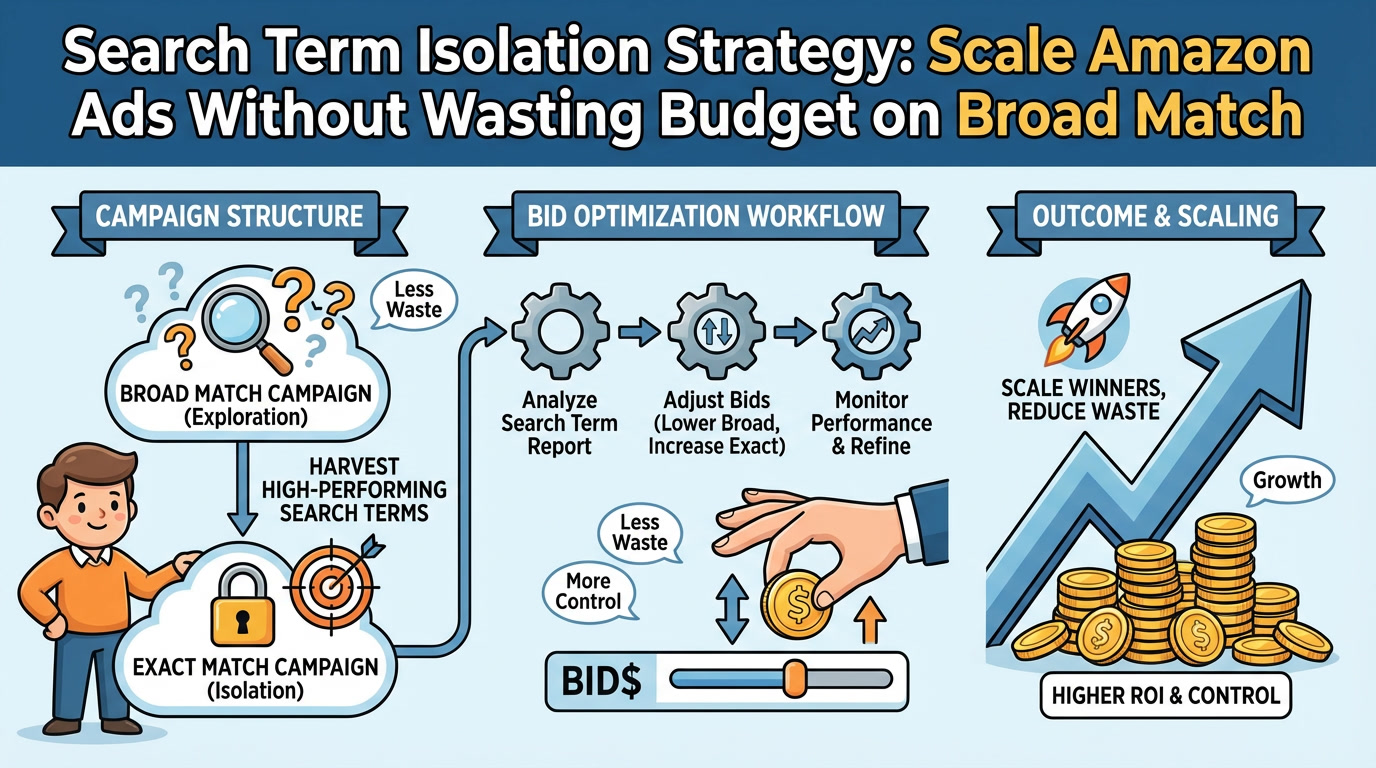
Move high-converting search terms from auto to exact match campaigns
Increase bids on exact match keywords showing 15%+ CVR
Expand ASIN targeting based on conversion data
Scale SBV budget on keywords where video outperforms static ads
Begin tracking organic rank position on launch keywords
Double down on top 3–5 performing keywords
This is where the Profit Feedback Loop framework kicks in. You've collected data in the discovery phase. Now you're pruning waste and reallocating to winners.
If a keyword generated 45 clicks and 2 sales at $3.50 CPC, that's $78.75 per sale. Brutal ACoS—but if your product is $35, you need to decide: is this keyword worth buying rank on, or is it a bleeder?
The answer depends on search volume and strategic value. A high-volume launch keyword might justify the short-term loss. A low-volume term probably doesn't.
Weeks 5–8: Scale + Rank Capture
Primary Goal: Achieve organic rank, transition to profitable PPC
Actions:
Scale exact match budgets on keywords showing organic rank improvement
Reduce bids on keywords where you've achieved page 1 organic
Layer in additional Sponsored Brand campaigns for keywords with proven CVR
Consider external traffic for Brand Referral Bonus acceleration [10]
Begin transitioning from "launch mode" to "profit mode" bidding
Set TACoS targets based on actual unit economics
By Week 5, you should see organic rank movement on your launch keywords. Tools like Helium 10's keyword tracker or Brand Analytics show where you're positioned.
The pattern you want: as organic rank improves, organic sales increase, and your PPC dependency decreases. Your TACoS should start compressing.
If you're Week 6 with zero organic rank improvement, something's broken:
Listing conversion rate is too low
Launch keywords were poorly selected (too competitive)
Velocity wasn't concentrated enough (budget spread too thin)
Reviews haven't accumulated (Vine enrollment delayed?)
This is diagnostic information. Don't keep throwing money at a broken strategy—analyze and pivot.
Setting Realistic Launch Expectations
Here's where I lose people.
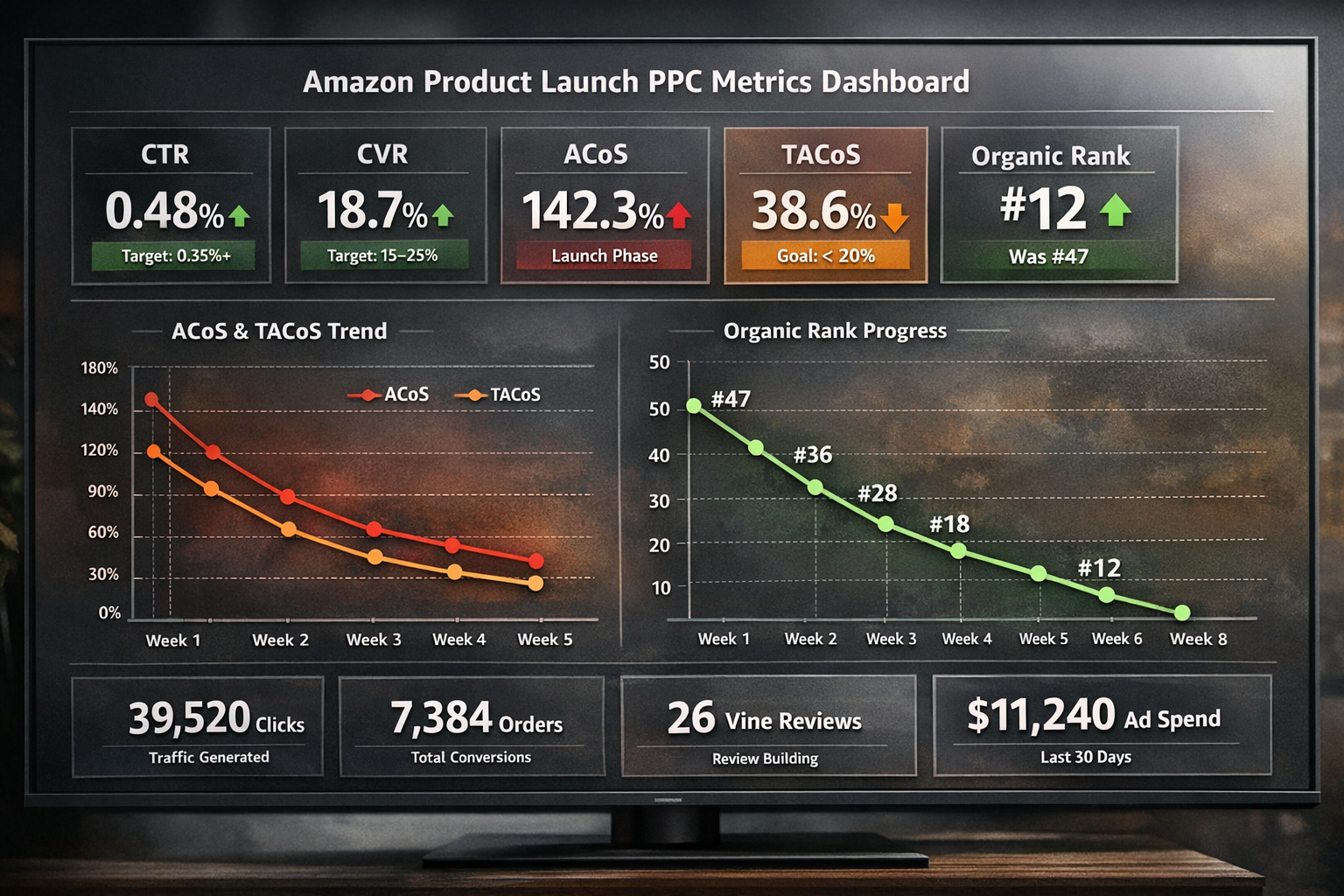
Your ACoS during launch will be 100%+. Often 150–200%.
If you're not prepared for this, you're not prepared to launch products on Amazon.
Launch PPC is an investment in rank—not a profit center. You're buying velocity that Amazon's algorithm rewards with organic position. The payoff comes later, when organic sales comprise 60–70%+ of your total volume and PPC becomes supplementary rather than primary.
I worked with a kitchen brand last year. Launch month: $12k in PPC spend, $8k in PPC revenue. ACoS: 150%. Horrible, right?
By month three: $6k in PPC spend, $32k in total revenue ($22k organic). TACoS: 18.75%. They'd bought organic rank that generated profit for the next 18 months.
Metrics that actually matter during launch:
| Metric | Target | Why It Matters |
| CTR | 0.35%+ | Indicates listing relevance and appeal |
| CVR | 15–25% | Confirms product-market fit |
| Impressions | Increasing weekly | Shows Amazon expanding your reach |
| Organic Rank | Improving weekly | Validates strategy is working |
| TACoS | Compressing over 8 weeks | Shows organic taking over |
| Review Count | Growing via Vine | Builds conversion foundation |
ACoS is almost meaningless during launch. A 180% ACoS with improving organic rank is infinitely better than a 45% ACoS with zero rank movement.
Common Launch Mistakes (And How to Avoid Them)
After managing millions in launch spend, these are the patterns I see repeatedly:
Mistake 1: Skipping Vine enrollment.Aggressive PPC + zero reviews = wasted budget. Get reviews accumulating before you scale spend. The math doesn't work otherwise.
Mistake 2: Budget spread too thin.Five campaigns, 200 keywords, $75/day total. Amazon needs concentrated velocity on specific keywords to move rank. Pick 5–10 launch keywords and dominate them.
Mistake 3: Cutting spend when ACoS spikes.Launch ACoS will spike. That's the plan. Sellers who panic and slash budgets at Week 2 kill their velocity right when the algorithm is starting to pay attention—and right in the middle of the honeymoon period.
Mistake 4: Ignoring Sponsored Brands Video.Most sellers default to Sponsored Products only. SBV often delivers better CTR at lower CPCs. For launches where every click matters, that efficiency compounds.
Mistake 5: Wrong keyword selection.Targeting "kitchen gadgets" when you're launching a specific garlic press. Your launch keywords need tight relevance. Broad terms come later, after you've established baseline organic presence.
Mistake 6: Ignoring conversion rate issues.No amount of PPC spend fixes a 6% conversion rate. If your listing doesn't convert, you're just paying Amazon to show shoppers a product they don't want to buy. Fix the listing first.
Mistake 7: No negative keyword discipline.Auto campaigns will spend on garbage terms. If you're not adding negative keywords every 3–4 days during launch, you're bleeding budget on irrelevant clicks.
Connecting Launch to Long-Term Profit
Launch PPC is Phase 1 of the Profit Feedback Loop.
You're collecting data: which keywords convert, which ASINs send buyers, what your true conversion rate looks like with real traffic. This intelligence feeds every optimization decision for the life of the product.
The sellers who treat launch as "just spend money and pray" end up with chaotic accounts, no organic presence, and perpetual PPC dependency. The sellers who treat launch as a structured data collection and rank-building system end up with products that generate profit for years.
The transition happens around Week 8:
Organic sales should comprise 40–60%+ of total volume
TACoS should be compressing toward your target (usually 12–20% for healthy products)
You have proven keyword and ASIN targeting data
You can shift from "buy velocity" bidding to "protect margin" bidding
At that point, launch mode ends and maintenance mode begins. Different playbook, different priorities—but built on a foundation of clean data and established rank.
Your 60-Day Launch Action Plan
Pre-Launch (Before Day 1): Enroll in Vine. Optimize listing for 15%+ CVR. Prepare SBV creative. Identify 5-10 launch keywords.
Days 1–14: Launch auto + exact match + SBV + product targeting. Collect data aggressively. Negative garbage terms fast. Track CTR and CVR, not ACoS. Capitalize on honeymoon period.
Days 15–28: Pause non-converters. Graduate winners from auto to exact. Increase bids on launch keywords showing traction. Scale SBV on high-performers. Monitor organic rank.
Days 29–45: Scale exact match budgets on proven winners. Reduce bids where organic rank is established. Add Sponsored Brand headlines for high-CVR keywords.
Days 46–60: Assess organic position. If ranked on launch keywords, transition to profit-focused bidding. If not ranked, diagnose and adjust.
This isn't complicated. It's disciplined.
Stop Launching Products Without a System
Every product launch is an investment. The question is whether you're investing strategically or just gambling.
The playbook above has generated page 1 organic rank on target keywords for dozens of products across categories. It works because it aligns with how Amazon's algorithm actually functions—rewarding concentrated velocity with organic visibility.
If you're launching 2–4 products per year and don't have a repeatable framework, you're leaving money on the table. Worse, you're training yourself that "launches are expensive and unpredictable" when they're actually systematic and measurable.
Want to see how launch data feeds into long-term optimization? Explore the Profit Feedback Loop to understand how the intelligence you collect during launch drives every decision afterward.
Ready to launch your next product with a profit-first framework? Book a call to discuss how we structure launch campaigns for 7-figure sellers—or check out our SOPs for the tactical execution details.
Frequently Asked Questions
How much should I budget for a product launch PPC campaign?
Plan for $3,000–$7,000 in PPC spend over 60 days for a typical launch, depending on category competitiveness. The exact amount depends on your target keywords' CPCs and the velocity needed to move rank. Budget enough to generate 20–30 sales per week minimum on your launch keywords—below that threshold, you won't build meaningful velocity. Factor in Vine enrollment costs separately.
Why is my launch ACoS so high, and when will it come down?
Launch ACoS typically runs 100–200% because you're investing in rank, not immediate profit. This is expected behavior during the honeymoon period. ACoS compresses as organic rank improves (usually starting around Week 4–6) and organic sales begin contributing to total revenue. By Week 8, your TACoS should be trending toward your target range of 12–20%.
Should I use Sponsored Products or Sponsored Brands Video for launches?
Use both. Sponsored Products exact match campaigns drive the concentrated velocity that builds rank. Sponsored Brands Video often delivers higher CTR at lower CPCs, giving you more efficient visibility during the critical launch window. The combination creates visibility dominance on your launch keywords—you want to own multiple placements on the same search results page.
How do I know if my product launch PPC is working?
Track organic rank position on your launch keywords weekly. If rank is improving while you maintain sales velocity, the strategy is working regardless of ACoS. Also monitor CVR (target 15–25%) and CTR (target 0.35%+). If these metrics are healthy and rank is moving, you're on track. Review accumulation from Vine is another leading indicator of future conversion improvement.
When should I stop "launch mode" and switch to normal PPC management?
Transition when organic sales comprise 40–60% of your total volume and you've achieved page 1 rank on your primary launch keywords. This typically happens around Week 6–10. At that point, shift from aggressive bidding to margin-protection bidding and begin optimizing for TACoS rather than pure velocity. The honeymoon period is over—now you're playing the long game.
About PPC Maestro
PPC Maestro is a profit-first Amazon PPC agency built for 7-figure sellers who are done watching ad spend leak into wasted clicks. Founded by Bernard Nader, we've managed millions in Amazon ad spend using systematic frameworks—not guesswork. Our Profit Feedback Loop methodology has helped sellers cut wasted spend by 30%+ while scaling profitable campaigns. Every recommendation we make ties back to contribution margin, TACoS targets, and actual business outcomes—not vanity ACoS metrics.
Cited Works
[1] Amazon Seller Central — "A9 Algorithm and Product Ranking Factors." https://sellercentral.amazon.com/help/hub/reference/G201687550
[2] Amazon Vine — "Vine Program Overview and Enrollment." https://sellercentral.amazon.com/help/hub/reference/G92T8UV339NZ98TN
[3] Helium 10 — "Understanding Amazon's Honeymoon Period for New Products." https://www.helium10.com/blog/amazon-honeymoon-period/
[4] Amazon Advertising — "Sponsored Products: Automatic Targeting." https://advertising.amazon.com/help/GKWGFM9BA5P8CQSD
[5] Amazon Seller Central — "Brand Analytics: Search Query Performance." https://sellercentral.amazon.com/help/hub/reference/G5NXWNY8HUD3VSZW
[6] Amazon Advertising — "Bid Recommendations and Placement Strategies." https://advertising.amazon.com/help/GTQ9NVHXQD8YQVJV
[7] Amazon Advertising — "Sponsored Brands Video Creative Guidelines." https://advertising.amazon.com/help/GZBDMGQ6NZ4SXKF4
[8] Amazon Advertising — "Product Targeting for Sponsored Products." https://advertising.amazon.com/help/G9RKGRL5DYFGDPXS
[9] Jungle Scout — "Amazon Advertising Benchmarks: CTR, CVR, and ACoS." https://www.junglescout.com/blog/amazon-advertising-benchmarks/
[10] Amazon Brand Referral Bonus — "Earn a Bonus for Driving External Traffic." https://brandservices.amazon.com/brandbenefits/brand-referral-bonus