Last week I pulled a search term report for a seller spending $47k/month on Amazon PPC.
His broad match campaigns were bidding $2.40 on every single search term. The term converting at 18%? $2.40. The garbage term that burned $1,200 with zero sales? Also $2.40.
That's not a slot machine.
Search term isolation is how you stop gambling and start scaling. It's the difference between throwing money at Amazon's algorithm and building a profit machine you actually control.
Here's the operational playbook we use at PPC Maestro to isolate winning terms, kill the bleeders, and scale ad spend without lighting your margins on fire.
What Search Term Isolation Actually Means (And Why Most Sellers Skip It)
Broad and phrase match campaigns have a fundamental problem.
They bid the same amount on every search term Amazon decides to match you with. Your $1.50 bid goes to the term that converts at 12% and the term that's burned $400 without a single add-to-cart.
You can't scale your winners without overpaying for your losers.
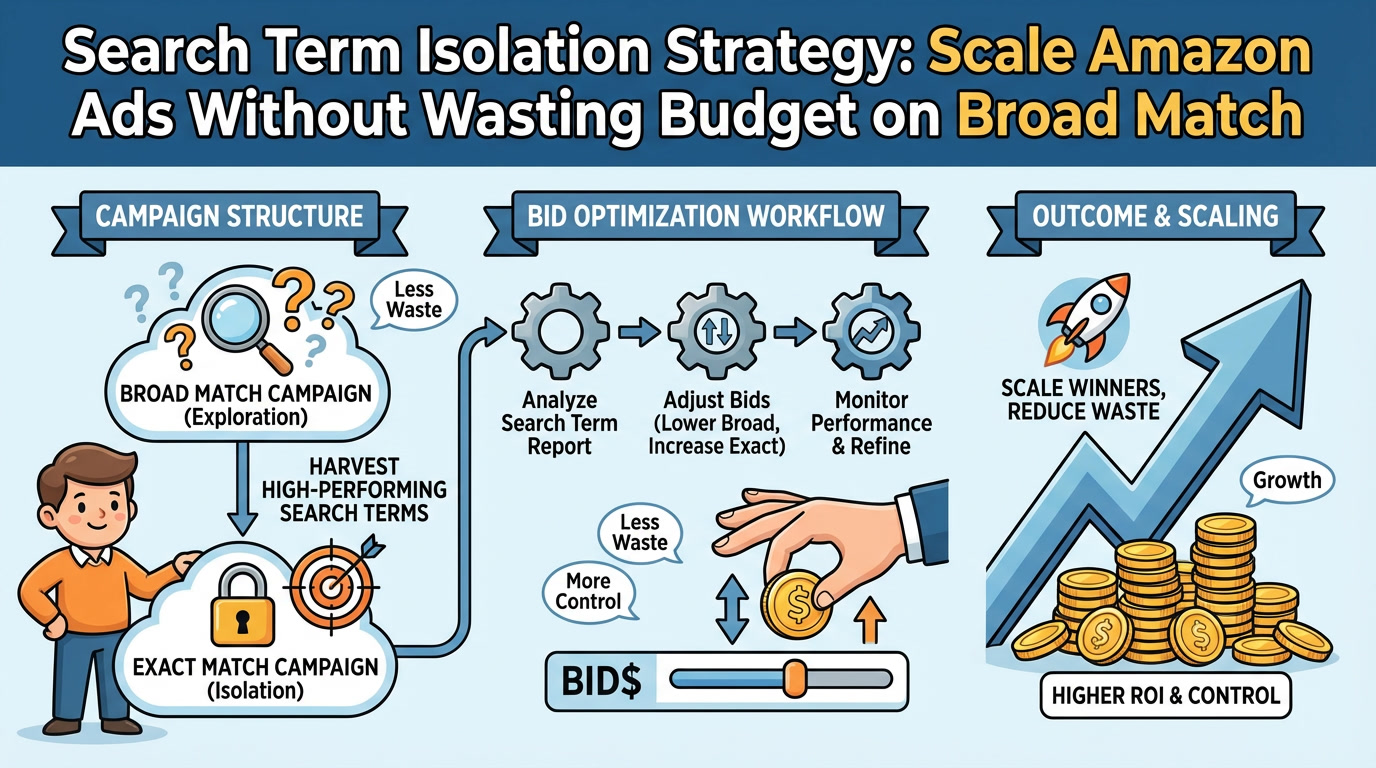
Search term isolation solves this by giving you per-term bid control. You pull your best-performing search terms out of broad/phrase campaigns, move them into exact match campaigns, and negative them out of the original campaigns.
Now you can bid $3.00 on the term printing money and $0.00 on the term burning it.
Simple concept. Most sellers still don't do it.
Why? Because it requires actual work. You need to pull reports, analyze data, create new campaigns, add negatives, and monitor performance. It's not sexy. It's operational.
But operational is where profit lives.
The Profit Feedback Loop we use with every client has isolation built into the system. Launch campaigns, gather data, identify winners, isolate and scale, prune the rest. Rinse and repeat.
The 3-Campaign Framework That Makes Isolation Work
Before you can isolate anything, you need a structure that supports it.
Most accounts I audit are a mess. Campaigns named "Broad - January" mixed with "Test 3 Final FINAL." No system. No hierarchy. No way to track what's working.
Here's the framework we build for every client:
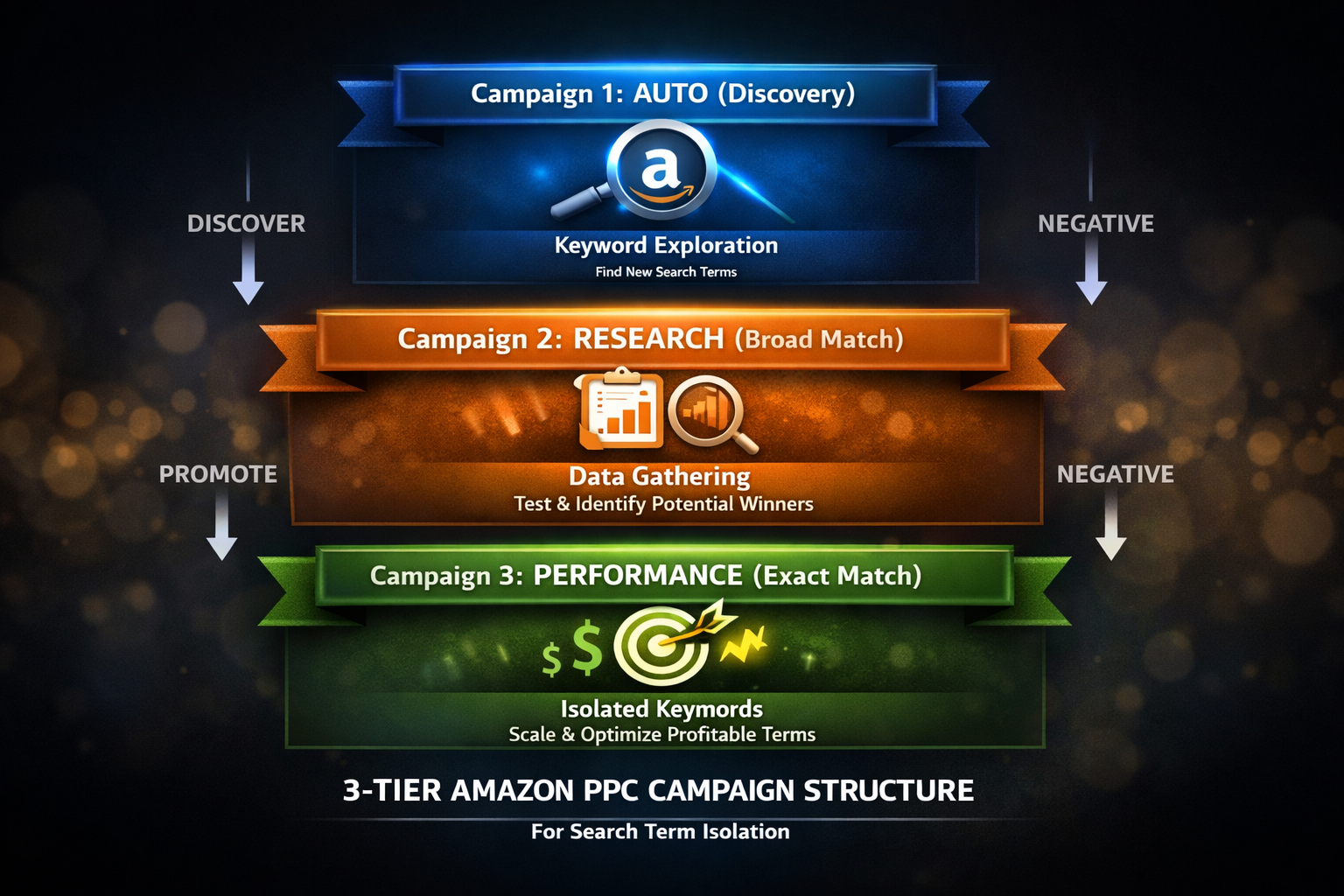
Campaign 1: Auto (Discovery)
Auto campaigns exist to discover search terms you'd never think to bid on.
Amazon's algorithm matches you with relevant queries. Some will be gold. Most will be garbage. That's fine—this is a data-gathering exercise, not a profit center.
Set modest bids. Accept that ACoS will be higher here. Your job is to mine this campaign for winners, not squeeze profit from it directly.
Campaign 2: Research/Broad (Data Gathering)
This is where you test the terms you think will work.
Broad and phrase match campaigns let you cast a wider net around your target keywords. "Silicone baking mat" might match "best silicone mat for cookies" or "non-stick baking sheet silicone."
Same deal as auto: you're gathering conversion data, not optimizing for immediate profit. Let the terms run. Collect the data. Make decisions with evidence, not hunches.
Campaign 3: Performance/Exact (Isolated High-Converters)
This is where profit happens.
Performance campaigns contain only search terms that have proven themselves. They've converted. They've hit your CVR threshold. They've earned the right to scaled spend.
Because these are exact match keywords, you control exactly which search queries trigger your ads. No surprises. No wasted clicks on tangential nonsense.
You can bid aggressively here because you know these terms convert. The data already told you.
The system flows one direction: Auto → Research → Performance. Terms graduate when they prove themselves. Terms that don't perform get negated and cut.
The Isolation Workflow: Step-by-Step
Theory is worthless without execution. Here's exactly how we isolate terms for clients:
Step 1: Pull Your 30-Day Search Term Report
Go to Campaign Manager → Reports → Search Term Report.
[INSERT IMAGE: Screenshot of Seller Central navigation to Search Term Report]
Download the last 30 days. If you're spending less than $5k/month, pull 60 days to get enough data.
Pro tip: If you're running bulk operations, the search term report via Bulk Files gives you more flexibility for filtering and pivot tables.
Step 2: Filter for Isolation Candidates
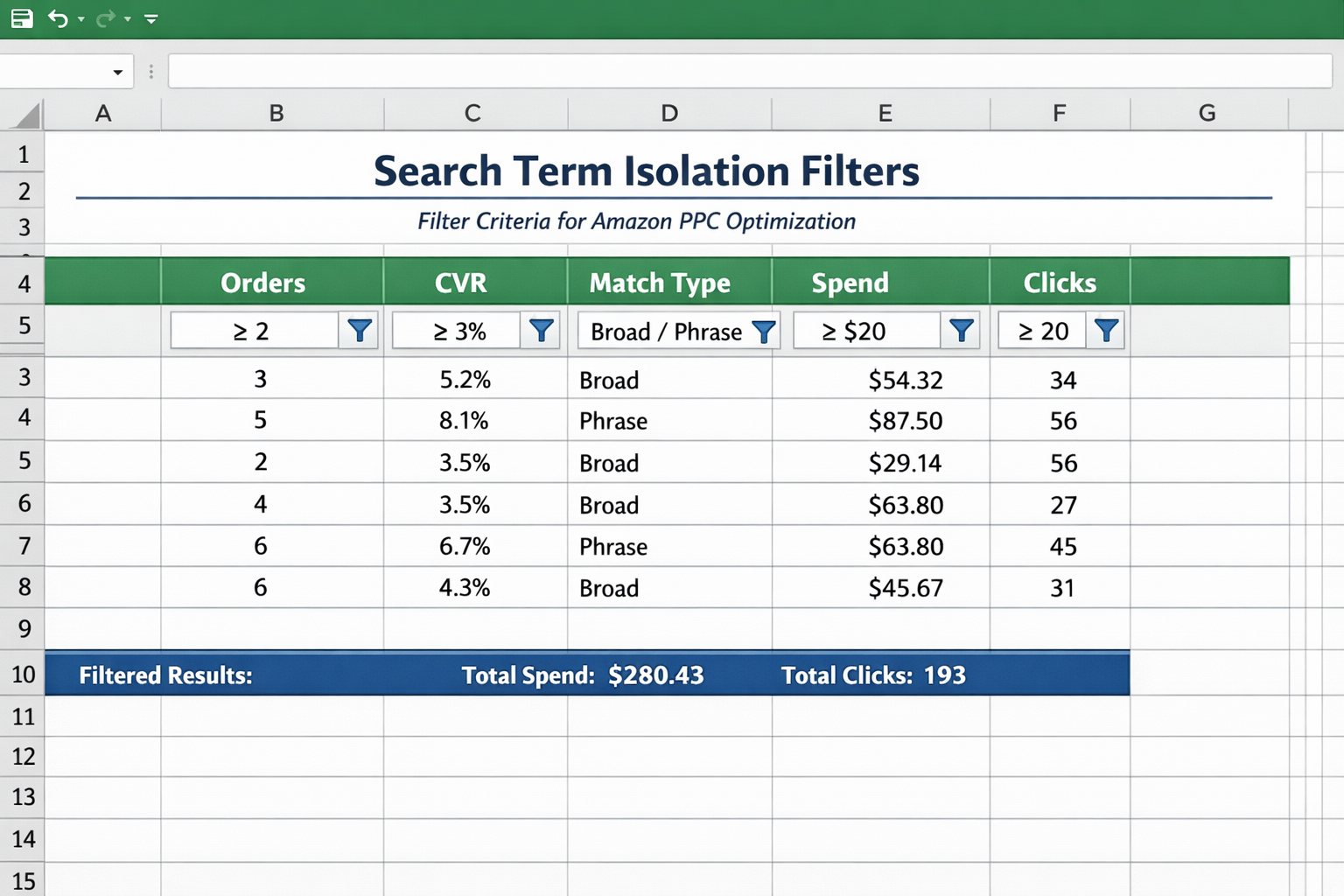
Open the report in Excel or Google Sheets. Create filters for:
✅ ISOLATION CANDIDATE CHECKLIST
| Filter | Threshold | Why It Matters |
| Orders | ≥ 2 | Term has proven buyer intent |
| CVR | ≥ 3% | Converts at a healthy rate |
| Match Type | Broad or Phrase | Not already isolated |
| Spend | ≥ $20 | Enough data to trust |
| Clicks | ≥ 20 | Statistical confidence |
These filters surface your proven winners—terms that are making money but don't have dedicated bid control yet.
[INSERT IMAGE: Screenshot of Excel/Sheets with filter settings applied]
Step 3: Calculate Your Exact Match Bid
Here's what most guides skip: the math.
Don't just "bid aggressively." Calculate your maximum profitable bid using data you already have: Max Bid = Target ACoS × Product Price × CVR
Max Bid = Target ACoS × Product Price × CVR
Let's say you're isolating a term with these numbers:
Product price: $29.99
Observed CVR from broad campaign: 8%
Your target ACoS: 30%
Max Bid = 0.30 × $29.99 × 0.08 = $0.72
That's your ceiling. Start there or slightly below, then optimize based on performance.
If the term was converting profitably in your broad campaign at $1.80 CPC with 8% CVR, you now know you can bid up to $0.72 and stay within target ACoS. The guesswork is gone.
For terms with higher CVR, you can bid more. A 15% CVR term on the same product?
Max Bid = 0.30 × $29.99 × 0.15 = $1.35
This is why isolation matters. You're not bidding the same amount on an 8% CVR term and a 15% CVR term anymore.
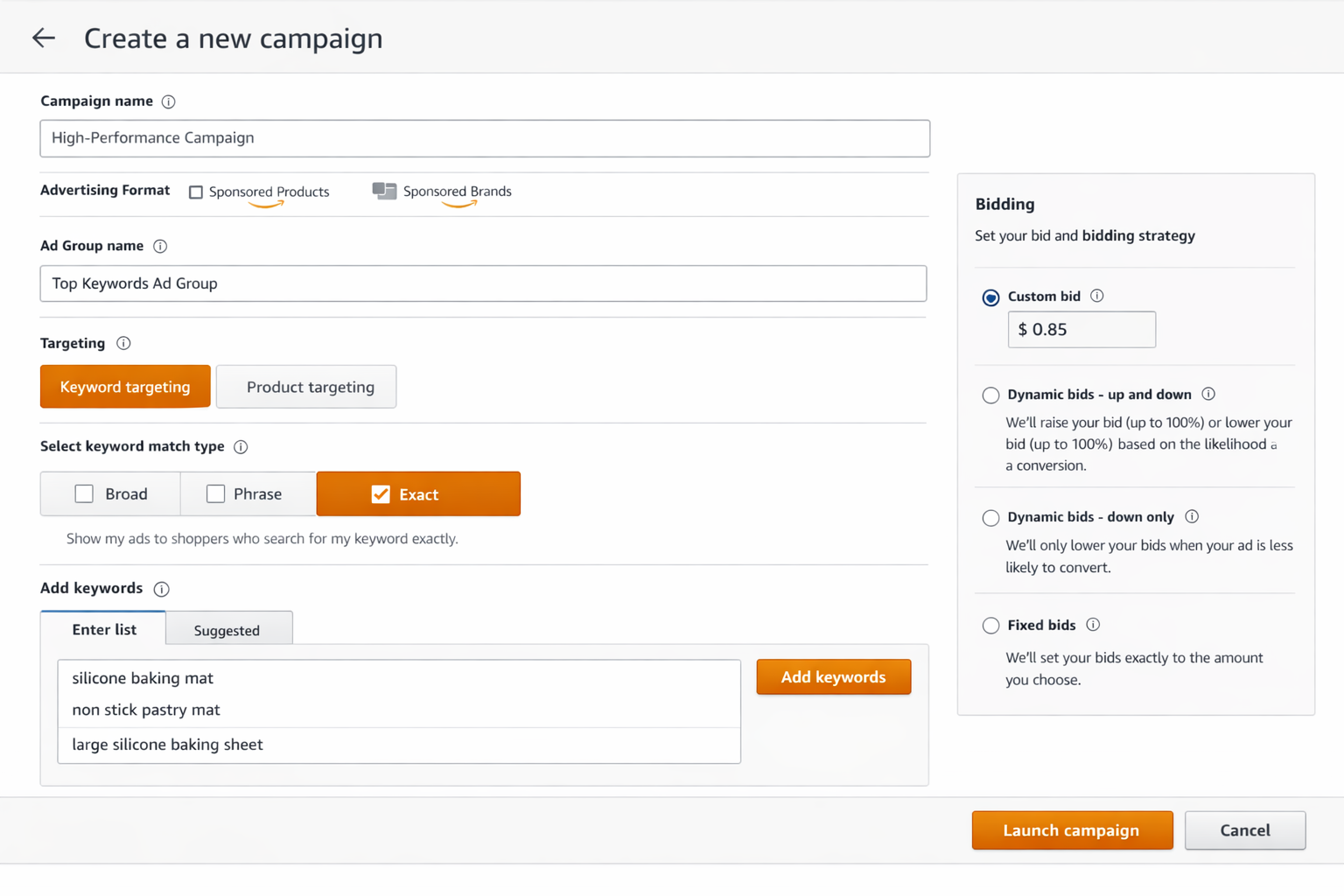
Step 4: Create Exact Match Campaigns for Isolated Terms
For each winning search term, create a new exact match campaign (or add to an existing Performance campaign).
[INSERT IMAGE: Screenshot of Campaign Creator with exact match selected]
Structure options:
Single Keyword Ad Groups (SKAGs): One keyword per ad group. Maximum control, more management overhead.
Themed Performance Campaigns: Group similar high-performers together. Less granular but easier to manage at scale.
For most 7-figure sellers, themed performance campaigns work fine. You don't need 200 single-keyword campaigns unless you're spending $100k+/month and have the bandwidth to manage them.
Step 5: Negative the Terms in Original Campaigns
This step is non-negotiable.
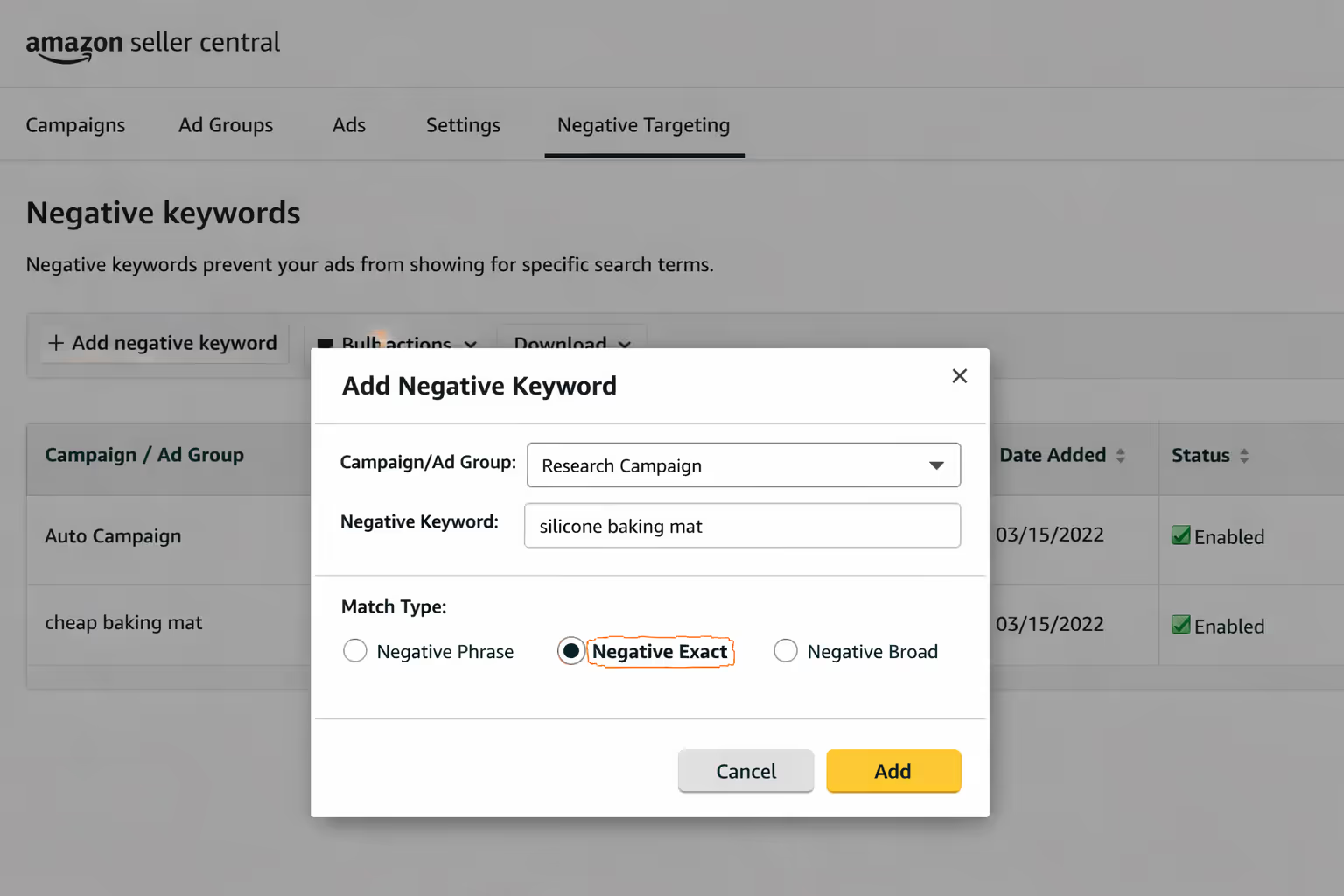
After you create the exact match campaign, go back to your auto and research campaigns and add those terms as negative exact match.
[INSERT IMAGE: Screenshot of negative keyword interface with "Exact" match type selected]
Critical distinction: Use negative exact, not negative phrase.
Why? Negative exact blocks only that specific search term. If you isolated "silicone baking mat," negative exact blocks that term but still allows your broad campaign to discover variations like "large silicone baking mat" or "silicone baking mat set."
Negative phrase would block all of those variations—killing your discovery pipeline.
If you skip negatives entirely, Amazon will show your ads for that search term in both campaigns. You'll cannibalize yourself, split your data, and lose bid control—the exact thing isolation was supposed to fix.
I see this mistake constantly. Sellers do all the work of isolation, then forget the negative, and wonder why their ACoS didn't improve.
Add. The. Negatives.
Step 6: Monitor Post-Isolation Performance
Here's what most guides won't tell you: ACoS often spikes temporarily after isolation.
Why? Because you just removed high-converting terms from your broad campaigns. The remaining terms have worse average performance. That's expected.
Your total account performance should improve because you're now scaling the winners with higher bids while the losers get less spend.
Give it 7-14 days before panicking. Monitor the Performance campaigns specifically—those should be crushing it. If they're not, revisit your isolation criteria (maybe you moved terms too early).
Common Mistakes That Kill Your Isolation Strategy
Isolating Too Early
A term with 1 conversion and 8% CVR looks great. But with only 12 clicks, that's a tiny sample size.
Wait for statistical significance. I typically want 20+ clicks and 2+ conversions before isolating. At $5k+/month spend, you'll get there fast. At lower spend, be patient.
Bad data leads to bad decisions. You'll isolate a "winner" that was actually just lucky, waste time building campaigns, and wonder why performance tanks.
Forgetting to Add Negatives
Already covered this, but it's worth repeating: if you don't negative the term in the original campaign, you haven't actually isolated anything.
You've just created duplicate targeting that competes with itself.
Our Cutting Bleeders SOP walks through the negative keyword workflow in detail. It's the same process—just applied to different scenarios.
Not Monitoring After Isolation
Isolation isn't set-and-forget.
Check your Performance campaigns weekly. Are the isolated terms maintaining their CVR? Did CPC spike because competitors noticed the same opportunity?
Check your Research campaigns too. Did new winners emerge now that the old winners are gone? Keep the pipeline flowing.
The Profit Feedback Loop isn't a one-time setup. It's a continuous cycle of launch, analyze, isolate, prune, repeat.
Isolating Every Converting Term
Not every converting term deserves isolation.
If a term converted once at 15% CVR but only has $8 in spend, don't rush it. Let it run. Gather more data.
If a term converted three times but ACoS is 85% and your margin is 30%, isolation won't save it. That's not a winner—that's a bleeder in disguise.
Isolation is for terms that are both high-converting and profitable at scale.
Why This Matters for Profit (Not Just ACoS)
Most PPC content focuses on lowering ACoS. ACoS is a vanity metric.
ACoS is a vanity metric.
What matters is profit per click. TACoS. Contribution margin. The dollars that end up in your bank account after Amazon takes their cut, COGS, and ad spend.
According to industry benchmarks, average Amazon PPC conversion rates hover between 9-10% across categories [1]. That means if you have terms converting at 15%+, you're sitting on gold that deserves scaled spend—not the same bid as your 3% converters.
Isolation directly impacts profit because it lets you:
Scale high-ROI terms aggressively — If a term converts at 12% CVR with 25% ACoS on a 40% margin product, you want more of that traffic, not less. Isolation lets you bid $3, $4, $5 without overpaying on garbage terms.
Starve low-ROI terms — Every dollar not spent on a non-converting search term is a dollar you keep. Negatives + isolation = surgical budget allocation.
Improve TACoS over time — As your Performance campaigns scale, a larger percentage of your ad spend goes to proven converters. Your total advertising cost of sales drops without sacrificing revenue.
This is the core principle behind everything we do at PPC Maestro. Not "lower your ACoS" but "increase your profit." Sometimes that means raising bids. Sometimes that means killing campaigns that look fine on the surface.
Isolation gives you the control to make those decisions with precision instead of guessing.
Real Numbers: What Isolation Looks Like in Practice
Here's what we saw after implementing isolation for a home goods seller doing $180k/month in revenue:
Before isolation:
Broad match campaigns: $18,400/month spend, 38% ACoS
No exact match structure
TACoS: 14.2%
After 45 days of systematic isolation:
Performance (exact) campaigns: $11,200/month spend, 22% ACoS
Research campaigns: $8,100/month spend, 41% ACoS (expected—losers concentrated here)
TACoS: 11.8%
The total spend actually increased slightly. But profit jumped because dollars shifted from 45%+ ACoS terms to 18-22% ACoS terms.
That's a 17% improvement in TACoS without cutting revenue. On $180k/month, that's roughly $4,300/month back in the seller's pocket.
Not by working harder. By building a system.
Want to see how much you're leaving on the table? Check your numbers with our free calculator.
The Bottom Line
Search term isolation isn't complicated. It's just work.
Pull reports. Filter for winners. Calculate your bids. Build exact match campaigns. Add negatives. Monitor and iterate.
The sellers who do this systematically scale their winners while their competitors keep bidding the same amount on everything.
The sellers who skip it keep wondering why their ACoS won't budge no matter how many bid adjustments they make.
Your broad match campaigns are a data source, not a profit center. Treat them that way. Extract the gold. Discard the rest.
Ready to stop gambling on broad match and start scaling with control?
We've built this isolation system into the Profit Feedback Loop we run for every PPC Maestro client. If you're a 7-figure seller tired of watching profit leak through unfocused campaigns, book a call and let's look at your account together.
Frequently Asked Questions
What is search term isolation in Amazon PPC?
Search term isolation is the process of moving high-performing search terms from broad or phrase match campaigns into dedicated exact match campaigns. This gives you independent bid control over proven winners while negating them from the original campaigns to prevent self-competition. The result is surgical budget allocation—you can scale profitable terms aggressively without overspending on low-converting traffic.
How many conversions should a search term have before isolating it?
Wait for at least 2-3 conversions and 20+ clicks before isolating. With smaller sample sizes, you risk moving terms that converted by luck rather than genuine buyer intent. At $5k+/month spend, you'll accumulate enough data within 2-4 weeks. Lower-spend accounts should extend their evaluation window to 45-60 days to ensure statistical confidence.
Why does ACoS spike after isolating search terms?
When you remove high-converting terms from broad campaigns, the remaining terms have worse average performance—so ACoS in those campaigns increases. This is expected. Your total account profit should improve because Performance campaigns now scale the winners. Focus on blended TACoS and total profit rather than individual campaign ACoS during the transition period.
How do I calculate the right bid for an isolated term?
Use the formula: Max Bid = Target ACoS × Product Price × CVR. Since you already know the term's conversion rate from your broad campaign data, you can mathematically determine your ceiling bid. Start at or below this number, then optimize based on actual performance in the exact match campaign.
How often should I run the isolation workflow?
Weekly or bi-weekly for accounts spending $10k+/month. Monthly for smaller accounts. Consistency matters more than frequency. Build isolation into your regular optimization cadence—pull the search term report, filter for new winners, graduate them to Performance campaigns, add negatives, and prune the losers. The Profit Feedback Loop systemizes this entire process.
Why Trust This Advice
PPC Maestro manages Amazon advertising for 7-figure private-label sellers focused on profit, not vanity metrics. Our founder Bernard Nader has built the Profit Feedback Loop framework after auditing hundreds of accounts and identifying patterns that separate profitable advertisers from those burning cash. Every strategy we publish comes from real account data and operational experience—not theory. We teach what we do daily for clients scaling toward exit.
Works Cited
[1] JungleScout — "Amazon Advertising Benchmarks." https://www.junglescout.com/resources/articles/amazon-ppc-advertising-benchmarks/
[2] Amazon Advertising — "Sponsored Products: Match Types." https://advertising.amazon.com/library/guides/sponsored-products-match-types
[3] Amazon Seller Central — "Search Term Report." https://sellercentral.amazon.com/help/hub/reference/G201834190
[4] PPC Maestro — "The Profit Feedback Loop." https://ppcmaestro.com/profit-loop
[5] PPC Maestro — "Amazon Ads: Cutting Bleeders SOP." https://ppcmaestro.com/amazon-ads-cutting-bleeders-sop/