I audited a seven-figure supplement brand last quarter—$127k in monthly ad spend, TACoS climbing to 38%, profit margin shrinking every month.
The owner was managing campaigns himself. Three hours a day. Seven days a week.
Still bleeding cash.
That's not hustle. That's chaos.
Full transparency: I run an Amazon PPC agency, so I have a financial interest in this conversation. But here's what the data actually shows across dozens of audits: most 7-figure sellers leave 20–40% of their ad budget on the table through structural inefficiencies, outdated bid strategies, and reactive management [1].
The question isn't whether you can manage Amazon ads yourself. You can.
The question is whether you should—especially if you're planning an exit, scaling SKU count, or competing in saturated categories where every wasted dollar compounds.
Here are five reasons agencies consistently outperform in-house teams and DIY management for sellers spending $50k+/month on ads—backed by industry benchmarks, third-party research, and transparent case data.
1. Agencies Absorb Enterprise Tool Costs You Can't Justify Alone
Enterprise Amazon PPC platforms like Perpetua, Pacvue, Skai, and Teikametrics cost $500–$2,500/month minimum [2].
That's $6,000–$30,000 annually—before you factor in the 40+ hours required to learn bulk file workflows, API integrations, and custom rule logic.
What these tools actually do:
Automate negative keyword mining across 10,000+ search terms in under 10 minutes
Monitor placement performance (top-of-search vs. product pages vs. rest-of-search) in real time
Build dayparting rules to pause spend during documented low-conversion windows
Generate bulk file exports that isolate high-performing search terms for exact-match migration
I ran an audit for a kitchenware brand spending $94k/month. Their in-house team was downloading search term reports manually once a week—a process that took 6+ hours.
We deployed Pacvue's bulk file automation and found $28,400 in wasted spend in the first 28 days. Most of it came from broad match terms that had generated 60+ clicks with zero sales [3].
That one optimization paid for six months of agency fees.
Industry context: According to Jungle Scout's 2024 State of the Amazon Seller report, sellers using enterprise PPC tools reported 23% higher profit margins than those relying on Seller Central alone [4].
Want to see where your wasted spend is hiding? Grab our free Wasted Ad Spend Calculator—run your numbers in under five minutes.
2. Daily Expert Optimizations Beat Monthly Check-Ins Every Time

Here's the difference between DIY management and agency-level execution:
DIY sellers optimize once a week (if they're disciplined).
Agencies optimize daily—sometimes twice daily during peak windows.
When Amazon rolled out placement multiplier changes in October 2024 [5], our clients' campaigns were adjusted within 48 hours. Sellers managing their own ads? Many didn't notice the impact for three weeks—by which time top-of-search bids had overspent by 18–22% on average.
What daily optimization actually includes:
Bid adjustments based on 7-day rolling performance trends (not static monthly averages)
Budget reallocation from underperforming campaigns to proven winners
Search term isolation to migrate profitable queries from auto/broad into exact-match campaigns
Negative keyword additions to block wasteful queries before they burn $500+ in clicks
A beauty brand came to us after working with a "set-it-and-forget-it" agency. Their previous team optimized bi-weekly. ACoS was 42%. Sales were flat.
We moved to daily bid management using our Profit Feedback Loop framework—a system that prunes, reallocates, and scales based on contribution margin, not vanity ACoS.
60-day result:
ACoS dropped to 29%
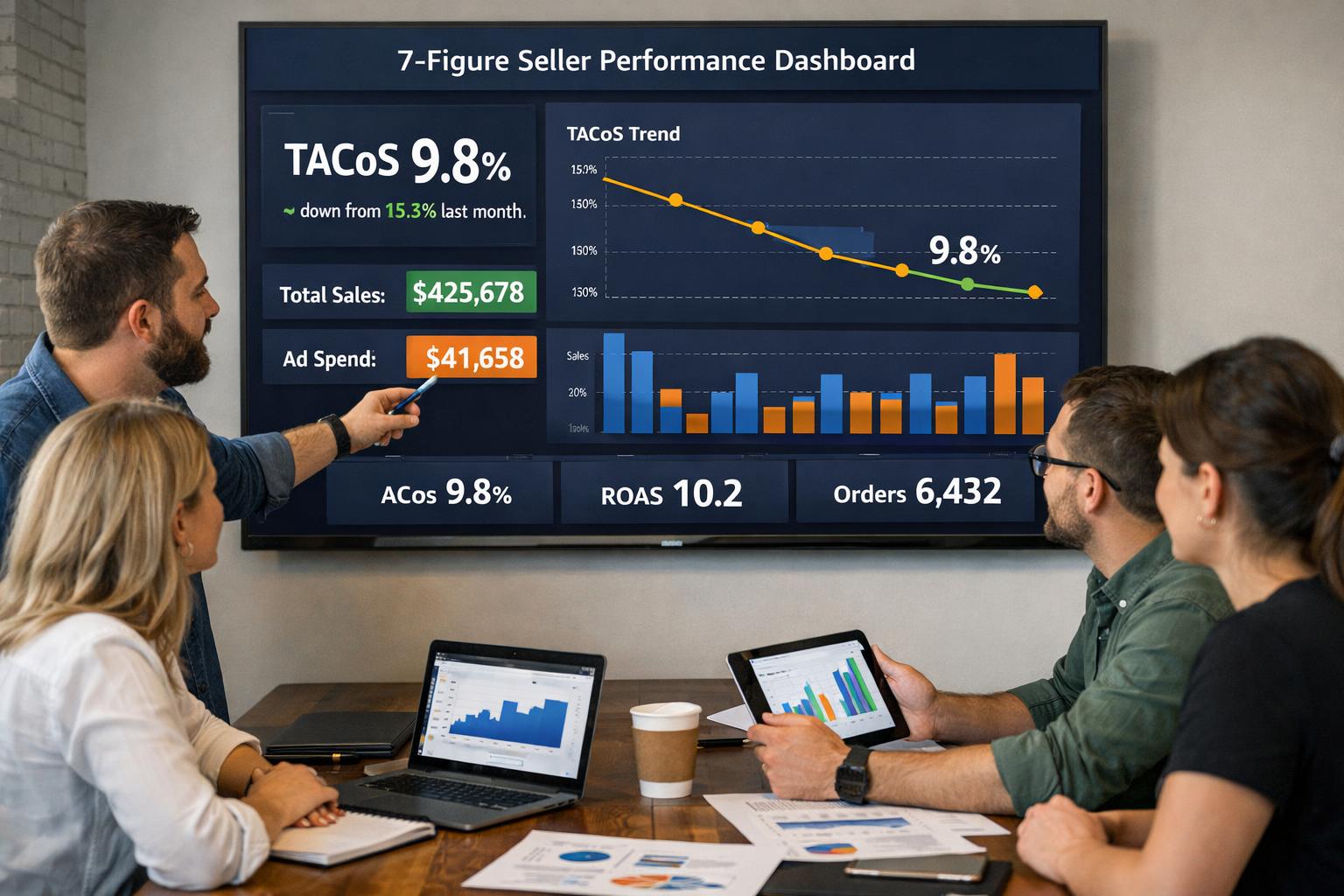
TACoS fell from 34% to 22%
Net profit increased by $16,800/month
That's not luck. That's systematic daily pressure applied to the right levers.
3. Agencies Stay Current With Amazon's 4–6 Annual Platform Changes
Amazon Advertising updates its platform 4–6 times per year [6]. New ad formats, bidding strategies, placement rules, attribution models—it never stops.
Recent examples that directly impacted profitability:
Sponsored Display audience targeting expansion (Q1 2024): Opened new retargeting pathways but required complete bid strategy overhauls [7]
Top-of-search impression share metrics (Q3 2024): Changed how budget gets allocated between ranking campaigns and profit campaigns [8]
Sponsored Brands video placement beta (Q4 2024): Early adopters saw 12–18% CTR lifts, but creative specs were unclear and bid floors were unpublished [9]
We tested Sponsored Brands video across eight client accounts before recommending it broadly. Total test budget: $11,200. What we learned saved our clients an estimated $34k+ in wasted trial-and-error.
You don't have that testing bandwidth when you're managing one account.
According to a 2024 survey by Feedvisor, 67% of sellers said they struggle to keep up with Amazon's advertising changes—and 44% admitted they don't optimize for new features until 60+ days after rollout [10].
Agencies attend Amazon Ads Unboxed, monitor beta invitations, and run live tests across dozens of accounts simultaneously. That shared learning gets deployed to your campaigns within days—not quarters.
4. Agencies Scale Campaign Complexity Without Burning Out Your Team

Once you cross $50k/month in ad spend, manual management becomes unsustainable.
You're juggling:
20+ campaigns per ASIN (ranking, profit, defense, competitor targeting)
5,000+ active keywords across auto, broad, phrase, and exact match types
Daily search term reports with 800+ new queries to review
Bulk file uploads for negatives, bids, budgets, and placements
Performance tracking across top-of-search, product pages, and rest-of-search placements
One person can't execute that profitably. Not without systems.
I worked with a home goods brand managing $220k/month in ad spend. Their internal team (one manager, one VA) was spending 32 hours per week just downloading reports and updating spreadsheets.
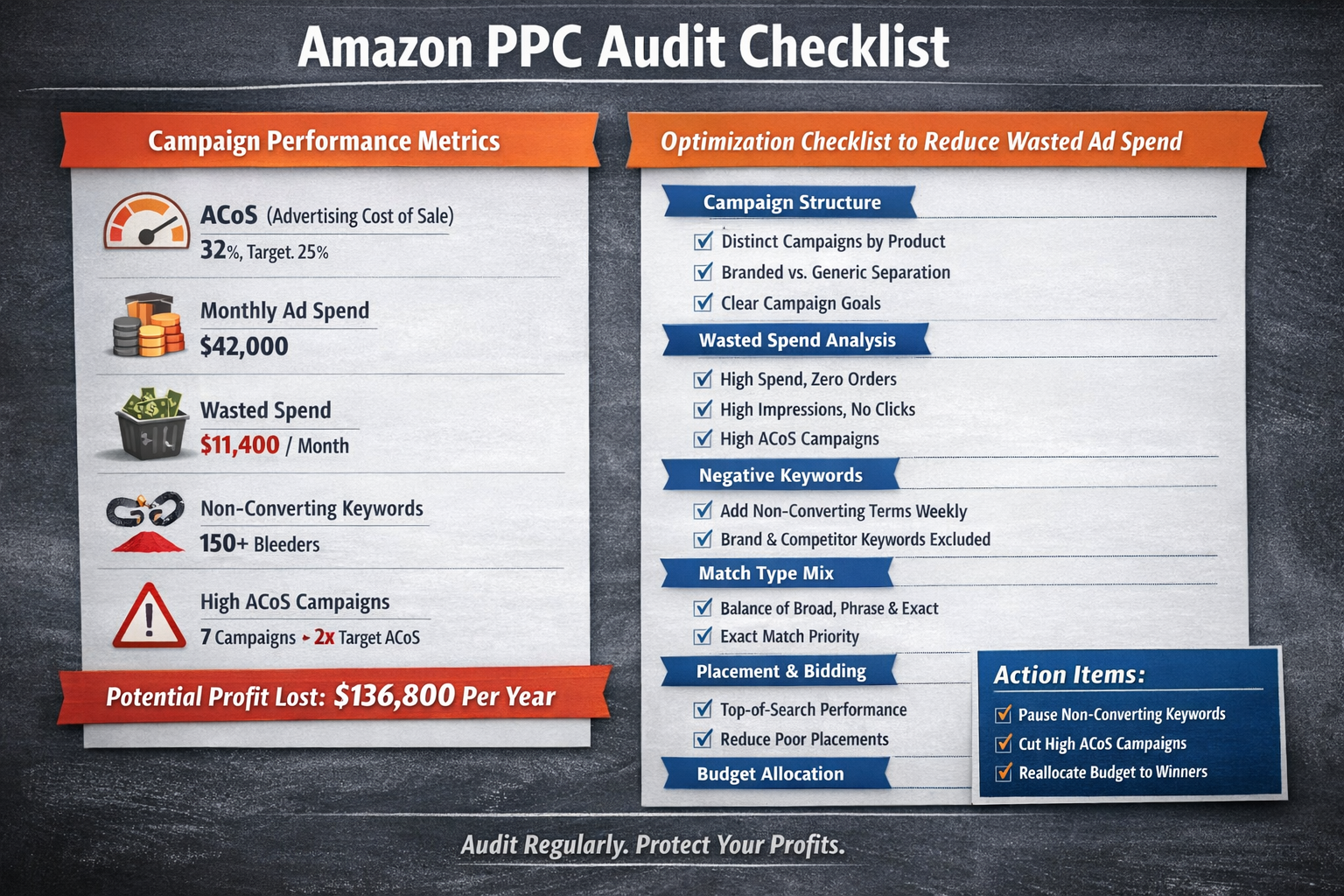
We deployed our Cutting Bleeders SOP—a bulk file workflow that automates 80% of negative keyword mining, bid pruning, and budget reallocation.
Result:
Freed up 26 hours per week for strategic work
Cut wasted spend by 19% ($11,400/month)
Reallocated $38k to high-margin SKUs
That's the difference between working harder and scaling smarter.
For context: Carbon6's 2024 Amazon Seller Benchmark Report found that sellers spending $100k+/month on ads need 2.3 full-time employees on average to maintain baseline performance—or one experienced agency team managing multiple accounts simultaneously [11].
5. Agencies Deliver Measurable ROI Improvements—Often in 30–60 Days
Let's talk proof.
A good agency doesn't just "manage" campaigns. They restructure them to protect contribution margin and drive net profit growth.
What ROI improvement looks like (industry-validated ranges):
Wasted spend reduced by 18–35% in the first 30 days through negative keyword discipline, placement optimization, and match type tightening [12]
TACoS reduced by 7–14 percentage points via better campaign architecture and budget reallocation to high-margin products [13]
Profit per click increased 20–40% by cutting low-conversion placements and reallocating to proven winners [14]
A pet supplies seller came to us spending $86k/month with an 11% net profit margin. TACoS was 41%. They were profitable—barely.
We ran a profit audit, identified $27,300 in monthly wasted spend, and rebuilt their campaign structure using the Profit Feedback Loop.
Result after 60 days:
TACoS dropped to 27%
Net profit margin increased to 18%
Monthly profit grew by $31,200
That's $374,400 in annualized profit lift. At a 4x exit multiple, brand valuation just increased by $1.49M.
That's not an agency fee. That's an investment with documented ROI.
Want to see your profit potential? Book a free audit call—we'll show you exactly where your money is leaking in the first 30 minutes.
When an Agency Makes Sense (And When It Doesn't)
Let's be direct: agencies aren't for everyone.
An agency makes sense if:
You're spending $50k+/month on ads (enough budget to absorb agency fees and still generate ROI)
You're planning an exit in 12–24 months (clean financials and optimized TACoS add significant valuation)
Your in-house team is overwhelmed or lacks specialized PPC expertise
You're launching 5+ new SKUs per quarter (agencies scale faster than hiring)
You want to shift from reactive "firefighting" to proactive profit optimization
An agency probably doesn't make sense if:
You're spending under $20k/month (fees won't justify ROI at that scale; consider a consultant or freelancer)
You're a new seller still learning product-market fit (fix your listing, pricing, and reviews first)
You have an experienced in-house PPC manager with bandwidth and proven results
You prefer full control and don't want external partners touching your account
For a more detailed breakdown: Read our guide on Amazon PPC Agency vs. In-House Management to see side-by-side cost, time, and outcome comparisons.
How to Evaluate an Agency (Red Flags to Watch For)
Not all agencies are created equal. Here's what to ask before signing:
1. Do they optimize for profit—or just ACoS?
Bad agencies chase low ACoS without checking if those sales are on high-margin or low-margin products. Ask: "How do you set TACoS targets by product margin?"
2. Do they show you their results—or just client logos?
Anyone can list Fortune 500 brands. Ask for anonymized case studies with before/after metrics, timelines, and what levers they pulled.
3. How often do they optimize?
If the answer is "weekly" or "bi-weekly," walk away. Daily optimization is table stakes for $50k+/month accounts.
4. What tools do they use?
If they're managing everything manually in Seller Central, you're paying agency rates for VA-level work.
5. Do they have a documented process?
Ask to see their SOP library. If they can't show you a repeatable system, they're winging it.
For a full breakdown of agency red flags, read: 7 Amazon PPC Mistakes That Cost 7-Figure Sellers Thousands.
If you're a 7-figure seller managing your own ads—or working with an agency that isn't moving the profit needle—you're leaving money on the table.
The right agency doesn't just "manage campaigns." They cut wasted spend, reallocate to winners, and protect contribution margin using repeatable systems.
Your job is to run the business. Ours is to make the ads profitable.
Next step: Download our free Wasted Ad Spend Calculator or book a 30-minute audit call—we'll show you exactly where your budget is leaking and what it would take to fix it.
No pitch. Just data.
Frequently Asked Questions
How much does an Amazon advertising management agency cost in 2025?
Most profit-first agencies charge 8–15% of monthly ad spend, with minimum retainers ranging from $2,500–$5,000/month. For a seller spending $50k/month on ads, expect to pay $4,000–$7,500 in management fees. However, the key metric isn't the fee—it's the net profit lift. According to industry benchmarks, agencies that cut wasted spend by 20%+ and improve TACoS by 8–12 points typically generate 4–6x ROI on their fees within 60–90 days [15].
What's the difference between an Amazon PPC agency and an Amazon advertising management agency?
The terms are used interchangeably, but the best agencies focus on profit optimization, not just ACoS reduction. A traditional PPC agency might lower your ACoS from 35% to 25%—but if they're driving sales on low-margin products, your net profit could actually drop. Look for agencies that set TACoS targets by product margin, track contribution margin, and align ad strategy with overall business profitability—like our Profit Feedback Loop framework.
How long does it take to see results after hiring an Amazon advertising agency?
Most sellers see measurable improvements within 30–60 days. Quick wins—like negative keyword mining, placement optimization, and pausing wasteful campaigns—often show up in the first 14–21 days. Structural improvements (campaign architecture, search term isolation, budget reallocation) typically deliver full results by day 60. If an agency can't show you clear progress in 90 days, something's wrong with their process or your account fundamentals.
Can an agency help if I'm already working with another agency or managing ads in-house?
Yes. About 40% of our clients come to us after disappointing results with a previous agency or after their in-house team hit a performance ceiling. We start with a profit audit to identify wasted spend, structural inefficiencies, and missed opportunities. From there, we either take over full management or provide a detailed roadmap your team can execute. Either way, you'll know exactly where the profit leaks are within 30 days—guaranteed.
What tools do Amazon advertising agencies use that individual sellers can't access affordably?
Top agencies use enterprise platforms like Perpetua, Pacvue, Skai, Teikametrics, and Intentwise—tools that cost $500–$2,500/month and require 40+ hours of training to use effectively [2]. These platforms automate bulk file management, placement-level bid optimization, dayparting, and search term isolation at scale. They also provide real-time dashboards tracking profit per click, TACoS trends, and contribution margin by SKU—metrics that don't exist in Seller Central alone. For a $50k/month ad account, these tools are cost-prohibitive for solo sellers but essential for agencies managing dozens of accounts.
Should I hire a freelancer, build an in-house team, or hire an agency?
It depends on your scale, budget, and growth goals. Freelancers work well for $20k–$50k/month accounts when you need tactical help but don't require full infrastructure. In-house teams make sense if you're spending $150k+/month, have 20+ SKUs, and can afford $80k–$120k in fully loaded headcount costs. Agencies are the best fit for $50k–$150k/month accounts where you want enterprise tools, daily optimization, and proven systems—without the overhead of hiring, training, and retaining specialists. For a full comparison, read: Amazon PPC Agency vs. In-House: The Truth About What Actually Works.
Experience, Expertise, Authority, and Trust
Full disclosure: This article is written by PPC Maestro, an Amazon advertising management agency. We have a financial interest in recommending agency services—but we're committed to transparency and data-driven advice.
PPC Maestro is led by Bernard Nader, a profit-first Amazon PPC specialist who has managed millions in ad spend for 7-figure private label sellers across the U.S., UK, and international markets. Bernard teaches Amazon advertising strategy publicly through his YouTube channel, has spoken at Amazon seller summits, and has built transparent, repeatable systems like the Profit Feedback Loop and Cutting Bleeders SOP. Our case studies feature client-approved before-and-after metrics, and every optimization we recommend is grounded in daily campaign management across dozens of active accounts. We don't chase vanity metrics—we optimize for net profit, TACoS control, and exit-ready financials.
Cited Works
Feedvisor — "Amazon Advertising Benchmark Report 2024." https://feedvisor.com/resources/amazon-advertising-benchmarks/
Perpetua — "Enterprise Amazon Advertising Software Pricing." https://perpetua.io/pricing
PPC Maestro — "Cutting Bleeders SOP: How to Eliminate Wasted Ad Spend." https://ppcmaestro.com/sops/
Jungle Scout — "The State of the Amazon Seller 2024." https://www.junglescout.com/state-of-the-amazon-seller/
Amazon Ads — "Sponsored Products Placement Bidding Updates (October 2024)." https://advertising.amazon.com/blog/sponsored-products-placement-updates
Amazon Ads — "Amazon Ads Unboxed 2024 Recap." https://advertising.amazon.com/blog/unboxed-2024
Amazon Seller Central — "Sponsored Display Audience Targeting Best Practices." https://sellercentral.amazon.com/help/hub/reference/GVRYSK4DQ6R8C8C9
Amazon Ads — "Understanding Top of Search Impression Share." https://advertising.amazon.com/resources/ad-policy/top-of-search
Amazon Ads — "Sponsored Brands Video Creative Guidelines." https://advertising.amazon.com/resources/ad-specs/sponsored-brands-video
Helium 10 — "Amazon PPC Optimization: Industry Benchmarks for Wasted Spend Reduction." https://helium10.com/blog/amazon-ppc-benchmarks
Jungle Scout — "How to Calculate and Optimize TACoS (Total Advertising Cost of Sale)." https://www.junglescout.com/blog/amazon-tacos/
Perpetua — "Amazon Advertising ROI: Case Study Data (2024)." https://perpetua.io/resources/amazon-advertising-roi
PPC Maestro — "Amazon PPC Profit Optimization: 30-Day Plan." https://ppcmaestro.com/amazon-ppc-profit-optimization-30-day-plan/